Laundry & Fabric Care · 6 min read · 9 April 2026
Appliance Maintenance Checklist (Printable) for Older UK Homes
Most appliance call-outs are not breakdowns at all. They are maintenance debt. Here is the schedule that keeps a washing machine going for twelve years instead of six, written for older British houses.
By the Nims Casa editorial team — written from professional cleaning experience and checked against our editorial standards.
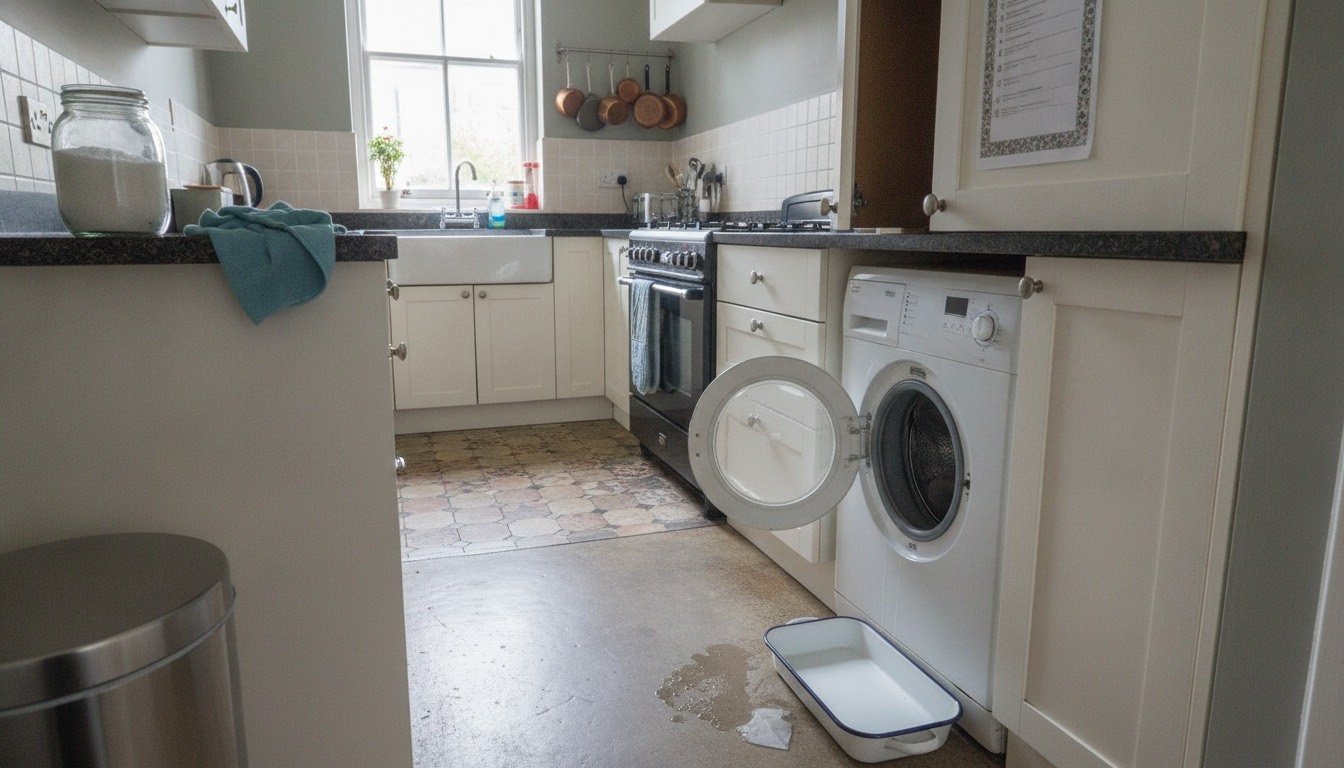
Most appliance call-outs are not failures. They are maintenance debt: a dishwasher filter nobody has lifted in four years, a pump trap holding two hair grips and a 5p piece, a condenser coil wearing a felt coat of dust. Deal with those on a schedule and a mid-range washing machine gives you eleven or twelve years rather than six.
What follows is a calendar you can print and tape inside a cupboard door. It assumes British conditions: hard water across the south and east, appliances squeezed into former sculleries, and — if the house predates 1930 — drainage and wiring never designed to run a 2.2kW washing machine and a 3kW dryer on the same afternoon. For the payback maths, our guide to how long appliances actually last gives realistic lifespans by type.
Why an Old House Is Harder on Appliances
A modern flat forgives neglect. A solid-wall Victorian or Edwardian house does not, and the reasons are structural rather than mechanical.
- •Waste goes to an open gully, not a sealed stack. In most pre-1960s houses the washing machine and dishwasher discharge into a back-inlet gully outside, where detergent scum, fat and lint set like grout. Flush it with hot water and soda crystals quarterly, or you will meet a machine that supposedly 'will not drain'.
- •Suspended timber floors flex. A 1400rpm spin over springy boards makes the machine walk and hammer the waste pipe loose. Level the feet with a spirit level across the top plate and lock the nuts; if it still moves, an 18mm plywood spreader board costs £15 and cures it.
- •Unheated back kitchens kill fridges. Check the climate class sticker inside the door: an SN-rated fridge-freezer needs 10°C minimum ambient. In a scullery at 4°C in January the compressor barely cycles and the freezer drifts above -18°C.
- •Solid brick behind an appliance is cold and airless. A fridge tight against a 225mm wall gets no airflow across the condenser and sweats on the plaster. Leave 50mm at the back, 25mm each side.
- •Pre-1970s circuits were not sized for this. Rewireable fuse carriers, no RCD and one radial serving the whole kitchen are still common. Never run a dryer and washer from one twin socket on an extension lead — read the signs a consumer unit needs upgrading first.
- •Lath and lime plaster will not hold a cooker hood. Fix through to the studs or resin-anchor into the masonry behind; plasterboard fixings tear straight out of lime.
Supplies: Around £40 Covers a Whole Year
Buy once, keep it in one box under the sink, and no task here gets postponed for want of a £3 brush.
- •Soda crystals, 1kg — £1.50. Maintenance washes, gully flushes, greasy filters.
- •Citric acid or descaler, 500g — £4. Essential in hard-water areas; our limescale guide covers the strengths that work.
- •Fridge thermometer — £5. The dial on the door is not a temperature.
- •Stiff brush and a packet of cocktail sticks — £3. Spray-arm jets and drain holes.
- •Coil brush or vacuum crevice tool — £8.
- •Spare braided fill hose, 1.5m — £9. Rubber is a five-year part.
- •Spirit level, 600mm — £10. The cheapest anti-vibration fix there is.
Monthly: 20 Minutes, About £1.50
This block does the heavy lifting. First Saturday of the month, in this order.
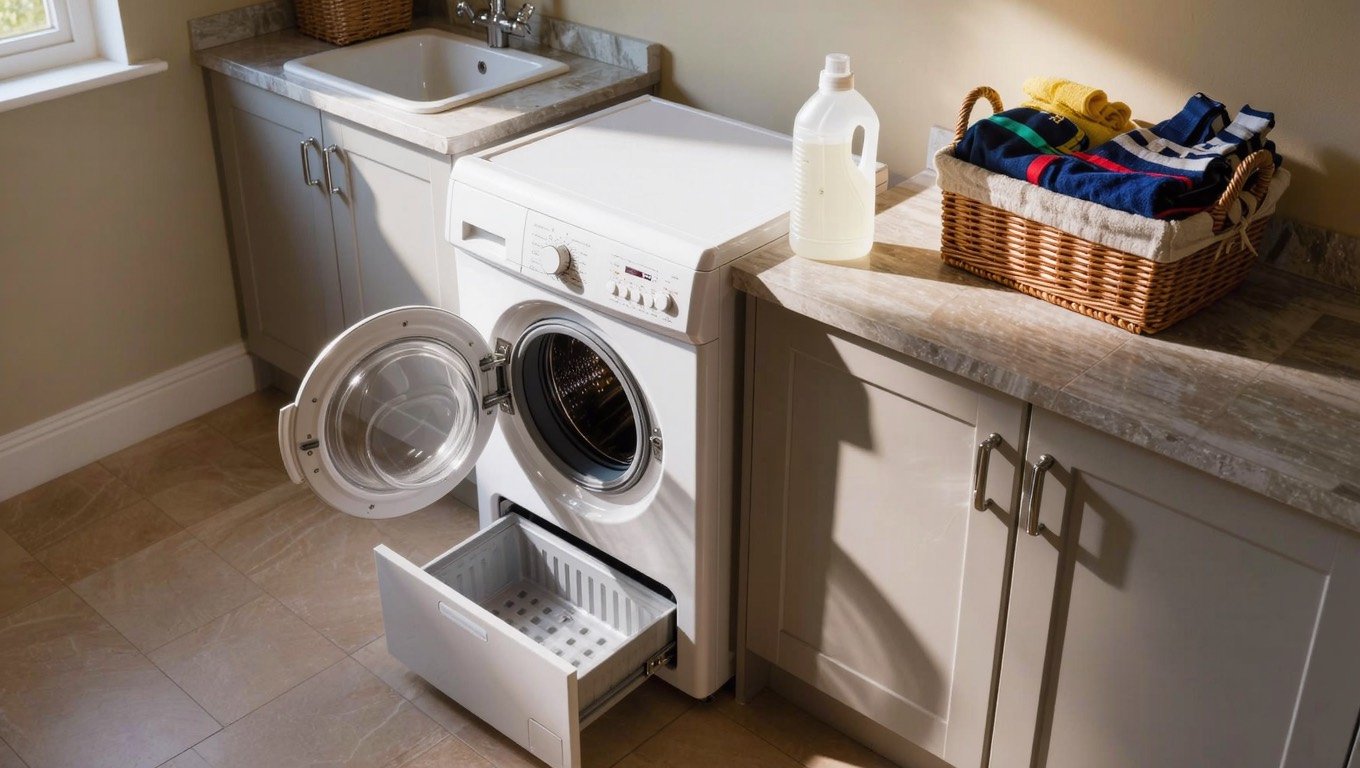
- •Washing machine pump filter, bottom front behind the flap. Towel down, tray underneath, unscrew slowly. 5 minutes.
- •Wipe the door gasket fold; leave door and drawer ajar between washes. If it already smells, use the full routine in our guide to cleaning a washing machine. 3 minutes.
- •Dishwasher filter out and rinsed, every spray-arm jet poked clear with a cocktail stick. Gritty plates? Our fix for a dishwasher that is not cleaning properly covers the rest. 6 minutes.
- •Check dishwasher salt and rinse-aid lights. In Kent, Essex or London, salt is not optional. 1 minute, about 30p.
- •Tumble dryer: lint filter after every load, plus the sponge filter and condenser rinse on heat-pump models. 4 minutes.
- •Confirm the fridge runs at 3–5°C and the freezer at -18°C by thermometer, not by dial. 1 minute.
Every Three Months: 45 to 60 Minutes
Quarterly work catches old-house problems before they become call-outs.
- •Maintenance wash: empty drum, 90°C cottons, 200g soda crystals. About 45p of electricity.
- •Lift the outside gully grid, clear it and flush with hot water and soda crystals. 10 minutes.
- •Hood grease filters through the dishwasher on a hot programme. 5 minutes.
- •Test door seals with a £10 note: shut it in and pull. No drag means the seal is why the compressor never stops. 3 minutes.
- •Clear the fridge drain hole at the back with a cotton bud. A puddle under the salad drawer is always this. 3 minutes.
- •Check fill and waste hoses for kinks, chalky drips at the collar and perished rubber. 10 minutes.
Twice a Year and Annually
These cost the most time and save the most in parts. Budget two hours across the year, plus £120–£190 in servicing if you have gas.
Vacuum the fridge-freezer condenser coils twice a year — 15 minutes, and typically 5–10% off that appliance's running cost. Defrost a manual freezer once frost passes 5mm. Replace rubber fill hoses every five years at £9 each; a burst hose over a lath-and-plaster ceiling is a £900 problem. Book the gas safety check and boiler service annually, £90–£140 from a Gas Safe engineer.
- •Twice a year: condenser coils, freezer defrost, oven shelves and door glass, dryer ducting on vented models.
- •Annually: gas service, descale kettle and steam appliances, new hood carbon filter (£12–£20), test every RCD with the trip button.
- •Every five years: fill hoses, dishwasher inlet hose, door seals that no longer grip a note.
- •When replacing anything: compare running costs over ten years, not just the purchase price.
If You Only Have an Hour, Do These
Short on time, or moving into an old house cold? This is the priority order, ranked by the cost of ignoring it.
- •1. Pump filter and fill hoses. Leaks and floods outrank everything.
- •2. Fridge and freezer temperatures. Food safety, plus the cheapest energy saving here.
- •3. Dishwasher filter and spray arms. Prevents the most common 'broken' dishwasher.
- •4. Dryer filters and ducting. Lint is a leading appliance fire cause in UK homes.
- •5. The outside gully. Fifteen minutes now versus a £90 drainage call-out later.
- •6. Condenser coils. Least urgent, dustiest, do them last.
Where DIY Stops in an Older House
Filters, hoses, levelling and seals are homeowner work. Stop at anything behind a fixed panel that needs the appliance live, anything involving gas, and anything needing a new circuit. In a pre-1970s house that last point matters: adding a dedicated dryer circuit to a rewireable board is a board upgrade with a certificate, not a swap.
Call an engineer when a machine trips the RCD repeatedly, when a fridge runs constantly with clean coils and good seals, when a bearing rumbles on spin, or when water appears at the back rather than the front. Get a quoted diagnosis first — our breakdown of appliance repair costs shows what is reasonable, and on an eight-year-old machine a £180 bearing job rarely is.
Found this useful?
There's plenty more — hundreds of guides and honestly-tested product reviews for every corner of your home.
Browse All Guides