Product Reviews · 6 min read · 14 August 2026
The Best Long-Handled Window Cleaning Kits (2026): Streak-Free Without a Ladder
Telescopic squeegees, DIY water-fed poles and magnetic cleaners tested — four picks that get two-storey glass streak-free while your feet stay on the ground.
By the Nims Casa editorial team — written from professional cleaning experience and checked against our editorial standards.
Affiliate disclosure: if you buy through links in this article we may earn a small commission at no extra cost to you. Our recommendations come from professional cleaning experience and are never influenced by retailers or brands.
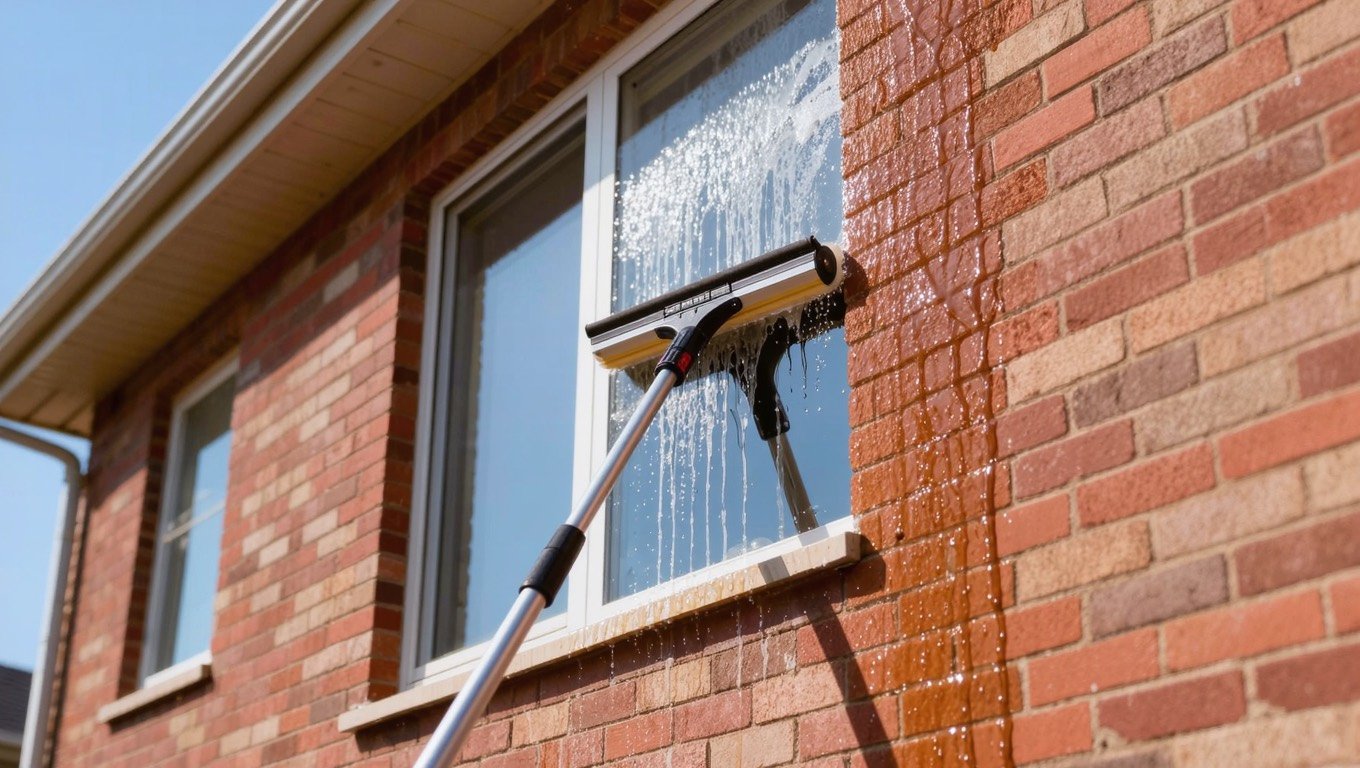
Every window cleaner knows someone who has come off a ladder. Falls from height remain the biggest killer in British trades — and that is among professionals with the right footwear and someone footing the stiles. The better answer is a long pole: a decent kit puts almost every pane on a typical two-storey UK house within reach while both feet stay planted on the ground.
We have tested the three tool families that genuinely work — telescopic squeegee kits, DIY water-fed poles and magnetic cleaners — and picked four worth your money, along with what separates a good kit from bin fodder and an honest line on which windows you should leave to a professional round.
Our top picks at a glance
Unger 2-in-1 Professional Window Cleaning Kit (3m telescopic pole)
~£45The same strip washer and squeegee channel the trade uses, on a rigid 3m aluminium pole with a swivelling head. Wash with the sleeve, flip, squeegee off — the finish is indistinguishable from a professional clean on anything up to first-floor glass.
Pros
- ✓ Trade-quality rubber blade leaves glass genuinely streak-free, even in direct sun
- ✓ Replacement rubbers, sleeves and channels are stocked everywhere in the UK for a few pounds
Cons
- ✗ 3m of reach covers first-floor glass only if you have level ground below it
- ✗ Squeegee technique at full stretch takes a weekend of practice to master
Dunelm Adjustable Long Handle Window Cleaning Kit
~£14The kit behind this year's search spike, and deservedly so at the price: a light adjustable aluminium handle with a combi head — washable microfibre pad one side, rubber squeegee the other. For ground-floor windows, patio doors and conservatory glass it is all most households need.
Pros
- ✓ Excellent value; microfibre pads machine-wash and last for years
- ✓ Light enough for anyone to use one-handed on patio doors
Cons
- ✗ Realistic reach is ground floor plus a stretch — the handle flexes at full extension
- ✗ The narrow squeegee needs two passes on wide panes, which risks lap marks
Maxblast 6m Telescopic Water-Fed Pole
~£90A glass-fibre water-fed pole that connects to a garden hose and scrubs glass, frames and sills through a soft brush head with rinse jets. It reaches second-storey windows on a standard two-storey house with both feet on the ground, which is the whole point.
Pros
- ✓ Cleans first-floor glass, frames and soffits with no ladder anywhere in the job
- ✓ Brush-and-rinse method shifts traffic film and bird mess better than a squeegee alone
Cons
- ✗ In hard-water areas you need an inline resin filter (£30-£60 extra) for a spot-free finish
- ✗ Front-heavy at full 6m extension — your shoulders will know about a whole-house clean
Tyroler Bright Tools The Glider Magnetic Window Cleaner
~£40Two magnetically coupled pads clean both faces of a pane at once while you stand safely indoors, with a safety cord anchoring the outer pad. It is the only sensible way to reach the outside of non-opening upper-floor windows without hiring anyone.
Pros
- ✓ Cleans outside glass from inside the room — no pole, no ladder, no leaning out
- ✓ Models sized for single, double and triple glazing, with a safety cord on the outer pad
Cons
- ✗ Must match your glazing thickness exactly, so measure the sealed unit before ordering
- ✗ Corners and edges need a slow, deliberate technique — the first window takes a while
Who These Kits Are For
If you live in a bungalow, a two-storey semi or a terrace, a long-handled kit will handle every outside pane you own, and it pays for itself fast: a typical window round charges £15-£25 a visit for a three-bed semi, so even the £90 water-fed pole below breaks even inside six months of monthly cleans. They also suit renters who cannot fix anything to the building, and anyone with glass above a conservatory or porch roof that no ladder can safely reach anyway.
They are not for everyone. Three-storey townhouses, dormers and Velux windows set into a roof pitch are beyond sensible DIY reach, and no pole fixes bad technique — the wipe pattern and the blade angle matter as much as the tool, which is why it is worth reading our guide to streak-free window cleaning before you spend anything. And if your actual problem is condensation on the inside of the glass, you want one of the best window vacs instead, not a pole.
How We Judge
We scored each kit the way a working cleaner would, on the things that show up after a month of real use rather than in the product photos:
- •Usable reach: the length at which the pole still holds a squeegee flat to the glass without flexing, not the number on the box.
- •Finish: does the glass dry streak-free in direct sun, the harshest test there is?
- •Weight and balance at full extension — 2kg feels like 10kg when it is 4m above your head.
- •Spares: replacement rubbers, sleeves and brushes you can actually buy in the UK.
- •Five-year cost against paying a professional round.
The Four Picks at a Glance
Full pros, cons and prices are in the review cards below, but here is the short version:
- •Best overall: Unger 2-in-1 Professional Window Cleaning Kit — the trade-standard strip washer and squeegee on a 3m telescopic pole; the finish is genuinely professional.
- •Best budget: Dunelm Adjustable Long Handle Window Cleaning Kit — the microfibre-and-squeegee combi head everyone searched for this year, and at around £14 it earns the hype for ground-floor glass.
- •Best for upper floors: Maxblast 6m Telescopic Water-Fed Pole — hose-fed brush that cleans second-storey glass and frames with your boots on the lawn.
- •Best for sealed or awkward panes: Tyroler Bright Tools The Glider — a magnetic cleaner that does both sides of a pane from indoors, ideal for upper-floor windows that do not open.
What to Look For in a Long Handle Window Cleaning Kit
Pole first, head second. Aluminium poles are fine to about 3.5m; beyond that, cheap ones whip like a fishing rod and you cannot keep pressure on the blade. Glass-fibre or carbon-composite poles stay stiff to 6m and beyond, which is why every water-fed pole worth buying uses them. Check the locking collars too — twist-lock cams hold better than plastic flip clamps, which slip once grit gets in.
On heads, insist on a proper rubber squeegee blade, not just microfibre. Microfibre washes; only a blade removes the water in one pass, and it is the removal that makes glass streak-free. Blades are consumables — a hard rubber edge lasts a season and replacements cost £3-£5, so pick a kit whose spares are stocked in the UK.
Water-fed poles add one more variable: water quality. In hard-water areas — most of southern and eastern England, where tap water runs 250-350 ppm dissolved solids — tap water dries to chalky spots, because with a water-fed system the glass is left wet rather than squeegeed. Professionals use purified water at under 20 ppm; for DIY, either fit an inline resin filter for £30-£60 or finish view-critical panes with the squeegee. In soft-water regions — most of Scotland, Wales and the North West — tap water dries close to spotless.
The Ladder Question: What Is DIY and What Is Not
Here is the boundary we would give a friend. DIY is any pane you can reach with both feet on firm, level ground — that covers all ground-floor glass, and with a 5-6m pole it covers standard first-floor windows on a two-storey house too. Inside faces, conservatory side glass and doors are all yours as well.
Professional territory is everything else: second-floor and taller, dormers, roof windows, glass above a fragile conservatory roof, and any window that tempts you to lean out over a sill or work a ladder off soft lawn or uneven paving. The Work at Height Regulations only bind people doing it for pay, but the physics applies equally to you, and a pro with a water-fed pole rig will do a whole semi for £15-£25 without anyone leaving the ground. It is the same rule we apply to cleaning gutters safely: the moment a job needs a ladder above first-floor height, the cost of doing it yourself stops being lower than the cost of getting it wrong.
One more boundary worth stating: magnetic cleaners are the only safe way to do the outside of a sealed or non-opening upper window yourself. Sitting on a sill to reach outside glass — still common with older sash windows — is how people fall from their own bedrooms. Do not do it.
Common Buying Mistakes
The same errors come up in almost every disappointed review, and all of them are avoidable:
- •Buying maximum advertised length. A cheap 9m aluminium pole is unusable past 4m — buy the stiffest pole that covers your tallest window plus a metre, not the longest number.
- •Running hard tap water through a water-fed brush and blaming the tool for the drying spots. It is the water, not the brush.
- •Ordering a magnetic cleaner without measuring glazing thickness. They are sized to the glass unit — a magnet rated for standard double glazing will not grip triple glazing, and one too strong for single glazing can crack old panes.
- •Ignoring spares. A kit with no replacement rubbers available becomes landfill the first time the blade edge nicks.
- •Blasting glass with a pressure washer. Even the best pressure washers can drive water past perimeter seals and blow the edge seal on double glazing — keep them for the patio, not the panes.
- •Expecting a microfibre-only head to leave glass streak-free at height. Washing and removing water are two different jobs; you need a blade or a rinse bar for the second one.
Found this useful?
There's plenty more — hundreds of guides and honestly-tested product reviews for every corner of your home.
Browse All Guides