Product Reviews · 6 min read · 21 April 2026
The Best Pool Cover UK (2026): What Actually Holds Heat in a British Summer
An uncovered outdoor pool loses most of its heat overnight. A cover is the cheapest performance upgrade a British pool will ever get — but the three jobs covers do need three different products.
By the Nims Casa editorial team — written from professional cleaning experience and checked against our editorial standards.
Affiliate disclosure: if you buy through links in this article we may earn a small commission at no extra cost to you. Our recommendations come from professional cleaning experience and are never influenced by retailers or brands.
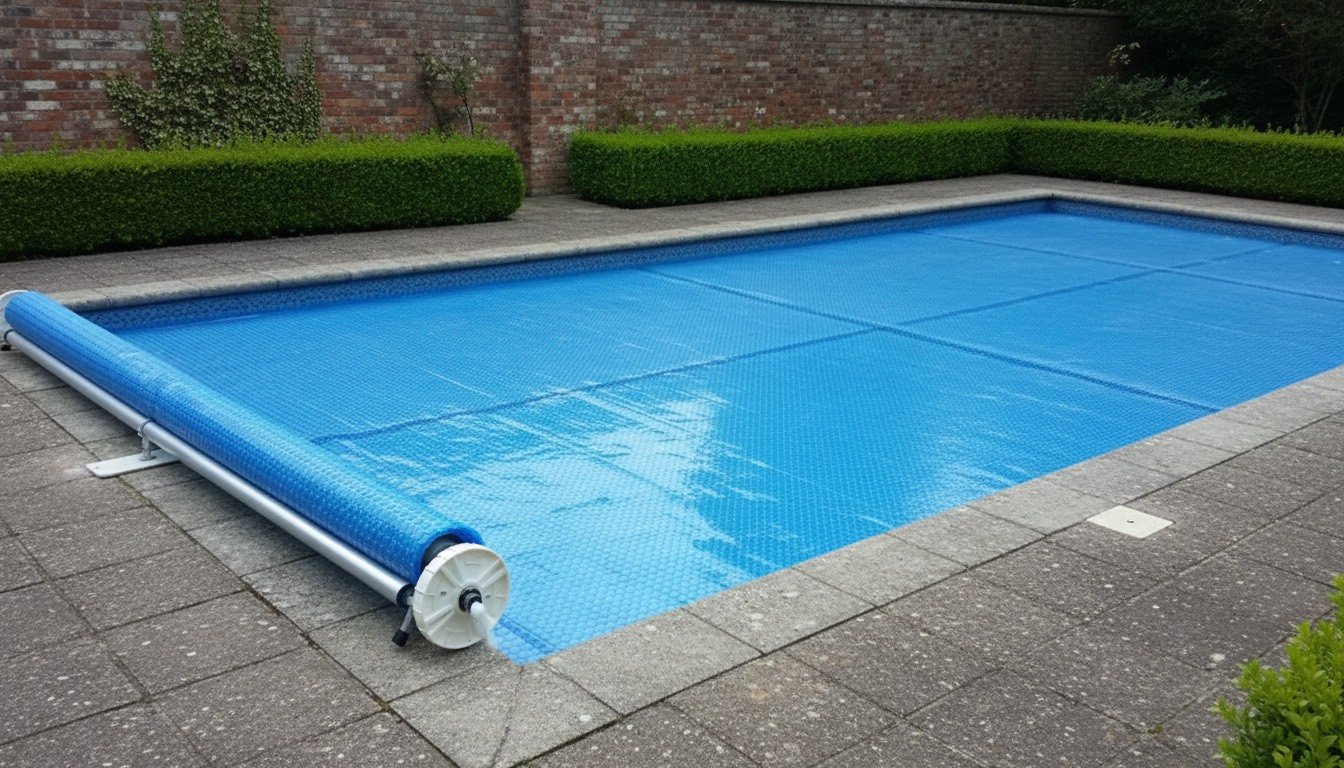
An uncovered outdoor pool loses roughly 70% of its heat through evaporation, and in this country almost all of that happens between 11pm and 6am, when the air sits five or six degrees below the water. Float a decent 500 micron bubble cover on the same pool and you keep about two-thirds of that heat overnight — in a Surrey garden, the difference between swimming from mid-May and swimming from the end of June.
What confuses people is that "pool cover" describes three products doing three jobs: holding heat, keeping leaves out, and stopping a child going in. No sheet does all three well, and buying the wrong one is why owners conclude covers do not work. Here are the four we would buy, and the UK rules that apply the moment a motor or an anchor bolt appears.
Our top picks at a glance
Plastipack Sol+Guard 500 Micron GeoBubble Solar Cover
~£11–15 per m² (cut to size)A UK-manufactured 500 micron cover whose double-radius bubble profile resists the UV and chlorine attack that splits conventional covers at the shoulder seam. On a standard outdoor pool it holds heat overnight better than anything else at sensible money and reliably reaches five to seven seasons.
Pros
- ✓ Trims cleanly with scissors to irregular and Roman-end shapes without unravelling
- ✓ Bubble seams survive UK chlorine levels far longer than standard 400 micron sheet
Cons
- ✗ Heavy enough that a pool over 5m genuinely needs a reel, adding £180–450
- ✗ Costs roughly 60% more per m² than a supermarket bubble cover
Plastipack EnergyGuard ST 500 Micron Cover
~£13–17 per m² (cut to size)Same 500 micron construction with a selective-transmission additive that blocks the light spectrum algae rely on, so chlorine demand drops noticeably through a warm July. Worth the premium on any pool that goes green faster than it goes cold.
Pros
- ✓ Measurably lower chlorine and algaecide use over a UK season
- ✓ Dark surface holds heat well once the sun drops in the evening
Cons
- ✗ Gains slightly less daytime solar heat than a clear or blue cover
- ✗ The grey-green finish looks industrial next to a smart paved surround
Plastica Heavy-Duty Winter Debris Cover
~£550–1,100 fitted (8m x 4m)A tensioned PVC or mesh cover fixed to stainless anchors set into the surround, and the only thing that reliably keeps oak and beech leaf tannin out of the water from October to April. It is a structural cover, not a floating one, and it is fitted once a year rather than daily.
Pros
- ✓ Ten years or more of service life from a single purchase
- ✓ Stops the spring reopening turning into a full drain-and-refill
Cons
- ✗ Anchor installation means drilling the surround, which is not reversible
- ✗ Standard versions are debris covers, not load-rated safety covers — specify that separately
Bestway Flowclear Solar Pool Cover
~£20–45A thin pre-cut floating sheet for round and rectangular above-ground pools where a cut-to-size GeoBubble makes no financial sense. It adds a genuine two or three degrees on a sunny UK day and will last two summers if you keep it out of the sun when it is off the water.
Pros
- ✓ Cheap enough to replace without argument every couple of seasons
- ✓ Light enough to fold and lift single-handed, so it actually gets used
Cons
- ✗ Thin gauge tears easily at the edge and degrades fast in strong sun
- ✗ Sizing is approximate — expect to trim, and expect some overhang
Who this is for — and which cover you actually need
Most UK domestic pools are outdoor, heat-pump heated and used for about four months. If that is you, the heat cover is the priority and everything else is secondary. Indoor pools gain less but still cut evaporation and dehumidifier load. Cover cost scales with surface area, so if the pool itself is still a decision, start with our UK pool cost breakdown. Match the cover to the real problem:
- •Water is cold and the heat pump runs constantly — a 500 micron solar cover, used every night, not just when you remember.
- •Water is warm but green by Wednesday — a selective-transmission thermal cover, plus an honest look at your chemistry.
- •Autumn leaf fall and winter rain — a fixed debris cover, tensioned to anchors in the surround.
- •Small children, dogs or a holiday let — a load-rated safety cover to NF P90-308, a structurally different product from anything that floats.
How we judged these, and what we did not do
The disclosure first: we have not run a controlled thermal trial across four covers on identical pools, and anyone claiming they have on a domestic budget is stretching it. These picks come from installer and service-engineer experience across UK pools, manufacturer data checked against what owners report, and the failure patterns we see when covers come off after two, five and ten seasons.
We weighted overnight temperature hold in a British spring, how the material degrades at the bubble seam under UV and chlorine, and the thing nobody asks in the showroom: whether one person can handle it unaided.
The four we would buy
The Plastipack Sol+Guard is the default for a standard rectangular outdoor pool: 500 micron, made in East Sussex, and the GeoBubble profile lasts longer because the failure point on a conventional bubble is the thin shoulder where it meets the sheet. EnergyGuard is the same construction with an additive that blocks the light band algae feed on — less chlorine demand, at the cost of a degree of solar gain. It pairs well with the routine in our pool water balancing guide.
The Plastica winter cover is a different animal: PVC or mesh, tensioned on stainless anchors, and the best defence against tannin staining from oak and beech leaf fall. Fit it every October alongside the pool closing checklist. The Bestway Flowclear is here because a 3m above-ground pool does not justify £400 of GeoBubble.
What to look for on the spec sheet
Micron rating is the headline number and the most misread. It describes thickness, not quality: 400 micron typically gives two to three UK seasons before the bubbles collapse, 500 micron gives five to seven. That extra £3 per square metre is the cheapest part of the decision. Beyond it:
- •Bubble geometry — a reinforced or double-radius bubble resists the UV and chemical attack that kills standard covers at the seam.
- •Colour — blue and clear gain the most heat; silver holds it best once the sun is off; selective-transmission greys trade gain for algae control.
- •Sizing — buy oversize and trim to roughly 10mm inside the waterline so the sheet floats free of the tiles.
- •Roller compatibility — anything over about 5m needs a telescopic reel, £180–450 manual, or the cover ends up on the lawn full of clippings.
- •Safety rating — a real safety cover is load-tested to NF P90-308. A solar cover carries no rating and is arguably worse than nothing, because a child can slip beneath it and become invisible.
Where UK regulation actually bites
There is no statutory duty in the UK to fence or cover a private domestic pool, unlike France, which has mandated a barrier since 2003. That should not reassure anyone. The Occupiers’ Liability Acts 1957 and 1984 leave you exposed for injury to visitors and, critically, to child trespassers, and most insurers now write a compliant safety cover or self-closing fence into the policy conditions. Let the place as a holiday cottage and HSE guidance HSG179 applies.
The electrical side is where DIY goes wrong. BS 7671 Section 702 defines zones around a pool with severe restrictions on what may be installed where, and any new circuit for an automatic cover motor, roller drive or pump is notifiable under Part P in England and Wales — certified by an installer registered with NICEIC, NAPIT or ELECSA, or notified to building control in advance. Retrospective sign-off is expensive and sometimes refused. Scotland requires a building warrant. This sits squarely on the list of electrical jobs you should never DIY.
Ground-level pools are usually permitted development, but a raised pool, a recessed pit for a slatted cover, or an enclosure over it can breach the limits — and those rights are curtailed on listed buildings and in conservation areas. Check our planning and building regs guide before anyone digs. Gas pool heaters are Gas Safe work.
Common buying mistakes
- •Fitting the cover bubbles up. Bubbles go down, in contact with the water — that is the insulating layer.
- •Buying to the pool’s advertised size rather than the water surface, then finding the coping eats 150mm a side.
- •Leaving a solar cover on through winter. Trapped chlorine and frost finish it in one season, and it stops no leaves.
- •Treating a floating cover as child protection. It is not, under any standard, anywhere.
- •Saving £250 on the roller, then abandoning the cover by July because handling it alone is miserable.
Running costs and when a cover is finished
For a typical 8m x 4m pool: a 500 micron cut-to-size cover runs £340–480, a manual reel £180–450, a fitted winter debris cover £550–1,100 with anchors. Automatic slatted covers are another budget entirely at £6,500–14,000 installed, the motor usually failing first at eight to ten years. Against that, heat-pump owners commonly report a third to a half off summer running costs from covering every night.
Replace a solar cover when the bubbles split along the seams or the sheet goes cloudy and brittle — that is UV and chlorine damage, not dirt, and cleaning will not bring it back. Fold it wet-side-in, keep it off hot paving in July, and rinse it before winter storage. If the water is the frustration rather than the temperature, the cover is not the fix — start with our swimming pool maintenance guide.
Found this useful?
There's plenty more — hundreds of guides and honestly-tested product reviews for every corner of your home.
Browse All Guides