Laundry & Fabric Care · 6 min read · 4 June 2026
How to Dry Clothes Indoors Without Causing Damp & Mould
Every airer-load releases litres of water into your home — straight into the coldest wall. The drying methods that don't feed the mould, ranked.
By the Nims Casa editorial team — written from professional cleaning experience and checked against our editorial standards.
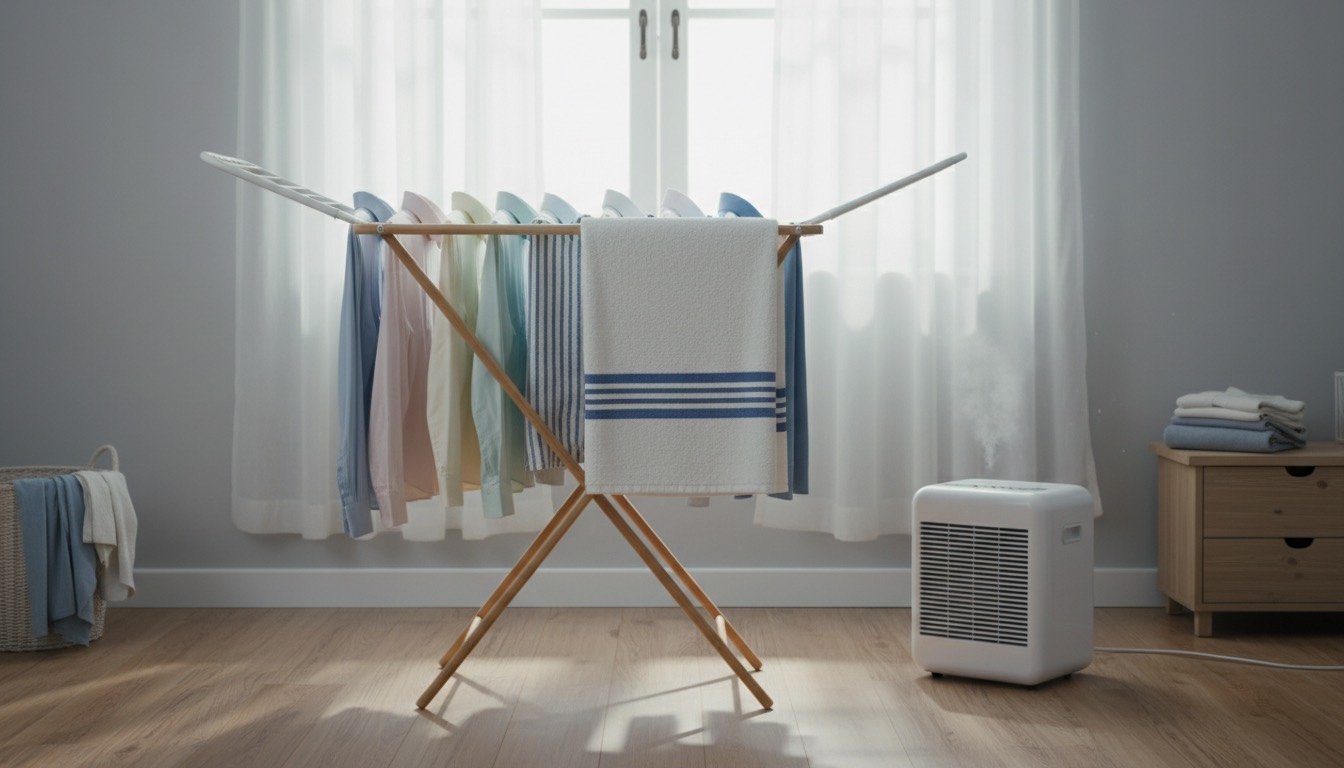
For most of the year, Britain dries its washing indoors — and every airer-load releases two to three litres of water straight into the household air. That moisture drifts to the coldest surfaces in the house, window reveals, north-facing walls, behind a wardrobe, and condenses there, feeding exactly the black mould we cover in our guide to mould on clothes and wardrobes. Multiply that by four or five loads a week over a damp winter, and a single airer can tip a borderline room into a real problem.
You don't have to stop drying indoors — you have to manage where the water goes. This guide ranks the drying methods by moisture risk, walks through the closed-room dehumidifier method step by step, prices up the kit involved, and flags the mistakes that turn an ordinary week's washing into a mould problem by February — plus when a damp house has stopped being something an airer routine can fix.
The indoor drying methods, ranked by moisture risk
- •Heat-pump tumble dryer: the gold standard. Moisture condenses into a tank, not your walls, at roughly 13–18p a cycle versus 45p or more for an old vented dryer. Machines start around £380 — see our best tumble dryers UK picks.
- •Airer plus dehumidifier in a closed room: the smart budget answer. A 10–12L dehumidifier (£90–£180) on its laundry setting, door shut, dries a full load overnight and collects the water instead of releasing it — see our best dehumidifiers UK round-up.
- •Heated airer with a cover: cheap to run and noticeably faster — but without a dehumidifier or an open window it just releases the same water faster. Always pair it with ventilation.
- •Plain airer in a lived-in room: the default in most homes, and the riskiest. Run the extractor fan or crack a window, and never the bedroom, where shut-door humidity condenses straight onto the coldest wall.
- •Radiators: the worst option on every count — blocks the heat warming the room, spikes humidity, stiffens fabric, and costs boiler efficiency. Break this habit first.
Step by step: the closed-room dehumidifier method
This gets a full load properly dry overnight without adding moisture to the rest of the house. It works in almost any spare room, bathroom or box room with a door that shuts.
- •Pick the smallest room with a door that closes fully — less air volume means the dehumidifier reaches a safe humidity faster.
- •Check the room's starting humidity with a cheap hygrometer; our ideal indoor humidity level guide explains the reading to aim for.
- •Space the washing a hand-width apart on the airer, then position the dehumidifier 30–50cm away, angled so its airflow crosses the fabric directly.
- •Switch to the 'laundry' or 'continuous' setting if it has one, so it keeps running rather than cutting out once the room reading looks acceptable.
- •Shut the door and leave it running 8–10 hours; overnight suits most households, and a standard load is usually bone dry by morning.
- •Empty the water tank before another cycle — a full tank silently stops most machines extracting, so you'll return to washing that's still damp.
- •Crack the door for 10–15 minutes once drying finishes, so the last humid air clears through a window, not into the hallway.
What the kit actually costs
Most households already own an airer — a dehumidifier is the one purchase that actually changes the equation.
- •Compressor dehumidifier, 10–12L: £90–£180 — more efficient than desiccant models in a warm house, and worth it for several loads a week.
- •Desiccant dehumidifier: £40–£70 — cheaper upfront and works in colder rooms, but pulls less water per hour.
- •Heated airer, standard 3-tier: £35–£70 to buy, roughly 2–3p an hour to run — worth it for speed, not for solving the moisture problem alone.
- •Plug-in hygrometer: £8–£20, useful for confirming a room has actually hit a safe humidity level.
- •Heat-pump tumble dryer: £380–£700+ — the only option here with no moisture-management step required at all.
Get more water out before you hang anything
Whatever method dries the washing, less water going in means less coming out into the room. Run an extra spin where the fabric allows it — 1400rpm leaves noticeably less water than 800rpm. Check the laundry symbols on delicate items before pushing the spin speed up.
Shake every garment out before hanging — creased, balled-up fabric holds water in its folds and dries slower. Space items a hand-width apart; a packed airer is a slow, musty one, because air can't move between garments to carry the moisture away.
If washing comes off the airer smelling faintly 'indoor-dried' rather than clean, treat it as an early warning, not something a fresher conditioner will fix. That mustiness is mildew's opening remark, well before any visible spotting — a hot wash and a hard look at the room's airflow will usually clear it before it becomes a fabric mould problem.
Mistakes that quietly feed condensation and mould
- •Drying a full airer in the bedroom overnight, door shut, no dehumidifier — eight hours of breathing plus wet washing easily pushes a small room's humidity past 70%.
- •Overloading a single airer instead of splitting the load across two rooms — cramming more on doesn't dry it faster, it just adds water to the same volume of air.
- •Ignoring a tumble dryer that's taking two cycles to dry what used to take one — that's very often a heating fault, not just a full filter; see our dryer not heating troubleshooting guide.
- •Letting a dehumidifier's tank sit full for days — most machines stop extracting the moment the tank fills, giving a false sense of security while it 'runs'.
- •Waiting for visible black spotting before acting on a musty smell — by the time mould is visible, spores have usually been active for weeks; see how to get rid of mould on bathroom ceilings and walls for the room it hits first.
When indoor drying isn't the real problem
If you're running a dehumidifier religiously and the walls still stream with condensation, the drying routine probably isn't the cause any more — it's whole-house ventilation. Bathrooms without working extractor fans and trickle vents painted shut push a home's baseline humidity up regardless of how carefully you dry washing; our signs of poor home ventilation guide covers the tells to look for room by room.
Get a surveyor involved rather than a bigger dehumidifier if mould covers more than roughly a square metre, keeps returning within weeks of cleaning, or tracks a specific cold spot on an external wall — that's usually rising or penetrating damp, which no airer routine will fix. In rented and social housing, persistent unresolved damp is a legal issue worth raising formally, not just a chore to manage around. The formal route now has real timescales attached — our guide to landlord repair deadlines for damp and mould sets them out.
Frequently asked questions
**Does drying washing indoors actually cause mould?** Not on its own — it's the combination of extra vapour and nowhere for it to go. A load on an open airer in a heated, ventilated room causes far less trouble than the same load in a small, cold, closed-up one. It is one more small entry in the when to turn the heating on calculation — drying loads in a completely unheated house takes days rather than hours.
**Dehumidifier or heated airer — which is better?** A heated airer dries faster but still releases the water; a dehumidifier captures it but adds no heat. Used together in a closed room, they're faster and safer than either alone.
**How long does a load take to dry indoors safely?** With a dehumidifier in a closed small room, 8–10 hours for a typical mixed load. On an open airer with no extra help, two to three days is common in winter — the window in which mustiness sets in.
**Can I dry washing in the bathroom instead of the bedroom?** Yes, if it has a working extractor fan — run it alongside the airer or dehumidifier. Avoid it only if the room already struggles with its own post-shower condensation.
**Is a heat-pump dryer worth buying just to avoid all this?** For more than two or three loads a week, yes — it removes the moisture-management step entirely, and the running-cost saving covers a meaningful chunk of the purchase price within a couple of years.
Found this useful?
There's plenty more — hundreds of guides and honestly-tested product reviews for every corner of your home.
Browse All Guides