Electrical · 6 min read · 10 May 2026
How to Calculate Home Electrical Load: The UK Method, With Diversity
Almost every UK home fails the paper sum. Here is how electricians work out maximum demand, apply diversity, and decide whether an 80A supply has room for a shower or a car charger.
By the Nims Casa editorial team — written from professional cleaning experience and checked against our editorial standards.
Nearly everyone reaching for a calculator and a list of appliances is answering one of three different questions, each needing a different sum. Pick the wrong one and you get a figure that looks authoritative and tells you nothing.
The arithmetic is trivial: watts divided by 230 gives amps. What matters is which loads you count and how much of each. UK installations are assessed using the diversity allowances in BS 7671 and the IET On-Site Guide, because no household runs the shower, oven, dryer and kettle at once. Skip diversity and you will conclude you need three-phase.
Start Here: Which Problem Do You Actually Have?
Two minutes on this before you write down a figure. The symptom tells you which calculation is worth doing.
- •One MCB trips when the kettle and air fryer run together, and nothing else is affected. That is a circuit-level overload, not a supply problem: see the signs of an overloaded circuit.
- •The main fuse under the meter has blown, or lights dip across the house when the shower fires. That is maximum demand: the calculation below.
- •The RCD trips at odd hours or in wet weather with no load pattern. That is earth leakage, and arithmetic will not touch it: start with why the breaker trips.
- •An installer quoting for a charge point or heat pump has mentioned load management. You need maximum demand plus headroom.
- •The consumer unit is simply full. That is board capacity, not load.
Safety First, and the Legal Line
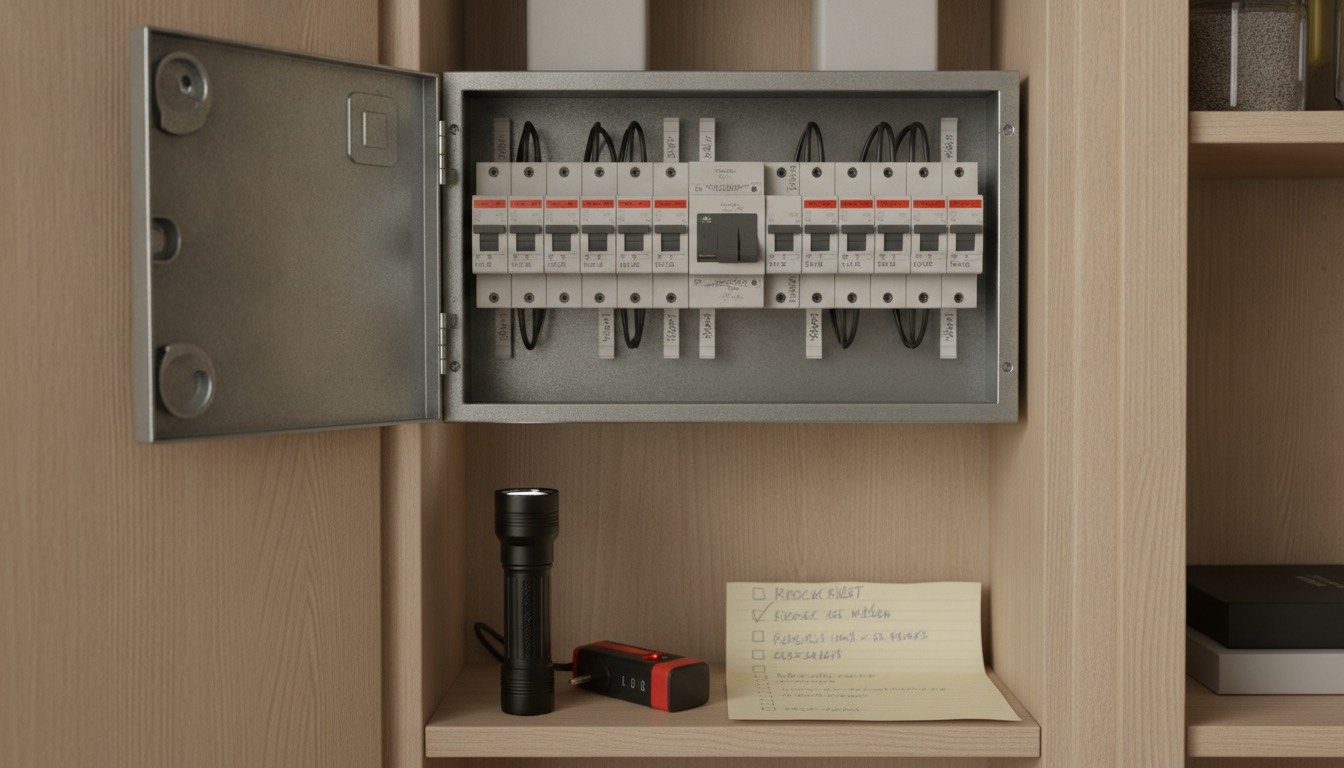
This is a desk exercise. Every figure comes off appliance rating plates, a photo of the consumer unit with the cover shut, and your bill. Remove nothing: live parts sit behind that cover even with the main switch off, because the meter tails stay energised. The cut-out fuse and meter belong to your network operator, and the seal on the fuse carrier is there for a reason.
England treats new circuits, consumer unit replacements and anything in a room with a bath or shower as notifiable under Part P. Wales kept the wider original scope, so kitchens and outdoor circuits are caught too, and Scotland works to the Building (Scotland) Regulations. All of it needs a registered electrician via NICEIC, NAPIT or STROMA, or a building control notice first: see when you need an electrical permit.
What You Need, Time and Cost
No tools, no test gear. Budget 45 to 90 minutes for a three-bed house, most of it behind appliances with a torch.
- •Appliance rating plates in watts or kilowatts. Use these, never the plug fuse rating.
- •Photos, taken with covers closed, of every MCB rating and of the cut-out fuse carrier under the meter.
- •A plug-in energy monitor for illegible plates, £10 to £20 from Screwfix.
- •Your smart meter display for live kW, and your bill for the MPAN: its two-digit distributor ID names your network operator.
The Calculation, Step by Step
Work in amps throughout. Mixing kilowatts and amps halfway down the column is the commonest homeowner error.
- •1. Convert your main fuse rating. At 230 V, 60 A gives 13.8 kW, 80 A gives 18.4 kW, 100 A gives 23 kW. Plenty of pre-1990 stock is still on 60 A or 80 A.
- •2. List every circuit by MCB rating: lighting 6 A, ring finals 32 A, cooker radial 32 or 40 A, shower 40 or 45 A, immersion 16 A.
- •3. Convert fixed appliances to amps: an 8.5 kW shower is 37 A, a 10.5 kW shower 46 A, a 3 kW immersion 13 A, a 7.4 kW charge point 32 A.
- •4. Lighting: total the connected load, take 66 per cent. All-LED, this is under 2 A.
- •5. Socket circuits: 100 per cent of the largest, 40 per cent of every other. A kitchen ring plus a general ring gives 32 A plus 12.8 A.
- •6. Cooking: the first 10 A in full, then 30 per cent above that, plus 5 A if the cooker control unit has a socket in it.
- •7. Instantaneous water heaters get no diversity, so an electric shower goes in whole. With two, count both in full and 25 per cent of any beyond.
- •8. Immersion heaters, storage heaters, electric underfloor and an unmanaged charge point get none either. They run at full rating for hours.
- •9. Add the diversified column and compare it with your fuse rating.
- •10. Cross-check against reality: take the highest kW your smart meter reaches in a cold January week and divide by 0.23.
Worked Example: A 1930s Semi Adding a Charge Point
Three-bed semi, gas combi, 80 A fuse, two ring finals, electric oven, 8.5 kW shower. The owner wants a 7.4 kW charger on the drive.
- •Lighting, two circuits, 600 W: 2.6 A, diversified to 1.7 A.
- •Kitchen ring at 100 per cent: 32 A. Second ring at 40 per cent: 12.8 A.
- •Electric oven, 3 kW: 13 A becomes 10 A plus 30 per cent of the remaining 3 A, so 10.9 A.
- •Shower, 8.5 kW, no diversity: 37 A.
- •Paper maximum demand before the charger: 94.4 A against an 80 A fuse.
- •Measured peak on the smart meter across a cold week: 6.8 kW, roughly 30 A.
- •Measured peak plus a 32 A charger: about 62 A. It fits, but nothing is spare if the shower runs mid-charge.
When the Numbers Don't Add Up
The gap between 94 A on paper and 30 A measured is not an error. Diversity tables are conservative by design, and almost every UK home fails the paper sum once a shower and two rings are in the column. That is why installers rely on measured demand, or a load-managing charger whose CT clamp throttles the car when the house pulls hard.
- •Fuse carrier unreadable: your network operator will confirm the rating from the MPAN.
- •Labels missing after a part-rewire: get an EICR, £150 to £300 for a three-bed.
- •A 60 A fuse: common on rewireable Wylex boards, and worth pricing beside a consumer unit upgrade.
- •Economy 7: a contactor feeds the heating circuit overnight, so it never meets your evening peak.
When to Stop and Call an Electrician
The calculation is yours. What it points to is not. A new circuit for a shower, cooker or charge point is notifiable work needing a registered electrician and a certificate your insurer and any buyer will want. Expect £45 to £75 an hour, or £250 to £400 a day: see what an electrician costs.
If the supply itself is too small, apply to your network operator to uprate the cut-out fuse. An 80 A to 100 A swap is often free, or a few hundred pounds, where the existing service cable will take it. If it will not, a new head and cable from the street runs £500 to well over £1,500, with a wait of weeks.
Two things are never a homeowner job: anything on the supply side of the meter, and anything behind the consumer unit cover. Both are on the list of electrical repairs you should never DIY. Hand your figures to the installer at survey stage and it settles the load management argument.
Found this useful?
There's plenty more — hundreds of guides and honestly-tested product reviews for every corner of your home.
Browse All Guides