Garden & Outdoor · 6 min read · 14 June 2026
How to Maintain a Swimming Pool: The UK Weekly Routine, Real Costs and When to Call an Engineer
Most British pools go wrong because owners only act when the water looks bad. Here is the dull weekly routine that prevents it, what it genuinely costs in 2026, and where a service quote stops being fair.
By the Nims Casa editorial team — written from professional cleaning experience and checked against our editorial standards.
By the time water looks wrong — hazy, green at the shallow end, a grey tidemark at the waterline — you are two or three hundred pounds into recovery chemicals and a fortnight of extra pump running nobody budgeted for. The work that prevents it is boring, takes twenty-five minutes a week, and costs a fraction of the rescue.
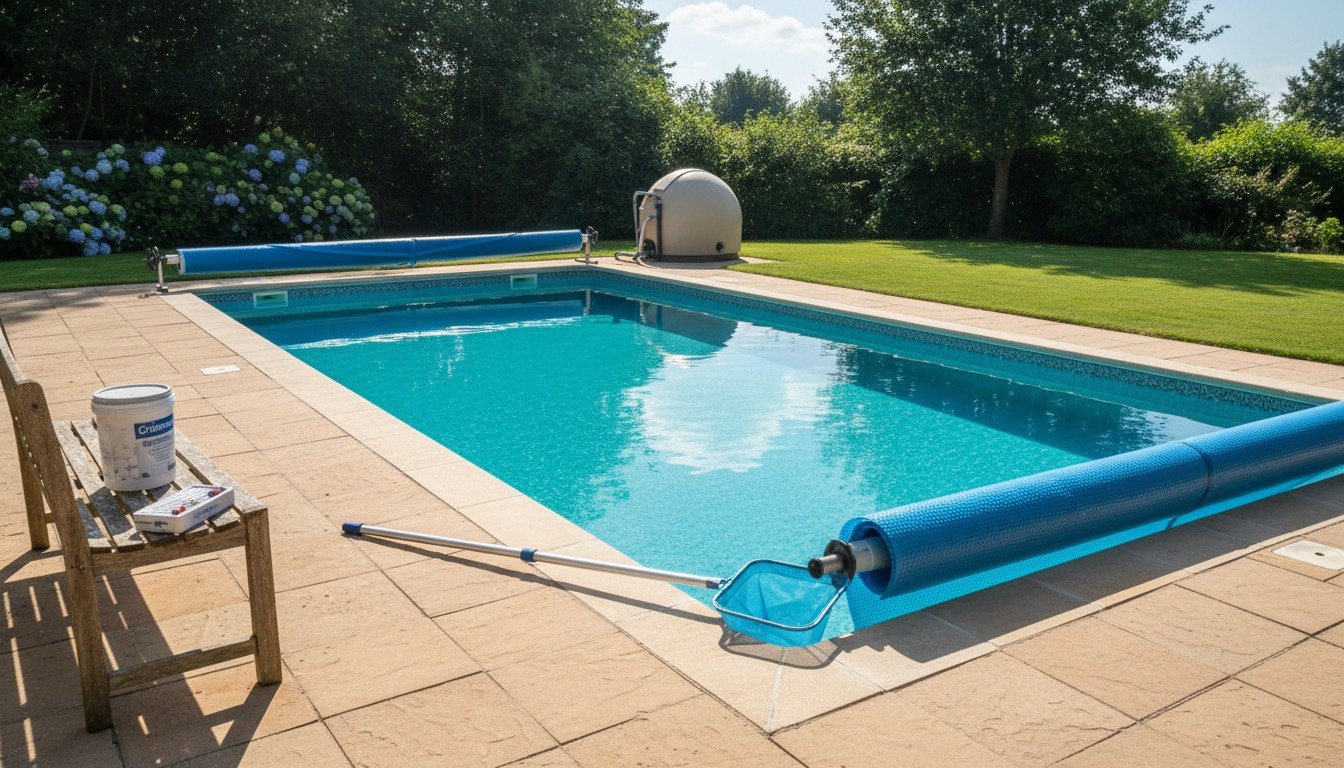
This covers the commonest UK setup: an outdoor 8m x 4m pool with a sand filter and heat pump, running May to September. Every figure is a 2026 UK price split into chemicals and labour, so you can spot a padded quote.
Safety first: the things that genuinely hurt people
Pool chemicals are the most dangerous items most households own, and almost nobody stores them properly. Granular chlorine and pH-minus in one damp cupboard will eventually vent chlorine gas; trichlor and calcium hypochlorite in contact can ignite. Separate sealed tubs, off the floor, dry outbuilding, under 25°C.
- •Always add chemical to water, never water to chemical — in a bucket, outdoors, upwind.
- •Never mix stabilised (trichlor) and unstabilised (cal hypo) chlorine in one feeder or bucket.
- •Do not swim until free chlorine falls below 5 mg/l after shocking — 12 to 24 hours with the pump running.
- •The pump circuit needs a 30mA RCD; lock the isolator off before opening a filter lid or strainer basket.
- •Never run the pump with a damaged main drain cover — suction entrapment kills children. A replacement is £40–£90.
- •No statutory fencing law covers private pools here, but most insurers require a lockable cover or 1.1m barrier.
Tools, chemicals and the test kit that pays for itself
Buy the test kit properly and economise everywhere else. Strips drift badly in sunlight, and half the ruined pools we get called to were ruined by someone dosing on a strip reading. A DPD comparator (£25–£40) or photometer (£150–£300) tells the truth. Once you can read the water accurately, balancing pool water is arithmetic.
- •Telescopic pole, leaf skimmer net and wall brush — £45–£90 for the set
- •Vacuum head and 9m hose, or a robotic pool cleaner at £400–£1,400 that repays itself in two seasons
- •Chlorine: 5kg stabilised tablets £35–£55; 5kg granular shock £25–£45; reagents about £15 a season
- •pH-minus and pH-plus, £15–£25 per 5kg tub; alkalinity increaser, 10kg, £20–£30; clarifier, £12–£20
- •Solar cover and roller — £250–£700, the best return on money you will spend; our pool cover guide explains why thickness matters
What a UK pool actually costs to run
Here is the honest annual picture for an 8m x 4m heated outdoor pool, May to September, at 26p per kWh. Chemicals are the small number; electricity is the big one, and heating is most of that.
Labour versus materials is where quotes diverge. A DIY season is almost all materials. Hand the job over and the ratio flips: a full contract runs 65–75% labour. That is not a rip-off — the labour is real — but never accept a single unitemised figure.
- •Chemicals for the season: £280–£550
- •Filtration pump electricity: £380–£700 single-speed at 10 hours a day, or £120–£220 with a variable speed pump
- •Heat pump electricity: £350–£900, depending on cover discipline
- •Water top-up and metered waste: £60–£140
- •Spring opening by an engineer £250–£450; winterising £250–£500, or nothing if you work through a pool closing checklist yourself
- •Weekly service visit £45–£90; a fortnightly contract typically £120–£250 a month
- •Realistic all-in totals: £1,100–£2,300 DIY, £2,600–£4,800 fully serviced
The weekly routine, step by step
Same day every week, twenty to thirty minutes. It prevents essentially every expensive problem below.
- •1. Isolate the pump, then empty the skimmer and strainer baskets. A blocked strainer cooks the mechanical seal — a £120 part plus £150 fitting.
- •2. Net the surface, then brush the walls, steps and the shaded corner where algae starts. Brushing lifts biofilm the vacuum cannot.
- •3. Vacuum — to waste if the pool is filthy, otherwise to filter.
- •4. Test the water. Targets: free chlorine 1–3 mg/l, pH 7.2–7.6, total alkalinity 80–150 mg/l, calcium hardness 200–400 mg/l.
- •5. Correct alkalinity first, then pH, then chlorine — alkalinity governs how stable your pH stays. Dose the deep end, pump running.
- •6. Backwash when the filter gauge reads 0.3–0.5 bar above your clean baseline, then rinse 30 seconds. More often wastes metered water.
- •7. Test stabiliser (cyanuric acid) monthly, holding 20–50 mg/l. Above 100 mg/l the chlorine barely works, and the only cure is a partial drain and refill.
- •8. Get the cover on every night. An uncovered pool loses 3–5°C overnight — that is where the heating bill comes from.
Seasonal jobs people skip and regret
The British climate does its damage in the shoulder seasons. Two dates matter more than the whole summer.
- •Opening, late April to mid-May: clean the debris cover, top up, run the pump 24 hours, shock to 10 mg/l, rebalance once it drops below 5. Allow two to four days before it is swimmable.
- •Mid-season: sand filter media needs replacing every 5–7 years — 100–150kg at £120–£300, plus two hours of labour.
- •Closing, early to mid-October before the first hard frost: balance, shock, drop the level below the skimmer, drain pump, filter and heat pump, antifreeze the pipework, cover.
- •Left unwinterised you risk a cracked heat exchanger or split pipework — a £900–£2,500 repair against a £250–£500 visit. The same chemistry governs spas, where errors bite harder: see cleaning a hot tub.
Troubleshooting the four problems you will actually get
Nearly every call-out we take is one of these. Three of the four are fixable for under £60.
- •Green water: chlorine has sat at zero for a while. Brush everything, shock to 10–15 mg/l, run the pump 24 hours, backwash. Cloudy grey afterwards is dead algae — good news. Cost: £30–£60 of shock plus £8 a day in electricity.
- •Cloudy but well chlorinated: filtration, not chemistry. Check run time is at least 8 hours a day, backwash, add clarifier. Still hazy after 48 hours and the sand has channelled or is spent.
- •Chlorine that will not hold: test stabiliser. In tablet-fed pools it creeps up all season and locks chlorine out. Drain 30% and refill.
- •Scale on tiles and exchanger: common in hard-water counties. Hold pH low in the range and hardness under 400 mg/l. Descaling £150–£300; a new exchanger £600–£1,200.
When to stop — and how to read the quote
Stop at anything electrical beyond resetting a breaker, the heat pump refrigerant circuit, liner damage below the waterline bigger than a patch kit covers, and any plumbing you cannot isolate. Pool electrics sit in a wet zone under BS 7671 and want a qualified electrician.
A reasonable quote is itemised, states £45–£75 an hour or £280–£420 a day, lists chemicals separately with quantities, and may add a real travel charge because pool specialists are thin outside the South East. Be suspicious of a weekly service under £30 — that buys fifteen minutes and a splash of chlorine — and of any invoice that shocks the pool every visit, which is padding rather than treatment. Ask about SPATA membership, ask what the pressure gauge read before and after, and get a second quote above £500. Our breakdown of what a pool costs gives the wider picture.
Found this useful?
There's plenty more — hundreds of guides and honestly-tested product reviews for every corner of your home.
Browse All Guides