Organisation & Storage · 6 min read · 20 June 2026
Kitchen Cupboard Organisation: Zones, Turntables & the Tupperware Truce
Kitchens work when things live where they're used — a zoning problem, not a tidiness one. The system, plus honest verdicts on decanting and the container cupboard.
By the Nims Casa editorial team — written from professional cleaning experience and checked against our editorial standards.
Kitchen chaos is rarely a discipline failure — it's a logistics failure. Cupboards fill up in whatever order things landed on moving day, so cooking turns into a relay of cross-kitchen fetches, and the top shelf becomes a graveyard for forgotten gadgets.
This guide covers the zoning method that actually holds, which storage gadgets earn their keep, how to fix a corner cupboard swallowing your pans, an honest verdict on decanting into matching jars, and the one rule that ends the Tupperware avalanche for good.
None of it needs a weekend or a van hire. Most UK kitchens can be re-zoned in an afternoon for the cost of a few turntables. If the cupboards feel chaotic again within a fortnight, the zoning probably didn't match how you cook.
Zone your cupboards by task, not by object
Most kitchens are organised by category — all mugs together, all tins together — which sounds logical until you realise a category doesn't say where in the room something gets used. Zoning by verb fixes that: group items by the job they do and put each group near where that job happens.
- •Map your stations: kettle zone (mugs, tea, coffee within one step), hob zone (oils, salt, utensils and weekly pans), prep zone (boards, knives, bowls near the biggest worktop), and baking zone (scales, tins, cake gear, used less so it can sit higher up).
- •Empty one cupboard at a time onto the worktop, sorting into keep, bin and relocate. Be honest about expired spices and the third ladle nobody remembers buying. Our guide to decluttering room by room covers the same method for the rest of the house.
- •Let frequency decide altitude: daily items at eye and waist height, weekly items above or below, and anything used once a year — the turkey platter, the fondue set — on the top shelf or in a garage box.
- •Assign the dishwasher-unload zone: everyday plates, bowls and glasses in the cupboard nearest the dishwasher. This one change removes more daily friction than any gadget, since unloading becomes a straight line rather than a kitchen-wide tour.
- •Reassess after two weeks. The first zoning pass is a guess — if you keep reaching past the "logical" spot, move it to where your hand actually goes.
Storage tools worth buying (and what to skip)
The storage aisle sells solutions to problems zoning already solves for free. A handful of buys genuinely change how a cupboard functions; the rest look good until the novelty wears off. Typical 2026 UK prices:
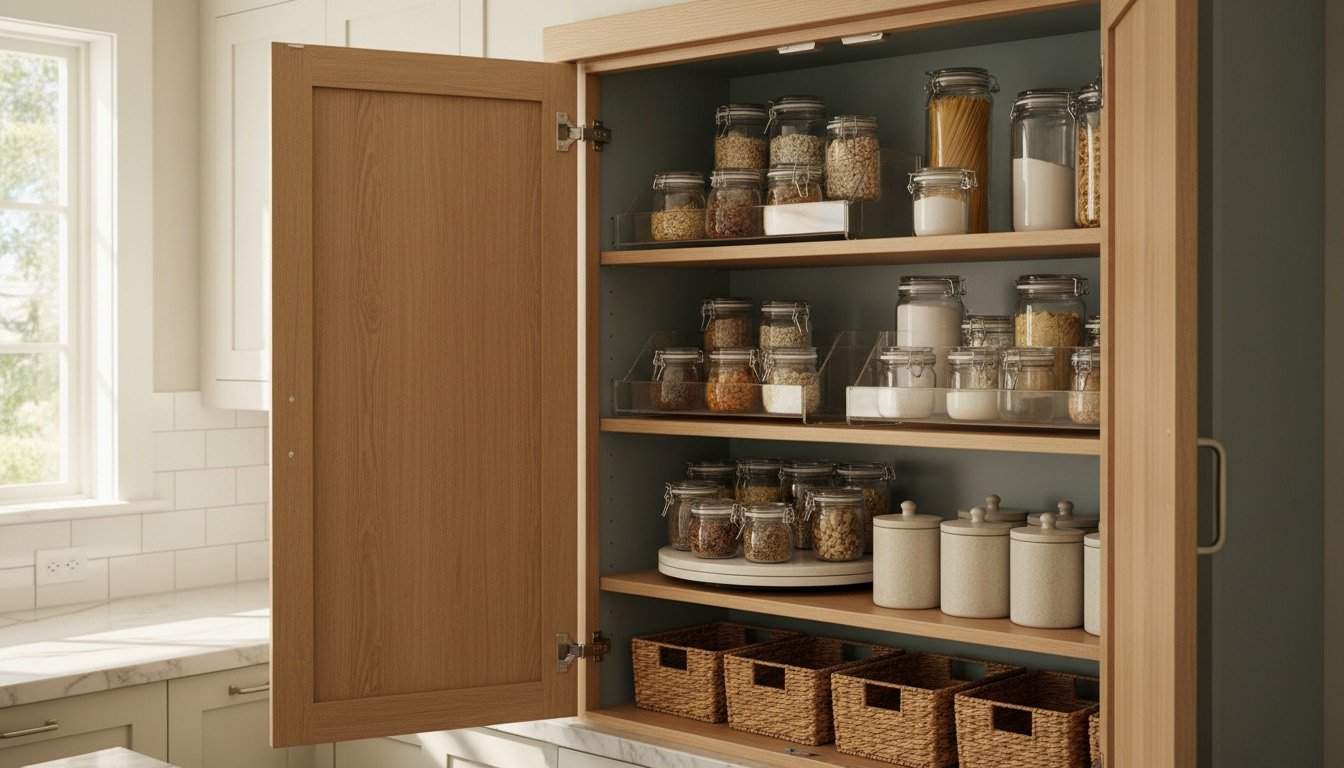
- •Turntables or lazy Susans, £8–£20: transform a deep corner cupboard or condiment shelf where things get lost behind the front row.
- •Tiered can and spice risers, £10–£25: reveal the back row of a shelf without moving the front — useful in cupboards deeper than about 30cm.
- •Under-shelf wire baskets, £6–£15 each: clip beneath a shelf to create a free half-shelf above tinned goods.
- •Drawer dividers, £10–£30 for an expandable set: stop a utensil drawer becoming one sliding mass of whisks.
- •Matching decanting jars, £3–£8 each or £25–£45 boxed: worth it for staples bought loose or in bags — see the decanting section below.
- •Fitted pull-out wire baskets, £25–£70 per runner, usually fitted by a joiner: the proper fix for a corner cupboard being replaced rather than retrofitted.
- •Skip elaborate acrylic organiser sets sized for a show-home cupboard, and anything bought before the zoning pass. For a whole kitchen tight on space, see small-space storage ideas for freestanding options.
Fixing corner cupboards and other blind spots
The corner cupboard is the worst-designed storage in most UK kitchens — a deep, dark void where slow cookers go to be forgotten.
- •Cheapest fix: a two-tier turntable (£12–£25) on the existing shelf. It won't use every millimetre of the corner, but everything on it becomes visible and reachable with one turn.
- •Mid-range fix: a bi-fold or pull-out carousel retrofitted into the existing carcass, typically £80–£180 fitted, swinging contents into the room as the door opens.
- •Full fix, only worth it during a wider refit: a magic-corner mechanism in a new cupboard, £150–£350 as part of a fitter's quote.
- •Other blind spots: the cupboard above the fridge suits seasonal baking tins; the gap beside the oven often takes a narrow pull-out spice trolley (£30–£70); and the plinth drawer under the base units suits baking trays and roasting tins.
Decanting honestly: what's worth it and what isn't
Decanting into matching jars gets sold as the whole solution, but it's only worth the effort for a specific category. Daily staples bought loose or in bags — pasta, rice, oats, cereal, flour — genuinely benefit: you see remaining stock at a glance, bags stop avalanching, and airtight jars keep pantry moths out, which matters more in older UK houses with patchier ventilation.
Where it's mostly theatre: back stock (a second bag waiting behind the first doesn't need its own jar), and anything with cooking instructions or allergen information you'll need to check. Label lids as well as fronts if jars will sit in a drawer — a lid-only label is invisible once the jar is put away. For the deeper store cupboard many UK kitchens keep separate, see pantry organisation ideas.
The Tupperware and container cupboard system
The container cupboard has one rule that fixes most of the chaos: lids stay on matching bases, or the household runs a strict two-stack system — bases nested by size, lids filed vertically in a rack. Anything without its partner after a proper matching session goes to recycling; an orphan lid is clutter with hope attached. The same discipline that keeps a laundry cupboard under control works just as well here.
Cap the collection to what the cupboard holds in a single flat layer per stack — takeaway tubs breed above that line. Water bottles and flasks are the other repeat offender: not really Tupperware, and better off in their own zone than wedged into a stack of nesting bowls.
Common mistakes and when to call in help
A few habits undo a good zoning job within weeks: buying storage before sorting; zoning by category instead of by use; ignoring frequency, so a seldom-used fondue set keeps prime shelf space; and skipping the two-week check-in, letting small daily frictions rebuild the old chaos. These sit alongside the broader home organisation mistakes that undo good intentions in every room, not just the kitchen.
If cupboards are chaotic across the whole kitchen, or the layout itself is fighting you, that usually points to an issue predating today's mess. A professional organiser session typically runs £150–£350 for a half-day on one room — worth it for households short on time rather than ability. It pairs well with a fridge deep clean and reorganisation while everything's already out on the worktop.
Frequently asked questions
**How long does it take to reorganise a full kitchen's cupboards?** Budget three to five hours in one go, or spread it station by station over a few evenings — finish one zone before starting the next.
**Should I clean the cupboards while I'm at it?** Yes — an empty cupboard is the easiest one you'll ever get to wipe down, and crumbs shift faster before everything goes back in. See how to deep clean a kitchen for the full order of work.
**What's the cheapest way to fix a corner cupboard?** A two-tier turntable on the existing shelf, roughly £12–£25, gets most of the benefit of a full carousel retrofit for a fraction of the cost.
**Are decanting jars worth it for a small household?** Only for the staples used fastest — usually pasta, rice and cereal. One or two people often get through a bag before an avalanche becomes a problem, so decant selectively.
**How often should the zoning be redone?** Almost never — it's a one-off fix, not a recurring chore. A reassessment after a house move or a change in who's cooking is usually all it needs.
**Do I need matching containers for everything?** No. The function comes from lids finding bases and jars being labelled, not from every jar being identical.
Found this useful?
There's plenty more — hundreds of guides and honestly-tested product reviews for every corner of your home.
Browse All Guides