Garden & Outdoor · 5 min read · 16 June 2026
Saltwater vs Chlorine Pool: Real UK Costs, Upkeep and Old-House Warnings
A salt pool is still a chlorine pool — the only difference is where the chlorine is made. Here is how the two compare on real UK costs, weekly upkeep and suitability for older homes.
By the Nims Casa editorial team — written from professional cleaning experience and checked against our editorial standards.
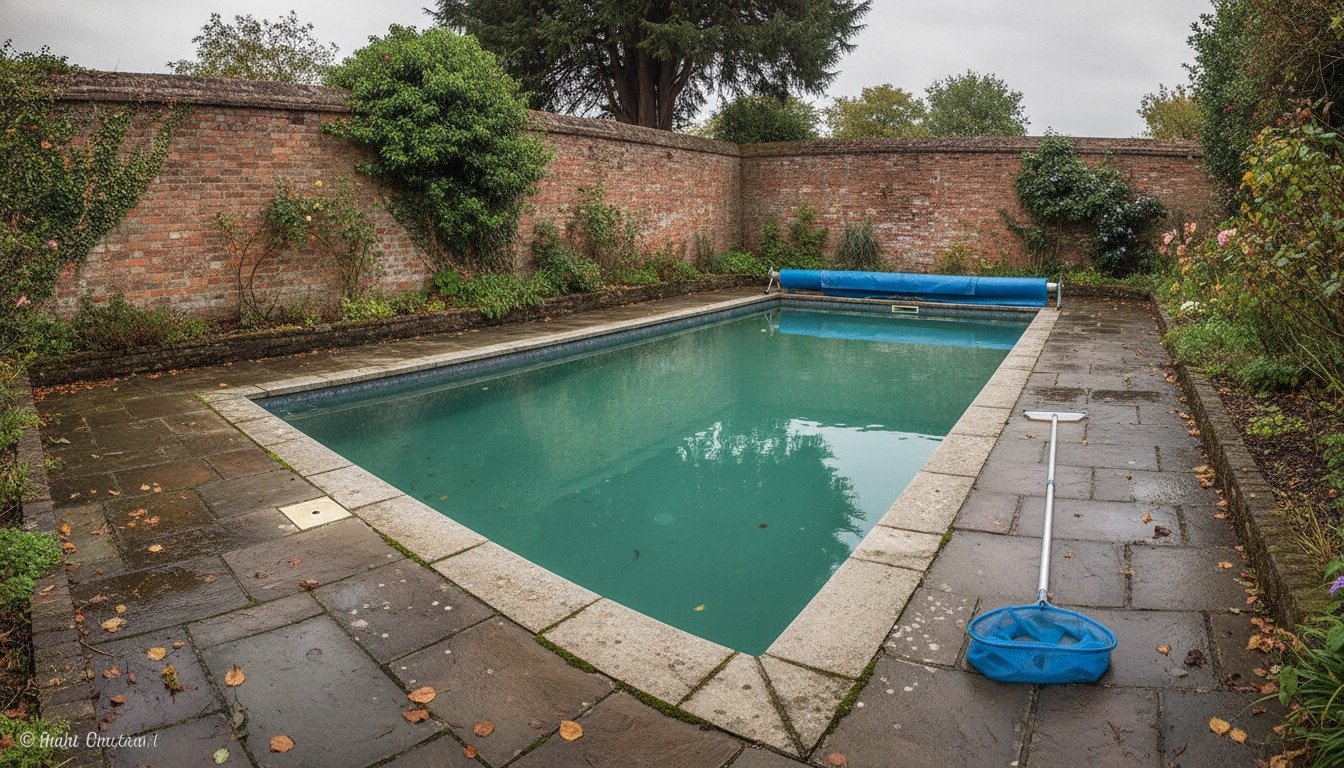
Ask three installers and you get three answers, mostly shaped by what they sell. The honest starting point: a salt pool is a chlorine pool. The only difference is where the chlorine comes from — a cell in the plant room, rather than a tub of tablets in the shed.
That matters more here than in Florida. Our season runs five months, much of our water is very hard, and a great many UK pools sit behind houses built long before anyone imagined a chlorinator bolted to a coach-house wall.
Salt Pools Are Chlorine Pools — the Actual Difference
A salt chlorinator passes a low-voltage current through water carrying dissolved sodium chloride. The cell splits it into hypochlorous acid — the identical sanitiser a trichlor tablet gives you — and the chloride recombines and goes round again. You are making chlorine, not avoiding it.
Salt sits at 3,000–4,000 mg/l against seawater's 35,000, so it tastes faintly of contact-lens solution rather than the Channel. Both systems chase identical targets — free chlorine 1–3 mg/l, pH 7.2–7.6, alkalinity 80–150 mg/l — and balancing pool water is unchanged by your choice.
- •Upfront kit: £900–£2,000 fitted for a chlorinator, versus £0–£250 for a feeder and test kit
- •Running cost: £40–£60 a season in salt, versus £250–£450 in tablets, shock and algaecide
- •pH: electrolysis drives it upward, so acid demand roughly doubles on salt
- •Cold water: cell output collapses below about 15°C; tablets dissolve at any temperature
- •Big consumable: the cell, £350–£900 every four to six years
- •Corrosion risk: real on salt — stone, lime mortar and ferrous fittings all suffer. Low on chlorine
Performance Through a UK Season
Salt water genuinely feels better. Free chlorine holds steadily at 1–3 mg/l instead of sawtoothing between 0.5 and 5 as tablets dissolve and June sun burns off the residual. Fewer chloramines form, so less municipal-baths smell and noticeably less red-eye.
The weakness is April and late September. Electrolysis tracks water temperature: below 15°C most cells cannot keep up, and below 10°C manufacturers say switch off. Run unheated and you will be buying granular chlorine exactly when you thought you had stopped. A well-fitted pool cover does more for either system than the sanitiser choice does. And neither shocks itself: after a hot bank holiday with ten swimmers, a cell at 80% output will not clear the combined chlorine.
Installation: What Changes in the Plant Room
The cell goes into the return line after the filter and heater, wants 400–450 mm of straight pipe ahead of it, and carries a flow switch so it cannot fire dry. The control box needs a supply that switches with the filtration pump, not a spur off the nearest socket.
The electrical side is where quotes diverge wildly. BS 7671 Section 702 sets out zones around the pool, supplementary bonding of all metalwork within reach of the water, and 30 mA RCD protection; in England and Wales it is notifiable under Part P. On a modern outbuilding with a sound sub-main it is a half-day job; otherwise treat it as work you should never attempt yourself.
The Ten-Year Cost, Worked for a Real UK Pool
Take an 8 m × 4 m outdoor pool, 50 m³, swum May to September. American guides show salt winning easily on running costs, and over a ten-month season it does — but compress the year to five months and the chemical saving halves while capital outlay stays put. Our pool cost breakdown covers groundworks and plant.
- •Chlorine: feeder and photometer test kit £250, then tablets, shock, algaecide, pH minus and stabiliser at about £320 a season. Ten-year total roughly £3,450
- •Salt: chlorinator fitted £1,400, initial 175 kg salt charge £110, two cells at £550, then salt, acid and shock at £150 a season plus £40 electricity. Ten-year total roughly £4,510
- •Add £600–£1,800 if the plant room needs a new armoured sub-main and consumer unit first, plus £250–£400 if saline backwash needs its own soakaway
- •The upshot: salt broadly breaks even here, winning outright only indoors or on a heated, covered pool
Maintenance, Week by Week
- •Chlorine: test free chlorine and pH twice weekly, load the feeder, shock after heavy use or rain, and watch cyanuric acid creep past 50 mg/l — the only fix is drain and dilute
- •Salt: same two tests, plus salt level monthly with a meter rather than strips, and acid far more often because electrolysis pushes pH toward 8.0
- •Hard-water areas — Kent, Essex, Hertfordshire, the Thames Valley — scale the cell plates even with reverse-polarity self-cleaning. Soak it in one part hydrochloric acid to ten parts water for 10–15 minutes each season
- •Both: brush the walls, empty the skimmer and check filter pressure weekly. The wider pool maintenance routine does not change
- •Autumn: the closing routine is identical apart from isolating the cell and storing it dry
The Period-Property Problem Nobody Mentions
Most pool advice assumes a modern house: cavity walls, porcelain coping, a purpose-built plant room. A good share of British pools sit behind Victorian and Edwardian houses, in walled gardens, plant crammed into a former stable. Salt behaves very differently there.
- •Lime mortar and soft stock brick: salt-laden splash-out wicks into the pores and crystallises as it dries, blowing the face off the brick and eating out the joints within a few seasons
- •Stone coping: York stone, limestone and sandstone all spall under salt cycling. Porcelain or engineering brick survive far better
- •Lime plaster on lath: salt is hygroscopic. In a converted outbuilding it draws moisture from humid pool air and keeps plaster damp, so you re-skim and it returns
- •Sash windows on an indoor pool room: single glazing against 28–30°C humid air already runs condensation onto the joinery; salt aerosol speeds the rot in the cills
- •Victorian drainage: often combined, with no surface-water run. Saline backwash needs the water company's consent for the foul sewer, and tipping it on borders kills them
- •Pre-1970s wiring: rubber or lead-sheathed cable, no circuit protective conductor, no RCD. Replacing it comes before any chlorinator, and that cost belongs in the salt column
Who Each Suits — and the Verdict
For most UK gardens — a seasonal outdoor pool beside an older house — chlorine remains the sensible answer, and the £1,400 saved buys a better cover and a bigger heat pump, which improve the swimming more than the sanitiser ever will. Salt earns its place indoors and on heated, covered pools with modern electrics.
Either way the discipline is identical: test twice weekly, hold pH between 7.2 and 7.6, and shock when the pool has been busy. That, not the badge on the plant room wall, decides whether the water is pleasant.
- •Choose salt if: the pool is indoors, or heated and covered April to October; the surround is porcelain, tile or engineering brick; the plant room has modern RCD-protected electrics; or someone reacts badly to tablet-dosed water
- •Choose chlorine if: you swim May to September only; the pool sits in a walled garden with lime mortar or stone coping; the house is listed or in a conservation area; the plant lives in a period outbuilding on old wiring; or you want kit you can fix yourself
Found this useful?
There's plenty more — hundreds of guides and honestly-tested product reviews for every corner of your home.
Browse All Guides