Tools & Workshop · 6 min read · 23 July 2026
How to Use a Circular Saw: Straight, Safe Cuts (UK Step-by-Step)
A circular saw is the cheapest way to buy a straight line – and the power tool most likely to hurt you. The method, the kit, the real costs, and a version that works in a rented flat.
By the Nims Casa editorial team — written from professional cleaning experience and checked against our editorial standards.
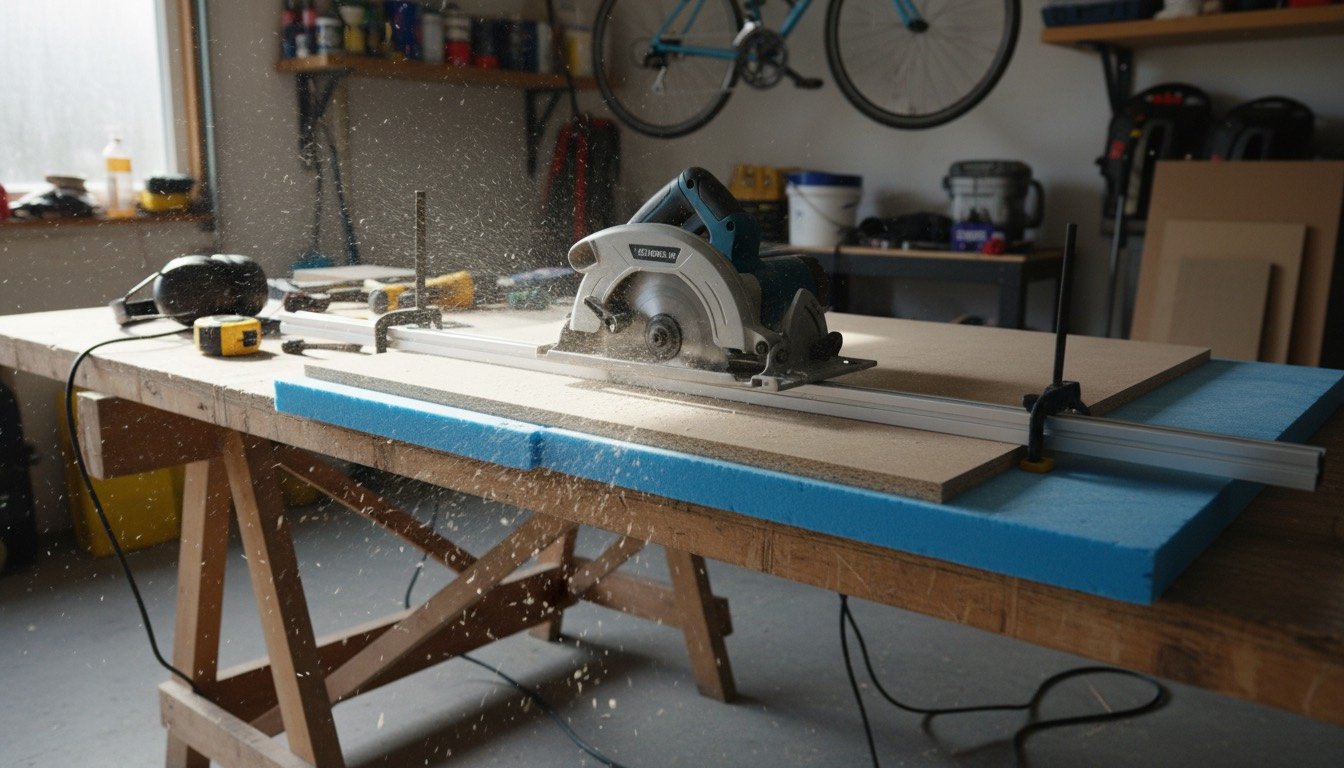
A circular saw is the cheapest way to buy a straight line. It will rip a 2440 x 1220mm sheet of 18mm MDF into shelf widths in under a minute. It is also the power tool most likely to hurt you, almost always for one reason: kickback from a cut that was never properly supported.
Everything here assumes UK kit: a 165mm cordless or 190mm corded saw with the riving knife fitted, sheet goods at 2440 x 1220mm, and a 230V lead that needs an RCD outdoors. If you are still choosing a machine, our circular saw buying guide covers what is worth the money.
Safety first: kickback is the only injury that matters
Kickback is the saw climbing back out of the cut towards you at speed. It happens when the blade binds – the offcut sags and pinches the kerf shut. Every rule below exists to stop that kerf closing; our power tool safety checklist covers the rest of the workshop.
- •Support the whole board both sides of the line. Two sheets of 50mm PIR on the floor let the blade cut 5mm into a sacrificial layer while nothing sags.
- •Never bridge the cut between two trestles with the offcut hanging free. That is the classic pinch.
- •Set the blade so one full tooth, about 5mm, clears the underside. Deeper means a more violent kickback.
- •Check the riving knife is fitted and the lower guard springs shut freely. Never tape or wedge the guard open.
- •Stand to the side of the blade line, not behind it, and keep both hands on the saw.
- •Defenders rated SNR 25dB or better – a saw runs at 100-105 dB(A) – EN166 goggles, and an FFP3 mask for MDF dust.
- •Use a 30mA RCD adaptor outdoors, and drop the battery before every blade change.
Tools, materials and what they cost
The guide matters more than the saw: a £60 saw against a clamped straight edge beats a £250 saw cut freehand. Our list of essential tools for UK homeowners sets out a sensible buying order.
- •Saw: entry corded 165mm from £45-£70; a solid corded 190mm around £110-£140; an 18V cordless bare unit £120-£200 before batteries.
- •Blades: 24-tooth for ripping timber (£15-£20), 48-60 tooth for ply, MDF and melamine (£20-£30). The blade in the box is a builder's blade – swap it.
- •Guide: a 1.4m aluminium rail is £60-£90, or build one for £12 from 9mm ply with a factory-straight edge, trimmed to your own blade.
- •Two 300mm quick clamps (£10-£16 the pair), PPE at about £30, and a 600mm speed square. Nothing gets cut freehand.
Realistic time and cost
- •Skill level: beginner, but not first-tool beginner. Spend an afternoon on scrap first.
- •Unboxing to first cut, including blade change and depth setting: 30-40 minutes.
- •Breaking a full 8×4 sheet into six shelves: 25-35 minutes; a joiner with a track saw does it in ten.
- •Starter outlay: about £120 at the cheap end, £280 with a rail and a decent cordless. A good 48-tooth blade does 40-60 sheets of ply.
The method, step by step
- •1. Fit the blade with the power disconnected, teeth pointing forwards and up at the front of the shoe – the blade cuts on the upstroke.
- •2. Mark with the good face down. The teeth exit through the top surface, so tear-out lands on the face you can see.
- •3. Set the depth. Rest the shoe on the board, unplugged, and drop the blade until roughly 5mm of tooth clears the underside. Lock it off.
- •4. Support and clamp, with no unsupported overhang at the cut. Clamp the guide at the offset from your line – measure shoe edge to blade once and write that figure on the saw; usually 90-105mm.
- •5. Rest the saw on the work before pulling the trigger, blade clear of the timber, shoe flat against the guide.
- •6. Let the motor reach full speed – 4,500-5,500 rpm – before the teeth touch, then feed at a steady walking pace. If the motor note drops, you are pushing too hard.
- •7. Avoid stopping mid-cut. If you must, back off 20mm, let the blade regain speed, then re-enter the kerf.
- •8. Release the trigger and keep the saw on the work until the blade stops.
- •9. Deburr with 120-grit and check for square before cutting the next piece to match.
The renter-safe version: sawing without losing your deposit
Nothing about a circular saw is inherently a tenancy problem – the trouble is where you cut and what you fix it to. Everything below is reversible, and it is the same discipline that keeps a shared space usable if you are carving a workshop out of a rented garage.
- •Cut outside: a balcony, a shared drive or a doorstep with a dust sheet down. MDF dust in a carpet pile is a deduction; a plunge through the floor is a bigger one.
- •Choose battery over corded – no lead trailing across a communal hallway, which most leases and fire risk assessments prohibit.
- •Work 9am to 6pm on weekdays and Saturday mornings; a 100dB saw earns a complaint long before the 11pm-7am statutory night hours.
- •Never cut anything fixed. Trimming an internal door or shortening a fitted worktop is an alteration needing written consent – cut new material to fit around the fixture.
- •Build freestanding: shelf boards for a bookcase you own, a bed base, a plinth to lift a wardrobe off a damp wall.
- •Fix with tension rods, adhesive strips rated to around 7kg, or freestanding uprights rather than plugs and screws.
- •Nowhere safe to cut? Use the in-store cutting service at B&Q or Wickes for a small charge per cut.
Troubleshooting: what the cut is telling you
- •Burn marks along the edge: blunt blade, too slow a feed, or resinous timber. If the teeth look grey, replace it.
- •The cut drifts off the line: you are steering by eye. Freehand wander is about 3mm per metre.
- •The saw bogs down and howls: too deep, too fast a feed, or the offcut is pinching. Check the support before blaming the motor.
- •Chipped, feathered edge on melamine: wrong blade, wrong face. Use a 60-tooth negative-rake blade, cut face down, score the line first.
- •Blade binds halfway and the saw jumps: the board sagged. That is the whole diagnosis.
- •Cordless saw dies mid-sheet: an 18V 5.0Ah pack gives roughly 40-60 crosscuts in 18mm ply.
When to stop and call a professional
A circular saw is a breaking-down tool, not a fine joinery tool. Cutting sheet material to fit, including underlay and vinyl plank flooring, is DIY. The following is not.
- •Anything structural. Notching or drilling joists, rafters and studs is governed by depth and position limits in the Building Regulations.
- •Any unidentified board in a property built before 2000. Asbestos insulating board looks like soft, fibrous plasterboard and turns up in ceilings, soffits and around old boilers – a power saw makes it a licensed problem.
- •Fibre cement board and concrete pavers, where dry-cutting releases respirable crystalline silica well past the workplace exposure limit.
- •Worktop sink cut-outs and mitred joints in 40mm laminate. Those need a jig and a router.
Found this useful?
There's plenty more — hundreds of guides and honestly-tested product reviews for every corner of your home.
Browse All GuidesKeep reading
Tools & Workshop · 6 min read
Power Tool Safety Checklist (Printable UK Workshop Guide)
The injuries that come out of home workshops are boringly repetitive, and nearly all of them trace back to one skipped check. Here is the routine that prevents them, plus an honest DIY-or-pro line.
Tools & Workshop · 6 min read
How to Use a Torque Wrench Properly: A UK Step-by-Step Guide
Most torque wrenches in British garages have been used twice and calibrated never. Here is how to set one, pull it correctly, and where UK law says to put it down.
Tools & Workshop · 6 min read
How to Organise a Workshop in an Older UK Home (Garage, Shed or Cellar)
A workshop is a set of surfaces and fixings, not a pile of tools. In an older UK house, soft lime mortar, lath ceilings and pre-1970s wiring decide the layout for you.
Keep your home in brilliant shape
Hundreds of honest guides and tested product reviews — written from real hands-on experience.