DIY & Maintenance · 11 min read · 1 July 2026 · Updated 3 October 2026
How to Get Rid of Damp & Mould in UK Homes (Causes, Cures & Myths)
Black mould on cold walls is a symptom, not the disease. Diagnose which of the three damps you actually have before spending a penny on treatments.
By the Nims Casa editorial team — written from professional cleaning experience and checked against our editorial standards.
Key facts
- •Three different problems share one name: condensation damp (by far the most common), penetrating damp (water getting in from outside) and rising damp (rare, ground-floor only).
- •Mould needs sustained humidity: aim for 40-60% relative humidity indoors, and 40-55% from November to March — see our ideal indoor humidity guide.
- •Peak season runs October to March, when warm, wet indoor air meets cold walls and windows.
- •Renting in England? Social landlords have had fixed legal deadlines for damp and mould since 27 October 2025 under Awaab's Law, with Phase 2 extending the rules to more hazards from 30 November 2026 (MHCLG guidance).
- •Wiping mould off a wall buys weeks; fixing the moisture source is the only cure.
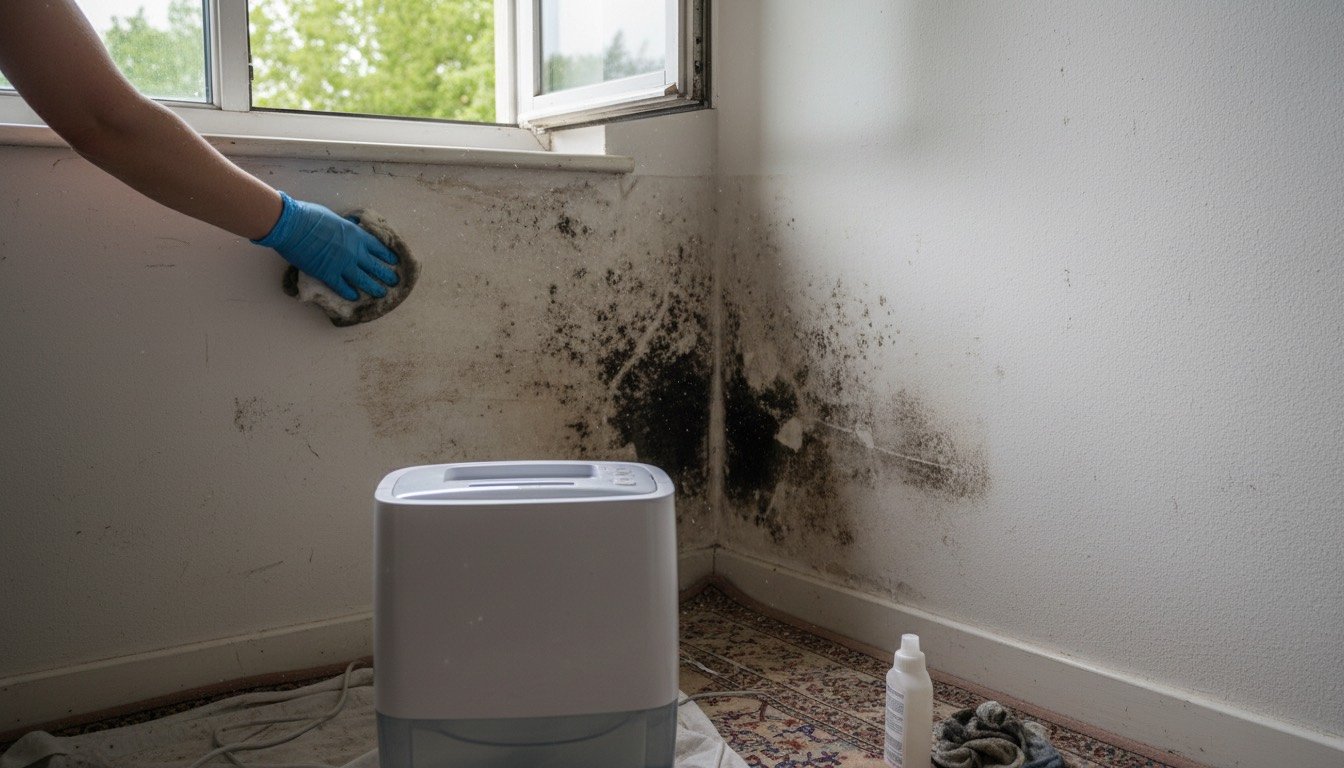
Every autumn, thousands of UK households scrub the same patch of black mould off the same bathroom ceiling or bedroom corner — and every autumn it's back within a few weeks. That's not bad luck: it's a sign the mould was only ever a symptom. Something in the house is putting moisture where it shouldn't be, and until that source is dealt with, wiping the surface is purely cosmetic.
Damp in British housing falls into three distinct categories, each with a different cause and fix, and confusing them is the main reason DIY treatments fail. Order a damp-proof course when the real culprit is a broken extractor fan, and you've spent a fortune solving nothing.
This guide covers how to identify which type of damp you actually have, the tools and safe method for killing existing mould, the habits that stop it returning, the mistakes that make it worse, and when it's worth paying a professional.
How to tell which type of damp you're dealing with
Correct diagnosis takes five minutes and saves weeks of wasted effort. Match what you see to one of three patterns.
- •Condensation damp — by far the most common cause in UK homes. Mould in cold corners, on external walls, around window frames and behind furniture; water beading on glass in the morning; worse in winter. Caused by everyday moisture from cooking, showering and drying clothes indoors meeting a cold surface — see also our guide to stopping condensation on windows.
- •Penetrating damp — a defined patch that darkens and spreads during or after rain, often upstairs, around chimneys, or below a window. The cause is outside: failed pointing, leaking guttering, cracked render, or perished seals letting weather in.
- •Rising damp — rarer than the damp-proofing industry suggests. Look for a tide mark up to roughly a metre on ground-floor walls, salty residue, and damp skirting. Needs a proper survey, but rule out condensation and bridged air bricks first.
Humidity, dew point and the point where mould starts
A £15 hygrometer turns damp from a guess into a number, and the number explains most mould patches on its own. Relative humidity is a ratio, not a quantity — the same air can read 55% in a warm living room and 90% behind a wardrobe on a cold outside wall — so take readings in the problem room, at the problem wall, first thing in the morning. The bands below are the ones we work to on jobs; the full reasoning is in our guide to the ideal indoor humidity level.
What actually decides whether a surface runs with water is dew point. Air at 20C and 50% humidity condenses on anything colder than about 9C; at 60% that rises to roughly 12C, and at 70% to about 14.4C. A single-glazed sash or an uninsulated window reveal can sit at 8-11C on a January morning, which is why the same room can be fine at 50% and streaming at 65%. Two levers move the result: lower the moisture (extractor fans, lids on pans, no indoor airers) or warm the cold surface (background heat, furniture off outside walls, insulation at the reveal).
| Reading | What it means | What to do |
|---|---|---|
| Below 30% | Rare in the UK; dry throats, static, timber shrinking | Nothing urgent — usually a very warm, over-ventilated house in freezing weather |
| 30-40% | Harmless short term in cold snaps | Leave it; do not buy a humidifier for a baby's room unless it reads below 35% |
| 40-55% | The target band — comfortable, kind to plaster and timber, hostile to dust mites | Maintain it with extractor fans and background heat |
| 55-65% | Dust-mite numbers climb; risky in older solid-wall homes, fine in a warm insulated one | Shorten the moisture load: vented drying, fans on for 15 minutes after showers |
| Above 65% | Condensation on cold surfaces, musty smells within days, visible mould within weeks | Treat the mould, then fix ventilation and heating — a dehumidifier holds the line meanwhile |
Tools and materials for treating damp and mould
A realistic 2026 shopping list, in order of priority:
- •Fungicidal mould remover spray — £5 to £9 a bottle; better than diluted bleach on porous surfaces.
- •Rubber gloves and an FFP2/FFP3 mask — £3 to £10, essential for anyone with a respiratory condition.
- •A stiff scrub brush for grout lines, from around £1.
- •Disposable cloths you're happy to bin afterwards, roughly £5 a pack.
- •A £15 to £20 hygrometer, so you're managing real humidity readings rather than guesswork.
- •A humidistat extractor fan, fitted, typically £150 to £220 including installation — the best single damp investment in the house.
- •A dehumidifier, usually £120 to £280 depending on capacity; our dehumidifier buying guide covers which size suits which room.
- •Mould-resistant paint for repainting treated areas, £20 to £35 a tin.
- •Sealant remover and fresh anti-mould silicone, about £10 to £15, for bathroom seals beyond saving.
Step-by-step: killing mould without spreading spores
Dry-brushing or vacuuming mould launches spores into the air you then breathe. Work wet, and follow this order:
- •Open a window and close the door to the rest of the house so spores don't travel.
- •Put on gloves and a mask before touching anything mouldy.
- •Never dry-brush mould off — dampen it first so spores stay put.
- •Spray a fungicidal mould remover, or diluted bleach on non-porous, colourfast surfaces only, and leave it to work for the time stated on the label.
- •Wipe from the least affected area towards the worst, then bin the cloth rather than rinsing and reusing it.
- •For mould rooted in bathroom silicone sealant, pack soaked kitchen roll along the line and leave for a few hours before wiping; badly blackened sealant is usually quicker to cut out and re-run. The same wet-first approach works for mould on bathroom grout.
- •Once fully dry, repaint with mould-resistant paint if the area was previously stained, so regrowth shows early.
- •Wash any fabrics that were in the room on a hot cycle — textiles hold spores and the musty smell long after the wall looks clean.
Stopping condensation and damp coming back
Killing existing mould buys weeks, not months, unless the moisture source is fixed. These are the actual cure.
- •Dry clothes outside or with a vented or heat-pump dryer — an indoor airer releases litres of water into the room's air; if you must use one, shut it in a single room with a dehumidifier running.
- •Run extractor fans for every shower and cook, and leave them going 15 minutes afterwards — and check they actually move air: our extractor fan and trickle vent check takes five minutes.
- •Keep low background heat on in cold rooms rather than blasting one warm room — mould thrives in the cold room next to the warm one.
- •Pull furniture at least 5cm off external walls so air can circulate behind it.
- •Hold indoor humidity under roughly 60%; a hygrometer tells you the real number, and a dehumidifier enforces it.
Common mistakes that make damp worse
- •Sealing draughts everywhere without adding ventilation — trapped moisture just condenses somewhere else.
- •Relying on vinegar alone for established black mould; it's noticeably weaker than a proper fungicidal treatment.
- •Painting straight over a damp patch without addressing the cause — the stain bleeds back through within weeks.
- •Letting mould-contaminated textiles go back into wardrobes without washing first — see our guide on mould on clothes and inside wardrobes.
- •Ignoring gutters and roofline maintenance, often the hidden trigger behind penetrating damp; routine gutter cleaning and maintenance is one of the cheapest damp preventions there is.
- •Staying silent in a rented property instead of reporting damp in writing, which leaves no paper trail if it's later disputed.
Renting in England: what your landlord must do, and by when
Damp in a rented home is no longer a matter of 'reasonable time'. Awaab's Law, named after two-year-old Awaab Ishak who died after prolonged exposure to mould, came into force for England's social rented homes on 27 October 2025 and gives social landlords fixed clocks once a tenant reports a problem (Ministry of Housing, Communities and Local Government, 27 October 2025). Phase 2 widens the regime from 30 November 2026 to cover excess cold and heat, falls, structural collapse, fire and electrical hazards and domestic hygiene hazards, according to the government's Phase 2 guidance for social landlords published on 13 July 2026 and updated on 31 July 2026.
The rules currently bind social landlords in England. The government has committed to extending Awaab's Law to private renters through the Renters' Rights Act, which completed its passage through Parliament on 22 October 2025, but at the time of writing no start date for private tenancies has been set — so if you rent privately, the practical advice is unchanged: report in writing, with dated photographs, and keep every reply. Scotland is bringing in its own investigation and repair timescales; our guide to landlord repair deadlines for damp and mould tracks both nations and sets out exactly what to put in the report.
| Stage | Deadline |
|---|---|
| Investigate a reported significant damp or mould hazard | Within 10 working days of being notified |
| Write to the tenant with the findings | Within 3 working days of the investigation ending |
| Make the property safe where a significant hazard is found | Within 5 working days |
| Emergency hazards (serious and imminent risk) | Action within 24 hours |
| Phase 2 (from 30 November 2026) | Same clocks extended to excess cold and heat, falls, structural, fire, electrical and hygiene hazards |
When it's worth calling in a professional
Some situations are past sensible DIY: mould covering more than roughly a square metre, mould that returns within weeks despite good ventilation habits, any damp in a rental (document it with photos and dates and notify the landlord in writing — persistent damp is legally their responsibility), or a household with anyone who has asthma or another respiratory condition. Renters should also know the fixed timescales landlords now face — our guide to landlord repair deadlines for damp and mould sets them out.
A proper damp survey typically starts from around £150 to £300, and full remediation costs vary by cause and scale; our guide to mould remediation costs sets out realistic UK price ranges to sanity-check any quote you're given.
Frequently asked questions
Is black mould dangerous to breathe in?
Brief exposure while cleaning a small patch isn't a major hazard for healthy adults provided you wear a mask and ventilate the room. It's a bigger concern for anyone with asthma or another respiratory condition, and for babies and young children — treat larger areas cautiously or bring in a professional.
Will bleach kill mould permanently?
Bleach can kill surface mould on non-porous materials like tiles and glass, but it doesn't reach roots growing into porous plaster, grout or silicone, which is why a dedicated fungicidal mould remover generally lasts longer. Once the wall is treated and fully dry, repainting with one of the best anti-mould paints helps stop regrowth in the paint film itself.
How do I know if it's condensation or rising damp?
Location is the giveaway: condensation clusters around cold spots, windows and corners and worsens in winter, while rising damp shows as a tide mark low on ground-floor walls with salty residue. When in doubt, rule out condensation first — it's by far the more common problem.
Can I claim on home insurance for damp and mould damage?
Standard buildings insurance usually excludes gradual issues like condensation or long-term rising damp, since insurers treat these as maintenance failures. Damage from a sudden escape of water, such as a burst pipe, is often covered instead — check your policy wording.
Is my landlord responsible for fixing damp in a rented home?
In most cases, yes — landlords have a legal duty to keep a rented property free from serious damp and mould hazards. Report the issue in writing with photos, keep copies, and escalate to your council's environmental health team if it isn't addressed within a reasonable time.
Does a dehumidifier actually stop mould coming back?
It helps enormously alongside ventilation, but it's a management tool rather than a cure — it lowers the humidity mould needs to establish, but won't fix a leaking gutter or a broken extractor fan causing the moisture in the first place. Background warmth is part of the same control — our guide to when to turn the heating on covers the point where holding out starts costing you in condensation.
What humidity level stops mould growing?
Keep rooms at 40-60% relative humidity, and nearer 40-55% between November and March when walls are coldest. Above about 65% condensation forms on cold surfaces and mould follows within weeks. A hygrometer costing £15 to £20 tells you where you stand; a dehumidifier or extractor fan brings the number down.
How long does a landlord have to fix damp and mould in 2026?
For social housing in England, Awaab's Law has required landlords since 27 October 2025 to investigate within 10 working days, report back in writing within 3 working days of finishing, and make the home safe within 5 working days, with emergency hazards dealt with inside 24 hours. From 30 November 2026 the same deadlines extend to more hazards. Private renters are not yet covered, although the government has committed to extending the law to them through the Renters' Rights Act.
Found this useful?
There's plenty more — hundreds of guides and honestly-tested product reviews for every corner of your home.
Browse All GuidesKeep reading
DIY & Maintenance · 10 min read
Is Your Extractor Fan Actually Working? Trickle Vent Checks 2026
A practical check of the extract fans and trickle vents most UK homes already have, including what a tissue test can and cannot tell you.
DIY & Maintenance · 6 min read
Damp and Mould in Autumn 2026: What UK Tenants Should Do
A warm, wet autumn is more likely in 2026, just as new damp and mould repair rules arrive. Here is what to check, record and report in the next few weeks.
DIY & Maintenance · 6 min read
The September Home Reset: A Practical UK Autumn Prep Checklist
A September home reset has two halves: the maintenance and prevention jobs first, then the seasonal touches. Here is the practical order to work through.
Keep your home in brilliant shape
Hundreds of honest guides and tested product reviews — written from real hands-on experience.