Cleaning Guides · 6 min read · 3 July 2026
Home Organisation Mistakes to Avoid (And Why Old UK Houses Punish Them Hardest)
A wardrobe pushed flat against a solid brick wall grows mould in one winter. Most organising advice assumes a new-build. Here is what actually goes wrong in older UK homes, ranked by what it costs you.
By the Nims Casa editorial team — written from professional cleaning experience and checked against our editorial standards.
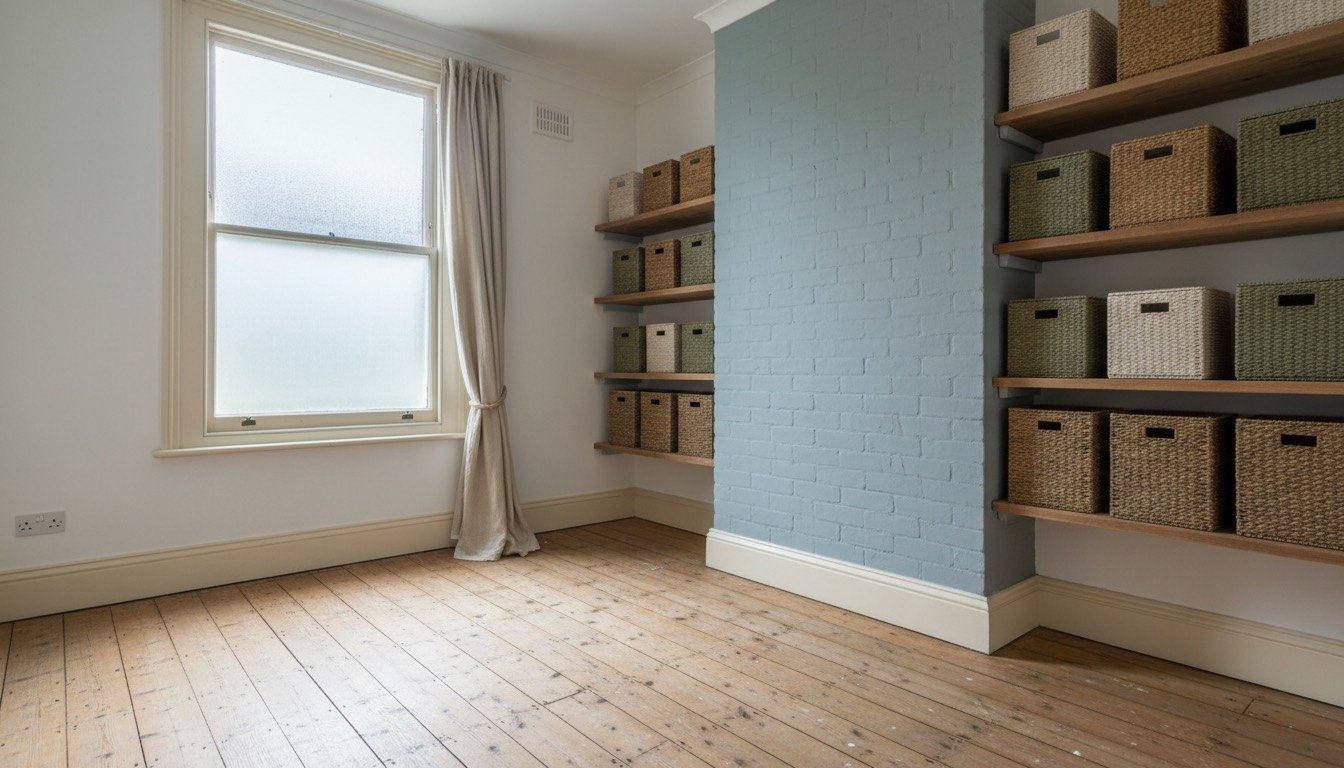
Push a melamine wardrobe flat against the back wall of a Victorian bedroom and you will find black mould on the backboard by February. Do the same in a 2015 new-build and nothing happens. That gap explains why so much storage advice fails here: it assumes cavity walls, plasterboard, trickle vents and a consumer unit from this century.
Around a fifth of English homes went up before 1919. There, storage decisions are building decisions, so we rank these by consequence rather than by how untidy something looks.
- •Level 1, dangerous: fire, electrical risk, or weight coming down through a ceiling.
- •Level 2, damaging: damp, mould, cracked lime plaster, blocked drains. Typically £300 to £3,000, and it takes three to six months to show itself.
- •Level 3, expensive: storage that doesn't fit or never gets used. £50 to £800 and bruised pride. With one free weekend, spend all of it on Level 1.
Level 1: The Mistakes That Are Genuinely Dangerous
Older stock has fewer sockets, lighter roof timbers and older protective devices than anything built after 1980. The loft is the worst offender: pre-war ceiling joists are often 100x50mm at irregular centres, sized to hold plaster up rather than boxes down, and boarding onto them crushes 270mm of insulation to 18mm. If you are already working through the usual problems in a century-old house, don't add roof loading casually.
- •Board a loft on loft legs or raised battens, keep weight near the perimeter over load-bearing walls, and get a structural opinion before storing anything heavy.
- •Never stack storage within 600mm of the consumer unit, gas meter or stopcock — especially with a rewireable fuse box and no RCD.
- •Stop daisy-chaining four-way extension leads behind new shelving. A 1930s bedroom often has one double socket; a second double costs £80 to £120 from a Part P registered electrician.
- •Don't hang heavy shelving from a lath and plaster ceiling, or into a chimney breast, without establishing whether the flue is still live.
- •Keep paint, white spirit and camping gas out of the understairs cupboard. In most terraces it opens onto the only escape route.
Level 2: The Storage Choices That Create Damp
A solid 225mm brick wall runs colder and wetter than a cavity wall. Seal a wardrobe against a north-facing one and the surface behind it drops below dew point on cold nights; mould shows eight to ten weeks after the heating goes on. Much of what we are called to inspect as damp and mould in period bedrooms is really a furniture placement problem.
- •Leave a 50mm air gap behind any tall unit on a solid external wall, and drill a few 25mm holes through a solid back panel.
- •Keep bedding and clothing out of the external corner farthest from the radiator; it typically runs 3 to 4°C colder than the room.
- •Nothing absorbent on a sash sill. Single glazing dumps condensation there nightly, and it takes the paint first, then the timber.
- •Cellars: no cardboard, no MDF, no fabric. Wire shelving 150mm off the floor and lidded crates only — a Victorian cellar is meant to breathe.
- •Never block an airbrick with a garden store, log pile or wheelie bin. Suspended timber floors rely on that cross-flow, and damp joists follow within a season.
Fixings: Lath, Lime Plaster and Sash Boxes Don't Behave Like Plasterboard
Plasterboard fixings hold nothing here. Lath is riven timber slats about 25mm wide with 6mm gaps, and lime plaster keys through those gaps into a fragile bond; load a shelf onto it and the key snaps, taking a dinner-plate-sized patch with it. Electronic detectors read continuous lath as continuous timber, so the older ways of finding a stud beat the gadget.
- •Tap for the dull note, then confirm with a 2mm test drill. Stud centres in pre-1919 houses run from 350mm to 600mm and vary along one wall.
- •On solid walls, go through to the brick: 7mm masonry bit, 60 to 75mm frame fixing, hammer action off for the first 20mm, and lime-compatible filler for any crumbling hole.
- •Never fix into the boxing beside a sash window — it is hollow and holds the counterweights and cords.
- •Floating shelves and lath do not mix. Use brackets fixed into studs or masonry, or an alcove unit that carries its load to the floor.
Blocked Access: Drains, Stopcocks and Airbricks
Victorian drainage is salt-glazed clay in short lengths with mortar joints, laid shallow and usually carrying root ingress by now. It needs rodding more often than modern plastic, always at the worst moment.
- •Photograph and mark the inspection chamber, rodding eye, stopcock and gas meter before you site a single unit.
- •Nothing fixed down over a manhole cover. A drainage engineer charges £90 to £150 an hour and won't dismantle your shed.
- •Keep the kitchen bin within one pace of the sink; every extra step is another pan of fat going into a hundred-year-old clay drain.
- •Keep gravel, decking and garden storage boxes at least 150mm below the damp-proof course, or you bridge it.
Level 3: The Mistakes That Only Cost Money
These are the ones people ask about, and they matter least — though wasted storage does tend to sit in the hall for a year before it reaches the tip.
- •Buying storage before decluttering. Settle the volume first, working room by room, then measure, then buy.
- •Assuming standard depths. Alcoves beside a chimney breast are usually 250 to 350mm deep and rarely square; measure at cornice, middle and skirting and expect 10 to 20mm of variation.
- •Chasing vertical space in a 2.9m room. Above 2.1m you need a stool, so it becomes archive storage — which is how the better small-space storage ideas treat it.
- •Under-bed boxes on castors over original floorboards. Boards cup and gap, wheels jam; flat-bottomed lidded crates slide better.
Where DIY Organisation Has To Stop
There is a clear line in an older property, and it is cheaper to know it before you pick up the drill than afterwards.
- •Textured coatings applied before 2000 may contain chrysotile asbestos. Don't drill, sand or scrape. A sample test is £40 to £60; removal is licensed work.
- •Paint on pre-1970 skirtings, doors and built-in cupboards may be lead-based — never dry-sand it to make way for shelving.
- •A rewireable fuse box, black rubber or lead-sheathed cable, or sockets warm to the touch: book an EICR, roughly £150 to £300 for a three-bedroom house, before adding load.
- •New cracks after loading a shelf or boarding a loft mean a structural engineer at £350 to £600 for a visit and short report, not more filler.
- •Anything that notches a joist, removes part of a chimney breast, or changes how weight travels down through the house.
What To Do This Weekend
Start with a torch and half an hour: loft hatch, consumer unit, understairs cupboard, every airbrick. Then pull each tall unit 50mm off its external wall and check the backboard — if it is spotted, you have found your real project.
After that, our organisation and storage guides cover wardrobes, cupboards, lofts and garages in an order that suits an older house.
Found this useful?
There's plenty more — hundreds of guides and honestly-tested product reviews for every corner of your home.
Browse All Guides