Product Reviews · 6 min read · 7 April 2026
The Best Dishwasher for Hard Water (2026): UK Picks for Limescale Country
If your kettle furs up in a fortnight, your dishwasher drinks the same water. Which machines survive UK hard water, how to set the softener, and how to fit one into a house built before dishwashers existed.
By the Nims Casa editorial team — written from professional cleaning experience and checked against our editorial standards.
Affiliate disclosure: if you buy through links in this article we may earn a small commission at no extra cost to you. Our recommendations come from professional cleaning experience and are never influenced by retailers or brands.
Two-thirds of England sits on chalk or limestone. If your kettle furs up in a fortnight, your dishwasher drinks the same water: 250 to 350 mg of calcium carbonate per litre, times nine litres per eco cycle. That is roughly three grams of dissolved scale every wash, looking for somewhere to settle.
Scale rarely kills a machine outright. It narrows the spray-arm jets, furs the heater so cycles run long, and clouds glassware permanently long before anyone notices. Every dishwasher sold here has a built-in ion-exchange softener to stop that, so the real questions are how precisely you can set it, how it dries, and whether it fits a kitchen built before dishwashers existed. If your glasses have already gone grey, start with why a dishwasher stops cleaning properly.
Our top picks at a glance
Bosch Serie 6 SMV6ZCX01G Fully Integrated Dishwasher
~£650-750A seven-step softener with a genuinely high ceiling, zeolite drying that finishes glasses without water spots, and around 9.5 litres per eco cycle. It also has the deepest spares and independent engineer coverage in the UK, which matters far more at year seven than anything printed on the box.
Pros
- ✓ Fine-grained softener settings that cope with 350 mg/l water
- ✓ Zeolite drying leaves glassware spot-free without a heated dry
- ✓ Stainless tub, easily rinsed triple filter, parts available everywhere
Cons
- ✗ Salt cap sits under the bottom basket, so refilling means unloading
- ✗ Eco cycle runs close to four hours
Miele G 5000 Series Fully Integrated Dishwasher (G 5210 SC)
~£850-1000Miele rates its dishwashers for twenty years of domestic use, and in hard-water areas that is exactly where the extra money goes. AutoOpen drying cracks the door at the end of the cycle, which is the single most effective anti-spotting feature you can buy.
Pros
- ✓ Built to a different standard; heaters and pumps rarely fail early
- ✓ AutoOpen drying is unbeaten on glassware in hard water
- ✓ Large salt reservoir and a clear, well-labelled hardness-setting menu
Cons
- ✗ Costs roughly double a competent mid-range machine
- ✗ Out-of-warranty parts and labour are priced accordingly
AEG 6000 Series FSE63607P Integrated Dishwasher
~£420-500AirDry opens the door automatically at the end of the programme, so it dries like a machine costing far more and avoids the cloudy film that plagues cheap condensation dryers in hard water. The softener range is adequate rather than generous, but it covers everything short of the very hardest supplies.
Pros
- ✓ AirDry door opening solves hard-water spotting at this price
- ✓ Around 9.9 litres per eco cycle and a quiet 44 dB
- ✓ Sensible internal layout with an adjustable middle basket
Cons
- ✗ Fewer softener steps than the Bosch, and a lower stated ceiling
- ✗ The door opening at the end is a nuisance in a narrow galley kitchen
Beko DIS15R10 Slimline 45cm Integrated Dishwasher
~£280-340A 45 cm machine for terraced and cottage kitchens where a 600 mm run simply does not exist. It has a working ion-exchange softener and salt reservoir, which is the thing to verify on any budget slimline, and ten place settings suits two or three people.
Pros
- ✓ Fits where full-size machines cannot, at half the price
- ✓ Proper softener and salt reservoir despite the budget
- ✓ Cheap and quick to repair, with widely stocked parts
Cons
- ✗ Condensation drying only, so glasses need a rinse-aid boost
- ✗ Expected life is closer to seven years than fifteen
Who this guide is for
Anyone on water above about 200 mg/l calcium carbonate, and especially above 300 mg/l: most of the South East, East Anglia, Lincolnshire, the Cotswolds, Hampshire and much of the Midlands. Manchester, Newcastle, Cardiff and Glasgow are soft enough that this guide is largely academic there.
Get your own figure before you shop: every water company publishes a free postcode hardness lookup. Roughly 17.8 mg/l equals 1 °dH, and °dH is what softener settings are calibrated in.
- •Soft, under 100 mg/l: softener level 0 to 1, salt rarely needed.
- •Moderately hard, 100 to 200 mg/l: level 2 to 3, salt twice a year.
- •Hard, 200 to 300 mg/l (11 to 17 °dH): level 4 to 5, salt every six to eight weeks.
- •Very hard, over 300 mg/l (over 17 °dH): level 6 to 7, salt monthly and rinse aid turned up.
How we judge these machines
This is an editorial shortlist built on trade experience and published specifications, not a laboratory. It draws on which machines keep arriving at repair benches with scaled heaters and blocked jets, and on what manufacturers state for softener range and salt capacity. We run no controlled wash tests, and say so. Longevity carries most weight: one machine lasting twelve years beats two that manage six, the arithmetic behind our guide to how long appliances last.
- •Softener range: how many steps, and whether the ceiling clears 50 °dH.
- •Salt reservoir capacity, and whether the cap is reachable with the bottom basket loaded.
- •Drying method. Plain condensation drying spots badly in hard water; heat-exchanger, zeolite and auto-open systems do not.
- •Filter design, spares availability, and the likely cost of a heater or pump at year six.
How the four picks differ
Full detail sits in the panels below; the short version:
- •Bosch Serie 6: the all-rounder, seven-step softener, widest repair network in the country.
- •Miele G 5000 series: buy once, rated for twenty years of use.
- •AEG 6000 Series: the value full-size, with AirDry door-opening to beat spotting.
- •Beko slimline: 45 cm, for the Victorian galley kitchen where 600 mm was never happening.
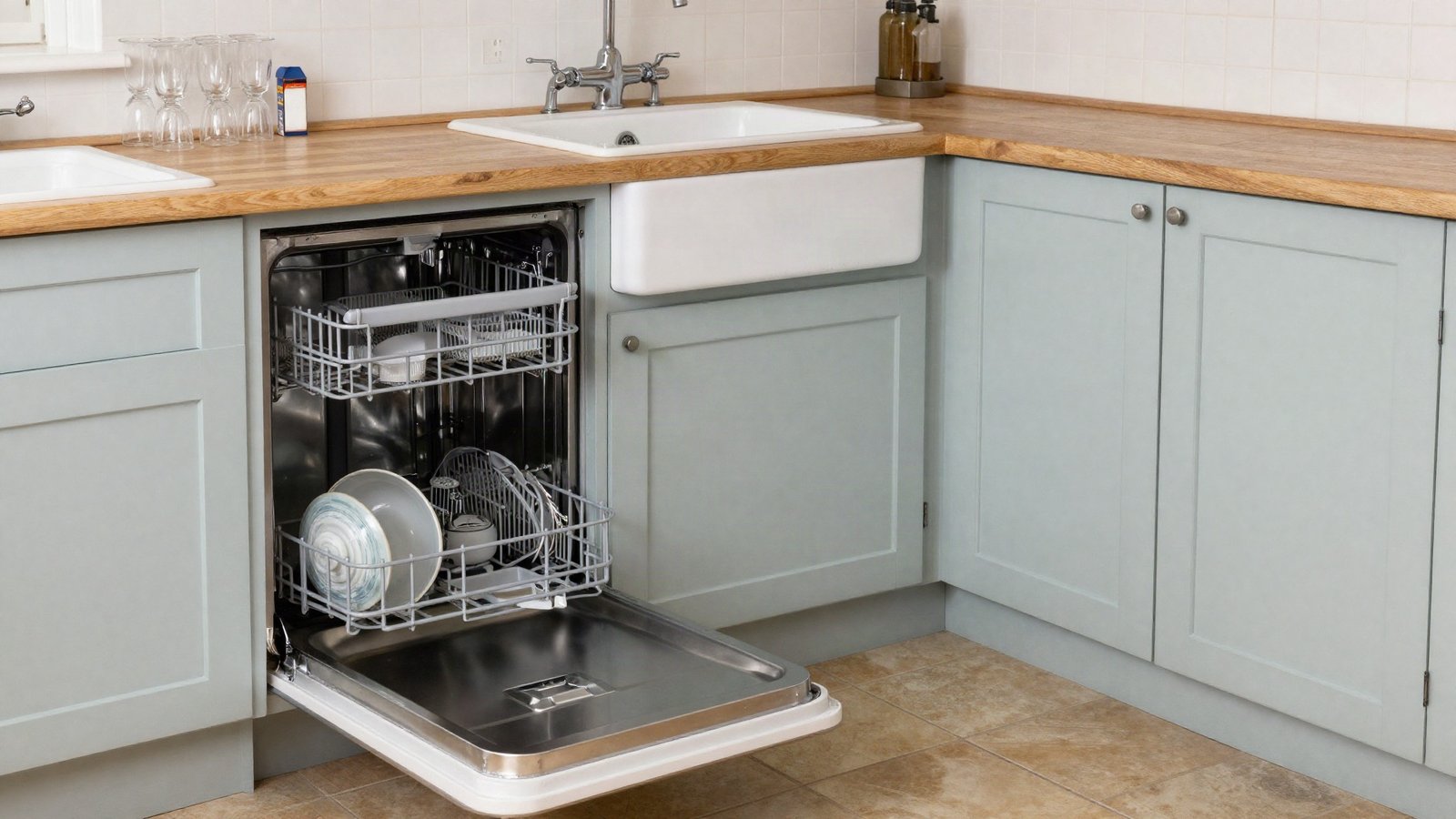
Fitting a dishwasher in a period property
The spec sheet is the easy part. In a solid-wall Victorian or Edwardian house, three things decide whether this is a morning's work or a fortnight of grief: the waste, the electrics behind the plaster, and the floor.
Older terraces often drain the kitchen sink into an open hopper head on the back wall, or a salt-glazed clay gully settling since 1898. Hot, greasy detergent water into an open hopper stains brickwork, smells by July, and falls foul of Approved Document H, which wants waste discharging below the grating of a trapped gully. Use a spigot on the sink trap, or a standpipe and washing-machine trap in the cupboard. If the clay run beneath is rooted or dished, hot discharge finds that fault within months; our guide to what a plumber costs by job prices a camera survey.
Then the electrics. A full-size machine is a 2.0 to 2.2 kW load and needs isolating without dragging it out: a switched fused connection unit above the worktop feeding a socket in the next cupboard. With pre-1970s rubber-insulated cable, unfused spurs and no RCD, that is not a job to improvise. Kitchen work is still notifiable in Wales, and any pre-1970s installation deserves an EICR first.
- •Measure the aperture at three heights: solid walls bow, and lime plaster on lath can eat 15 mm down one side.
- •Older cabinet runs are often 550 mm deep, not 600 mm, so a standard machine stands proud unless the plinth is reset.
- •Full-size machines adjust between roughly 815 and 875 mm; below an 800 mm worktop you need a slimline.
- •Sprung timber floors flex. Level the feet with the door both open and closed, or the seal will trickle.
- •Never chase a supply pipe into lime-plastered solid wall; you lose the key a metre either side. Run it in the cupboard, and replace any remaining lead rising main in copper.
What to look for in a hard-water area
Ignore noise figures below about 44 dB; the difference is inaudible in a room with a solid floor. Read the energy label, but in proportion: the gap between a C and an A is roughly 25 kWh a year, around £6, and never a reason to buy a worse-built machine. We work through that trade-off in our roundup of energy-efficient appliances.
- •A softener with at least six steps and a stated ceiling above 50 °dH.
- •Heat-exchanger, zeolite or auto-open drying rather than plain condensation drying.
- •A glass-care programme capping the wash at 40 to 45 °C; hot, over-softened water etches fastest.
- •A stainless steel tub; plastic tubs hold a scale film and never look clean again.
Common buying and setup mistakes
Most hard-water dishwasher complaints are not faults. They are setup errors nobody mentioned at the point of sale.
- •Never setting the softener. The default is level 2, calibrated for about 150 mg/l. At 340 mg/l the machine scales from the first wash.
- •Trusting all-in-one tablets to soften. The agent in a tablet is specified to around 21 °dH and struggles above 14. Keep coarse dishwasher salt loaded: 2 kg costs about £2 and lasts six weeks.
- •Using table or granulated salt: the anti-caking agents clog the resin bed permanently.
- •Over-setting the softener to be safe. Water that is too soft leaches minerals out of the glass itself, and etching is irreversible.
- •Assuming a whole-house softener makes the built-in one redundant. It largely does, but budget £900 to £1,600 fitted plus £40 to £80 a year in block salt — and under-sink space is what a Victorian kitchen lacks.
First week, and every month after
Set the hardness level before the first wash. Fill the salt reservoir with water and then salt, expect it to overflow, wipe the spill and run an empty hot cycle. After that: rinse the filter weekly, wipe the door seal, and run 200 ml of citric acid on the hottest programme every two months — the same principle as removing limescale from bathrooms and kettles.
When something does fail, scale is usually behind it: heater, pump or diverter, typically £120 to £220 fitted. That figure decides whether a six-year-old budget machine is worth saving, and why a ten-year-old Miele is — see our appliance repair cost guide.
Found this useful?
There's plenty more — hundreds of guides and honestly-tested product reviews for every corner of your home.
Browse All Guides