Kitchens & Bathrooms · 6 min read · 6 July 2026
Dishwasher Not Cleaning Properly? Fix It in 30 Minutes
Ninety per cent of 'broken' dishwashers are a blocked filter, clogged spray arms or empty salt reservoir. The half-hour service that fixes cloudy glasses.
By the Nims Casa editorial team — written from professional cleaning experience and checked against our editorial standards.
If your dishwasher is leaving gritty residue, cloudy glasses or a faint sour smell, the reflex is to blame the machine — book an engineer, start pricing a replacement. Don't, yet. Most 'broken' dishwashers are actually clean machines washing in dirty water, because a dishwasher recycles the same few litres through a whole cycle rather than using fresh water throughout, so a blocked filter or a scaled-up element quietly turns every wash into a power-wash with soup.
A genuine fault is rare. A 30-minute service — filter, spray arms, descale, salt and rinse aid — fixes most call-outs before they need booking. This guide covers what to check and in what order, the products worth keeping in, the loading habits that undo good maintenance, and the symptoms that mean a real fault.
It matters more here than owners realise: a large share of UK homes sit in a hard or very hard water area, needing a routine soft-water households can mostly skip. Get it right and a dishwasher can run for a decade without an engineer visit for a cleaning-related fault.
Tools and products you'll need (and what they cost)
Very little kit is required, and most of it earns its keep on other appliances too — the same descaler works in a limescale-prone kettle.
- •Dishwasher descaler or citric acid sachets — £3–£6 for citric acid, £4–£8 for a branded descaler; both dissolve the same limescale.
- •Dishwasher salt — around £3–£5 for a 1.5kg box, lasting several weeks in a hard water area.
- •Rinse aid — £3–£7 a bottle; concentrated formulas need topping up less often.
- •A stiff brush plus cocktail sticks or a spare toothbrush for the spray-arm jets — under £2 combined.
- •Interdental brushes for the filter mesh and door seal grooves — £2–£4 a pack, better in tight corners than a toothbrush.
- •Optional: a dishwasher cleaner tablet for a whole-machine clean alongside the descale — £5–£10 for three, worth it if the machine smells musty rather than just washes poorly.
The 30-minute four-part service
Do these jobs in order, on an empty machine, and most 'broken' dishwashers wash like new by the time you're done.
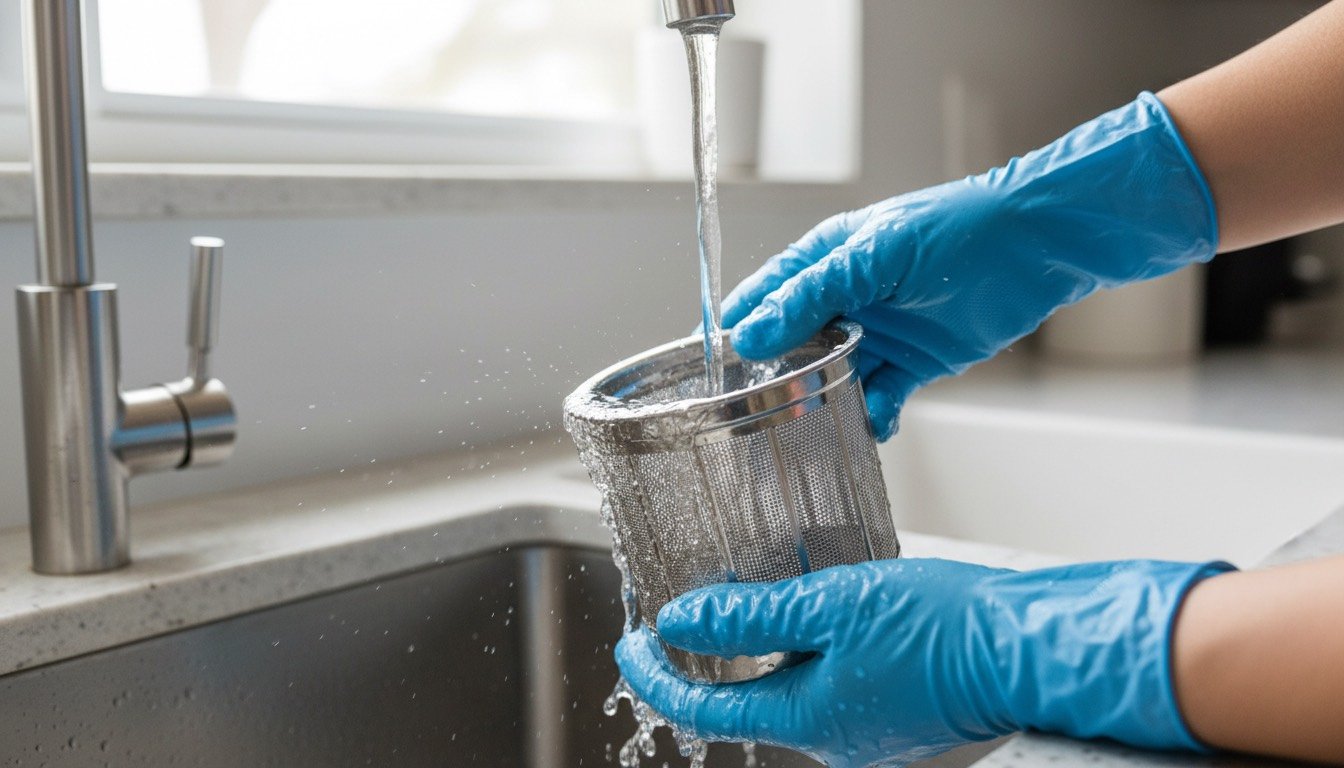
- •Filter (10 minutes): twist the cylinder filter anti-clockwise and lift it out with the mesh tray beneath. Rinse both under a hot tap until the water runs clear, not cloudy — brace yourself first time. Repeat monthly; it then takes under two minutes.
- •Spray arms (10 minutes): unclip the upper and lower arms and hold each to a light. Poke blocked jets clear with a cocktail stick and rinse through. Blocked top-arm jets are the most common reason the top rack washes worse than the bottom.
- •Descale (5 minutes active): with the machine empty, run the hottest cycle with a dishwasher descaler or citric acid sachets in the base. Limescale builds silently on the element and jets in hard water areas, and can roughly halve wash performance before it's visible.
- •Salt and rinse aid (5 minutes): fill the salt reservoir even with all-in-one tablets — in hard water, built-in salt isn't enough alone. Set the water hardness dial per the manual and top up rinse aid; this alone usually cures white film and greasy-feeling plastic.
- •Door seal and cutlery basket (5 minutes): wipe the door seal with a damp brush to clear gunge along its lower edge, and rinse trapped food from the cutlery basket — overlooked sources of the musty smell owners blame on the drain.
Hard water and limescale: the UK-specific culprit
Limescale is why dishwasher complaints cluster around the Midlands, East Anglia and the South East, where mains water runs hard to very hard. Every wash leaves a mineral deposit on the element, seal and jets, and the decline is gradual enough that owners rarely connect cloudy glasses in March with a filter that was fine in January.
If monthly descaling still leaves a chalky film, check whether the machine suits your water hardness — see our dishwasher picks for hard water areas for models with stronger built-in softeners. The same limescale removal method that clears a kettle also works on the door seal and detergent drawer.
Loading habits that quietly sabotage the wash
Don't pre-rinse plates — modern detergents need food soil to work on, and enzymes with nothing to digest instead attack glassware, causing the cloudy etching often mistaken for hard-water film. Do scrape off solids, and face the dirtiest side of each item toward the spray.
Avoid nesting bowls, and keep tall items clear of the spray arms' path — spin each arm by hand as a check after loading. On a cold-fill line, run the kitchen tap warm before starting the machine, so the first fill arrives hot rather than the wash beginning cold, the same sequencing logic behind deep-cleaning a kitchen properly.
Common mistakes that make dishwasher problems worse
- •Using washing-up liquid instead of dishwasher detergent — it foams uncontrollably and can force suds out under the door.
- •Overloading the cutlery basket so items nest together — they shield each other from the spray and come out filmy, exactly like a dirty filter would cause.
- •Ignoring a 'salt low' or 'rinse aid low' light for months — it's the machine telling you exactly why glasses are cloudy.
- •Running only short or eco cycles on a machine overdue a service — lower heat and less water are far less forgiving of a partly blocked filter.
- •Mixing bleach-based products with the machine's detergent — never combine them, as the reaction produces chlorine gas.
When it's not maintenance: signs you need an engineer
A handful of symptoms point to a real fault rather than a build-up, and are worth knowing before you lose a morning to a service that won't fix them.
- •Standing water in the base after a cycle ends, not just a damp floor — that's a drainage fault; our 10-minute dishwasher draining fix covers the blocked hose and valve issues behind it.
- •The machine won't fill, start or complete a cycle at all — an electrical or door-latch fault, not a cleaning issue.
- •An error code on the panel — check it against the manual first, since many point straight to the part at fault.
- •A smell that persists after the filter, seal and cleaner cycle are done — the drain may be blocked further down; if a nearby sink is also slow, clearing the P-trap is worth doing too, since older kitchens often share a stack.
- •Where it is a genuine fault, get a couple of quotes before booking — a repair call-out typically runs £60–£90 for the visit plus parts, similar in scale to what professional drain clearance costs if the problem sits downstream of the machine rather than inside it.
Frequently asked questions
**How often should I run the four-part service?** Rinse the filter monthly, check the spray arms every couple of months, and descale every six to eight weeks in a hard water area — softer-water households can stretch this to every three months.
**Why are my glasses cloudy even after descaling?** That's usually etching, not limescale — permanent scratches from years of pre-rinsing or an empty rinse aid reservoir. No cleaning reverses it; a lower wash temperature stops it worsening.
**Can I use washing soda instead of dishwasher salt?** No — it isn't formulated to regenerate the ion-exchange resin in the built-in softener, and some formulations can damage the reservoir seal.
**Is a whole-house water softener worth it instead of descaling appliances individually?** A plumbed-in softener costs more upfront but pays back across several appliances; for one dishwasher alone, monthly descaling is cheaper.
**Do dishwasher tablets already contain enough salt and rinse aid?** In soft to moderately hard water, often yes; in hard or very hard areas, no — the salt reservoir still needs topping up separately.
**Why does my dishwasher smell even though the dishes come out clean?** Food debris is usually trapped somewhere the wash doesn't reach, often under the lower spray arm mount or the base sump — lift the filter fully out and check underneath it, not just inside it.
Found this useful?
There's plenty more — hundreds of guides and honestly-tested product reviews for every corner of your home.
Browse All Guides