Tools & Workshop · 6 min read · 25 July 2026
Power Tool Safety Checklist (Printable UK Workshop Guide)
The injuries that come out of home workshops are boringly repetitive, and nearly all of them trace back to one skipped check. Here is the routine that prevents them, plus an honest DIY-or-pro line.
By the Nims Casa editorial team — written from professional cleaning experience and checked against our editorial standards.
A hand slipping onto a blade still coasting because the saw got put down two seconds early. A cutting disc exploding because it was fitted to a grinder that spins faster than the disc is rated for. A tingle up the forearm from a hedge trimmer plugged into a 1970s socket circuit with no RCD behind it. None of those needed bad luck. They needed one omitted check.
What follows is the routine we run ourselves, grouped by how often each item needs doing, with timings and UK prices — plus the bit most safety pages dodge: which jobs a competent DIYer can take on, and which are legally or practically somebody else's.
Where DIY stops and a professional starts
Most tool-safety writing treats every job as equally risky, which trains people to ignore all of it. Sort work into three buckets instead; the Tools & Workshop hub covers the buying side.
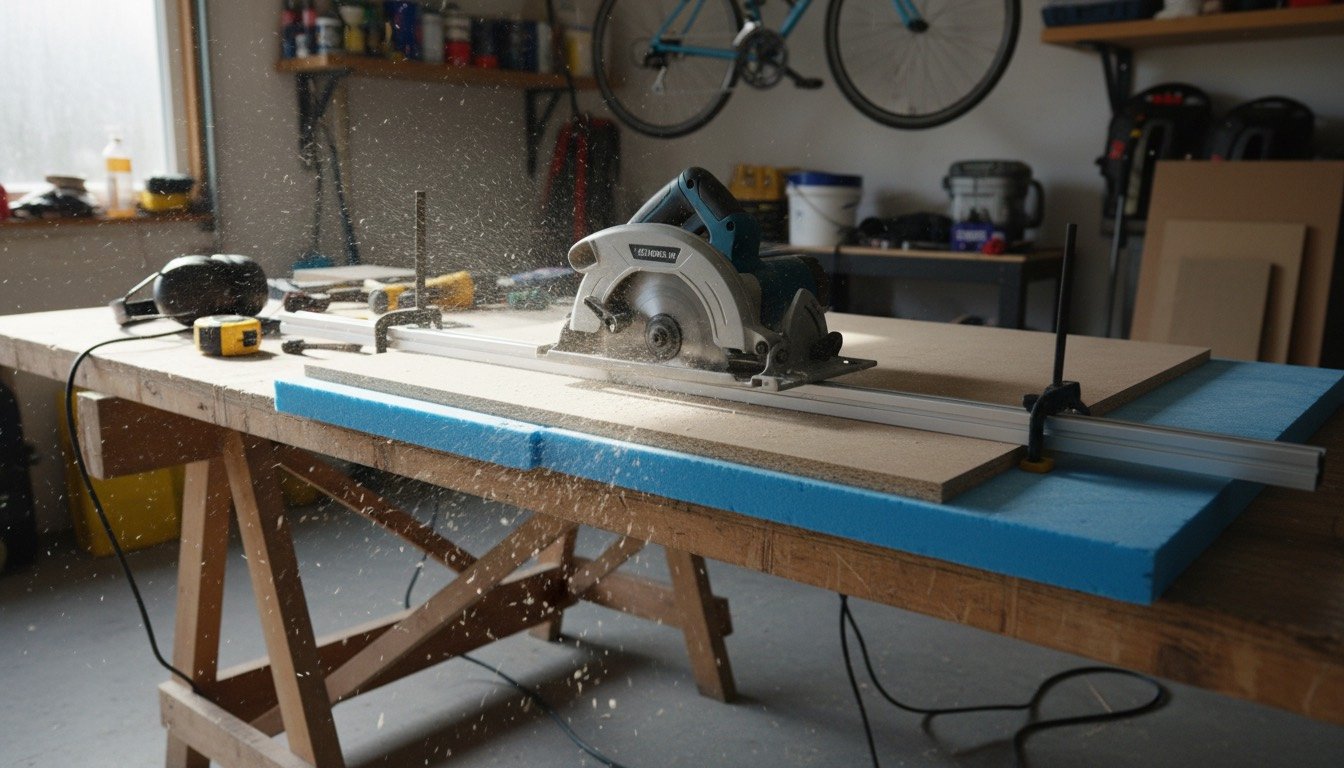
- •Green, no qualification needed: drill/driver work, jigsaw cuts, orbital sanding, mitre saw crosscuts, clamped router work and circular saw cuts on supported stock. Technique is the limit, not law — if you have never run one freehand, read how to use a circular saw first.
- •Amber, only with correct guarding, PPE and a rehearsal cut: angle grinding, SDS chasing and breaking, table saw ripping with riving knife, crown guard and push stick, and cutting paving, blocks or fibre cement — which throws respirable silica and needs water suppression or an M-class extractor plus FFP3.
- •Red, call someone: anything gas, which only a Gas Safe registered engineer may touch. Part P notifiable work in England and Wales — a new circuit, a consumer unit change, anything in a room with a bath or shower — needs a registered electrician or a building control notice, and Scotland needs a building warrant. Suspected asbestos in Artex, garage roof sheets or old flues: sample it through a UKAS lab at £30 to £60, never sand it. Roof work above single-storey height. And pre-1992 paintwork, where lead paint safety in old houses covers the alternative.
- •The test for amber: if you cannot say what the tool does when it kicks back, and where your hands will be, you are not ready for it.
Before every use: the two-minute pre-flight
Two minutes, no cost, and it catches most near misses. Run it every session.
- •Check flex, plug and tool body for damage. Bin any 240V lead with tape on it; a replacement moulded lead is £8 to £15.
- •Fully unwind extension reels. A 50m 1.25mm² drum rated 13A unwound can be as little as 3.1A coiled, and coiled drums are a classic garage fire.
- •Confirm RCD protection. Consumer units older than 2008 often cover sockets only, or nothing. A plug-in RCD adaptor is £12 to £20 from Screwfix or Toolstation.
- •Guards on, blade or disc correct: maximum rated rpm at or above the tool's no-load speed, arbor size matched. Never wire back a grinder guard.
- •Blade sharp and right for the material — a blunt 24-tooth blade forced through ply is what causes kickback.
- •Workpiece clamped, offcut free to fall, no hand within 150mm of the blade.
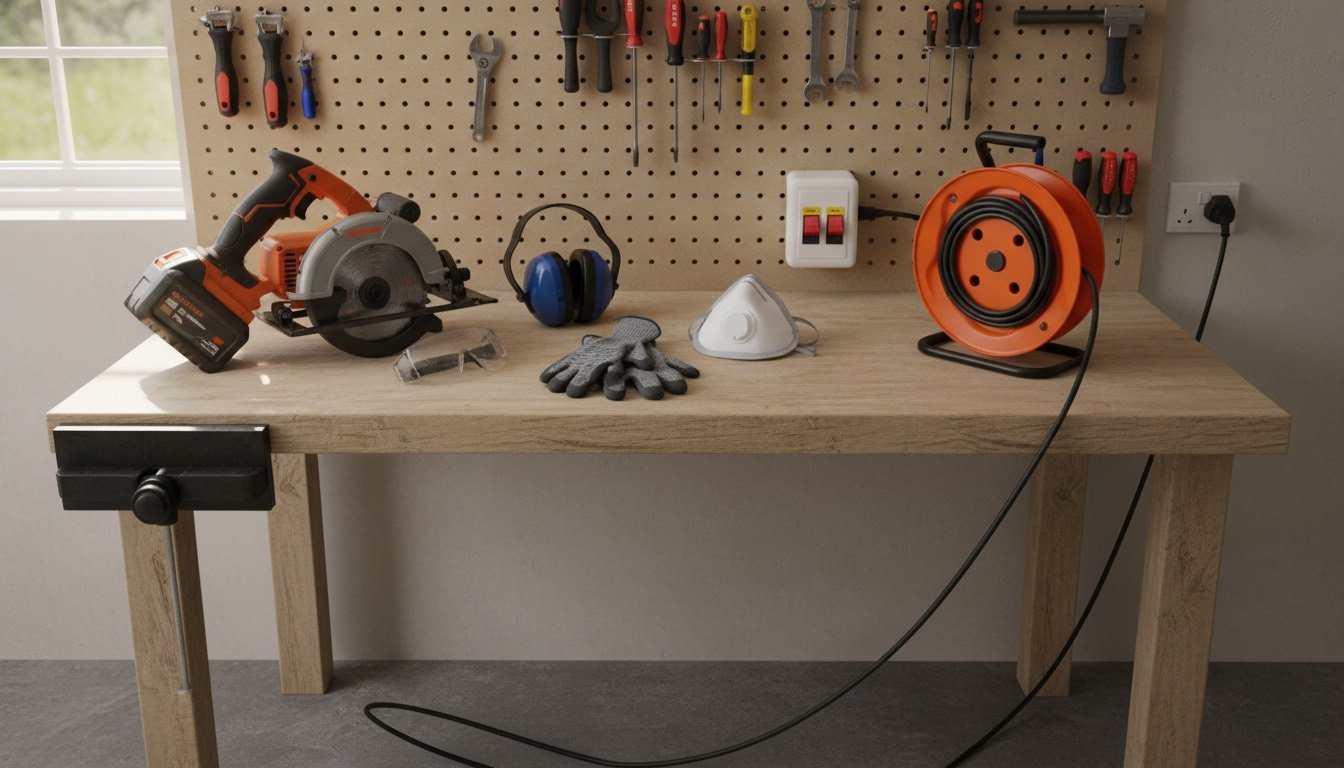
- •PPE on before the trigger: eye protection to BS EN 166, defenders above 85dB(A) — a circular saw runs 100 to 105dB(A) — and a mask matched to the dust.
- •Inspect battery packs. Swollen, dented or water-damaged lithium cells go into a metal box outside, not back on the charger. Keep a fire blanket (£10 to £15) within reach.
Weekly and monthly: the workshop reset
This is where a workshop quietly stops being safe: dust builds on a heater, leads snake across the floor, the extractor stops pulling. Ten minutes a week holds it — and a sensible layout does half the work, as how to organise a workshop sets out.
- •Weekly, 10 minutes, free: vacuum dust off benches, heaters and light fittings; hang leads off the floor; clear the bench back to a clamping surface; empty the extractor before it is two-thirds full, as suction falls off a cliff past that point.
- •Monthly, 15 minutes, free: check every guard springs back, every trigger brake stops a blade inside about two seconds, every lock-off still engages.
- •Monthly, 10 minutes: blow out motor vents, clean resin off blades, and check saw fences are square — a drifting fence is a pinch waiting to happen.
- •Monthly, 5 minutes: top stored lithium packs to half charge on a slab or steel shelf, then press the plug-in RCD's T button — it should trip instantly.
Every six to twelve months
The items nobody remembers and insurers ask about. Budget an hour and £40 to £80 a year in consumables.
- •Six-monthly: test the consumer unit RCD or RCBOs. If nothing trips, book an electrician; an EICR on a three-bed runs £150 to £250.
- •Six-monthly: inspect ladders and steps against BS EN 131 basics — straight stiles, intact feet, working locks. Damaged ones get destroyed, not stored.
- •Annually: change half-mask P3 filters (£12 to £20 a pair), which degrade whether used or not, and scrap grinder discs over three years old or any dropped or damp.
- •Annually: PAT test 240V tools you lend out or use for paid work, £1 to £3 per item locally.
Supplies and PPE: what to own and what it costs
A domestic workshop can be kitted out properly for under £200. Gloves are the item most often got wrong: never wear them near a rotating bit or blade, and keep the cut-resistant pair for sheet material and blade changes, as our work gloves guide explains.
- •BS EN 166 safety specs, £5 to £12; grade B face visor for grinding, £15 to £25.
- •Ear defenders at SNR 27 to 30, £12 to £25; electronic ones that pass speech, £40 to £70.
- •FFP3 disposables, £20 to £25 for ten; reusable half-mask with P3 filters, £35 to £55.
- •EN 388 cut-level-5 gloves, £8 to £15; workshop first aid kit with eye wash pod, £15 to £25.
- •Plug-in RCD adaptor, £12 to £20; socket tester with RCD trip function, £15 to £30.
- •Cable and pipe multi-detector, £30 to £60 — non-negotiable before drilling a wall you did not build.
- •M-class dust extractor, £150 to £400. A standard vac is not adequate for silica or plasterboard dust.
What to prioritise when you have only ten minutes
Some days the job is one hole in one wall and the full routine will not happen. These five prevent the injuries that put people in A&E, and none takes a minute. One caveat on rushing: a breaker rated at 12m/s² hits the daily vibration exposure action value in about 20 minutes of trigger time, so spread breaking-out across days. Numb fingertips next morning are a warning, not part of the job.
- •Scan the wall with the detector before drilling. Cables are meant to run in safe zones; in UK housing stock they frequently do not.
- •Confirm RCD protection is somewhere in the chain.
- •Guard on, disc or blade rated above the tool's speed, arbor correct.
- •Eyes and lungs covered. Most things can be improvised; a cornea cannot.
- •Clamp the work. If it can move it will, and your hand is what stops it.
Found this useful?
There's plenty more — hundreds of guides and honestly-tested product reviews for every corner of your home.
Browse All Guides