Roofing & Exterior · 6 min read · 12 April 2026
Lead Paint Safety in Old Houses: What to Test, What to Strip, What to Leave Alone
Lead paint sitting quietly under four coats of emulsion harms nobody. The trouble starts the moment someone reaches for a sander or a hot-air gun — and that is where most UK homeowners get it wrong.
By the Nims Casa editorial team — written from professional cleaning experience and checked against our editorial standards.
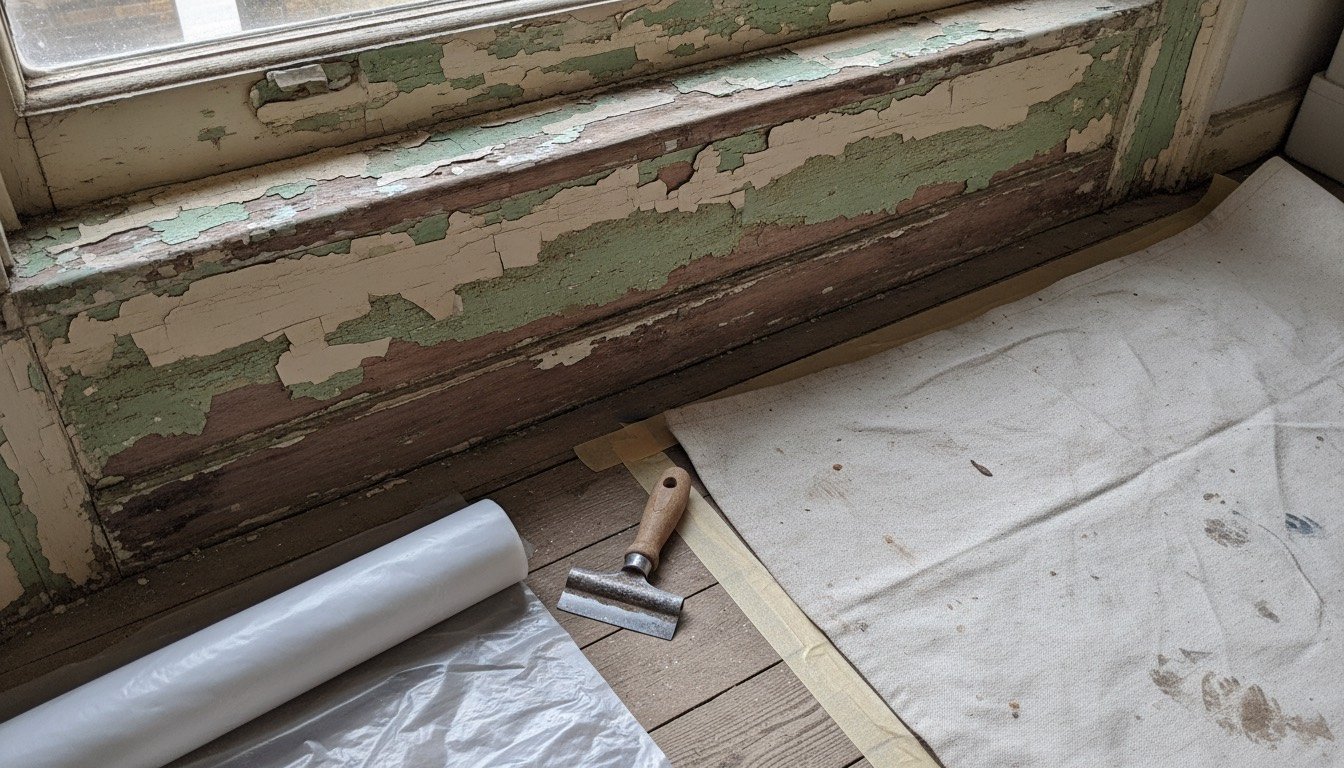
Lead was legal in British decorative paint until 1992, and the primers underneath are the worst of it. Close to four in ten English homes were built before 1945, so the skirting, architrave, staircase and window joinery in most period properties carry lead somewhere in the stack — usually under decades of later gloss.
Buried lead is not, on its own, a health problem — nobody has been poisoned by paint they left alone. Poisoning happens when paint becomes dust or fume, and nearly every case traces back to four things: a sander, a hot-air gun, a household vacuum, or a sash rubbing itself to powder in its box.
Start here: work out which lead problem you actually have
Before you buy a test kit or a tub of stripper, place your house in one of the five situations below. They need different responses, and most bad advice online applies scenario D's answer to scenario A's problem.
- •A — Intact paint, nothing planned. Sound paint on a door or skirting you are not touching. Leave it, wash it normally, repaint when it looks tired.
- •B — Intact paint on a friction or impact surface. Sashes in their boxes, door rebates, stair nosings, window troughs at toddler height. These grind themselves into fine dust daily with nobody sanding anything — the commonest real exposure in UK homes.
- •C — Paint failing on its own. Flaking, blistering, or chalky residue on your palm from an exterior wall. Contain it now, then find out why: most interior paint failure in old houses is a damp symptom, not a paint fault.
- •D — You are about to renovate. Stripping joinery, chasing walls, lifting floorboards. This is where dust gets dangerous, and the decisions must be made before the first tool comes out.
- •E — Vulnerable occupants. A pregnant person, or a crawling, hand-to-mouth child under six. This escalates every scenario by one level.
Test properly, or your result means nothing
Rhodizonate swab kits cost £12 to £20 for eight, but they only read the surface they touch. Swab a 1990s gloss on Victorian skirting and it comes back clean while a 1930s lead primer sits 2mm below. Cut a shallow V-notch through every layer to bare timber, then run the swab down the bevel so it crosses all the coats at once.
For a decision worth thousands, pay for a real answer: a UKAS lab analyses a paint chip for £35 to £70, and an XRF survey of a whole house runs £350 to £700. Sample four points — a window, a door casing, the staircase, one ceiling — because different elements were painted in different decades. Where old paint is failing across plaster rather than woodwork, read our guide to repairing old plaster walls first.
The mistakes, ranked by what they cost you
Worst consequence first, not most common first.
- •1. Heat above 450°C. Hot-air guns run at 350–600°C and blowlamps far higher; lead fumes from about 450°C. People do it because it is fast. The fume is invisible and goes straight into the blood.
- •2. Dry power sanding. A square metre of lead gloss under a random-orbit sander puts fine dust into every room on that floor, and permanently into the carpet.
- •3. Living in the house while the work happens. Contamination settles into carpets, sofas and soft toys, and stays.
- •4. Cleaning up with a domestic vacuum. Standard filters pass lead dust out at head height. Use M-class minimum, H-class ideally; hire £35 to £50 a day.
- •5. Trusting one negative swab — top-layer testing gives false reassurance more often than any other single error.
- •6. Repainting over damp-driven blistering. The coat fails within a season and you disturb the same paint twice; fixing peeling paint covers telling adhesion failure from damp.
- •7. Assuming a modern house is clear. Reclaimed doors, salvaged fire surrounds and second-hand shutters bring lead into 2005-built homes regularly.
- •8. Forgetting the soil — decades of flaking exterior paint concentrate lead in the dripline. No raised beds or sandpits within a metre of an old painted elevation.
- •9. Not telling your tradespeople. An unwarned decorator will sand. Say 'lead' at quoting stage, in writing.
How to work on it safely if you go ahead
Keep the paint wet, keep it whole, or keep it cold. Poultice strippers are the professional's choice because paint lifts inside a peelable blanket rather than as airborne flakes — £45 to £60 for a 5kg tub covering 5m². Infrared softeners work at 200–260°C, below the fuming threshold, and hire for about £40 a day.
Everything else is containment. Seal the room with 500-gauge polythene taped at every edge, cover carpets, tape round internal doors, and open a window rather than an extractor that pressurises the rest of the house. Wear a fitted FFP3 mask or half-mask with P3 filters (£30–£45), a Type 5/6 coverall and gloves, and take them off in the room, not the hallway. Clean up wet with sugar soap and disposable cloths, then wipe again next morning. Double-bag the waste and declare it at the recycling centre; never burn painted timber.
- •Do: wet-scrape, poultice-strip, wet-sand with a mist spray, encapsulate with a sealer, or simply overpaint sound paint.
- •Do not: dry-sand by hand or machine, use a hot-air gun or blowlamp, wire-brush dry, or pressure-wash paint off a wall.
- •Manage friction surfaces instead of stripping: ease sashes so they run without binding, fit parting-bead brushes, wet-wipe troughs weekly.
Where DIY stops and you ring someone
There is no UK certification rule for domestic renovation: as a homeowner you are legally free to do this badly. Contractors are not: the Control of Lead at Work Regulations 2002 apply the moment someone is paid, which is why a competent firm quotes 15–30% above standard redecoration and the cheapest quote is often the one planning to sand. Refurbishing one sash properly runs £180 to £400; the wider arithmetic sits in our breakdown of what it costs to renovate an old house.
Stop and call a specialist if someone in the house is pregnant or under six; if you are stripping more than a square metre in a room, or any exterior elevation; if the paint sits on a textured coating that may also contain asbestos; if the building is listed; or if heat is the only method that will work. For a blood-lead worry, ask your GP — the UK action threshold for children is 5µg/dL.
Quick answers
- •Can I just paint over it? Yes, if it is sound and not on a friction surface. A modern eggshell over the top is a legitimate, permanent answer for skirting and panelled doors.
- •Is stripping windows worth it? Often, because sashes are the friction problem — but strip in situ with poultice or infrared, never by dipping, which loosens joints. See restoring original wood windows.
- •Does lead come alone? Rarely: rubber-insulated wiring, lath-and-plaster ceilings and lime mortar all want handling differently — see common problems in 100-year-old houses.
- •Next step: notch-test one window, one door casing and the staircase this weekend. Twenty minutes tells you which scenario you are in, and that decides everything else.
Found this useful?
There's plenty more — hundreds of guides and honestly-tested product reviews for every corner of your home.
Browse All Guides