Product Reviews · 6 min read · 28 May 2026
The Best Gutter Guards for UK Homes in 2026: What Actually Survives a Wet Winter
Clearing a blocked gutter costs about £90. Ignoring it can cost thousands in damp repairs. Here is what genuinely works on UK housing stock, where moss beats leaves as the real enemy.
By the Nims Casa editorial team — written from professional cleaning experience and checked against our editorial standards.
Affiliate disclosure: if you buy through links in this article we may earn a small commission at no extra cost to you. Our recommendations come from professional cleaning experience and are never influenced by retailers or brands.
Clearing a blocked gutter on a two-storey semi costs roughly £70 to £120. Letting one overflow down a solid brick wall for two winters can cost several thousand in replastering and redecoration. That gap is the entire commercial argument for gutter guards, and it is also why so much of this market is sold on fear rather than measured performance.
The awkward truth from years of pulling this stuff out of rainwater goods across British housing stock is that our blockages are not the tidy heaps of autumn leaves the marketing photos show. They are moss, granular grit shed off concrete interlocking tiles, and the grey silt those two make once they sit in standing water from November to March. Any product judged only on leaves will flatter itself and disappoint you.
Our top picks at a glance
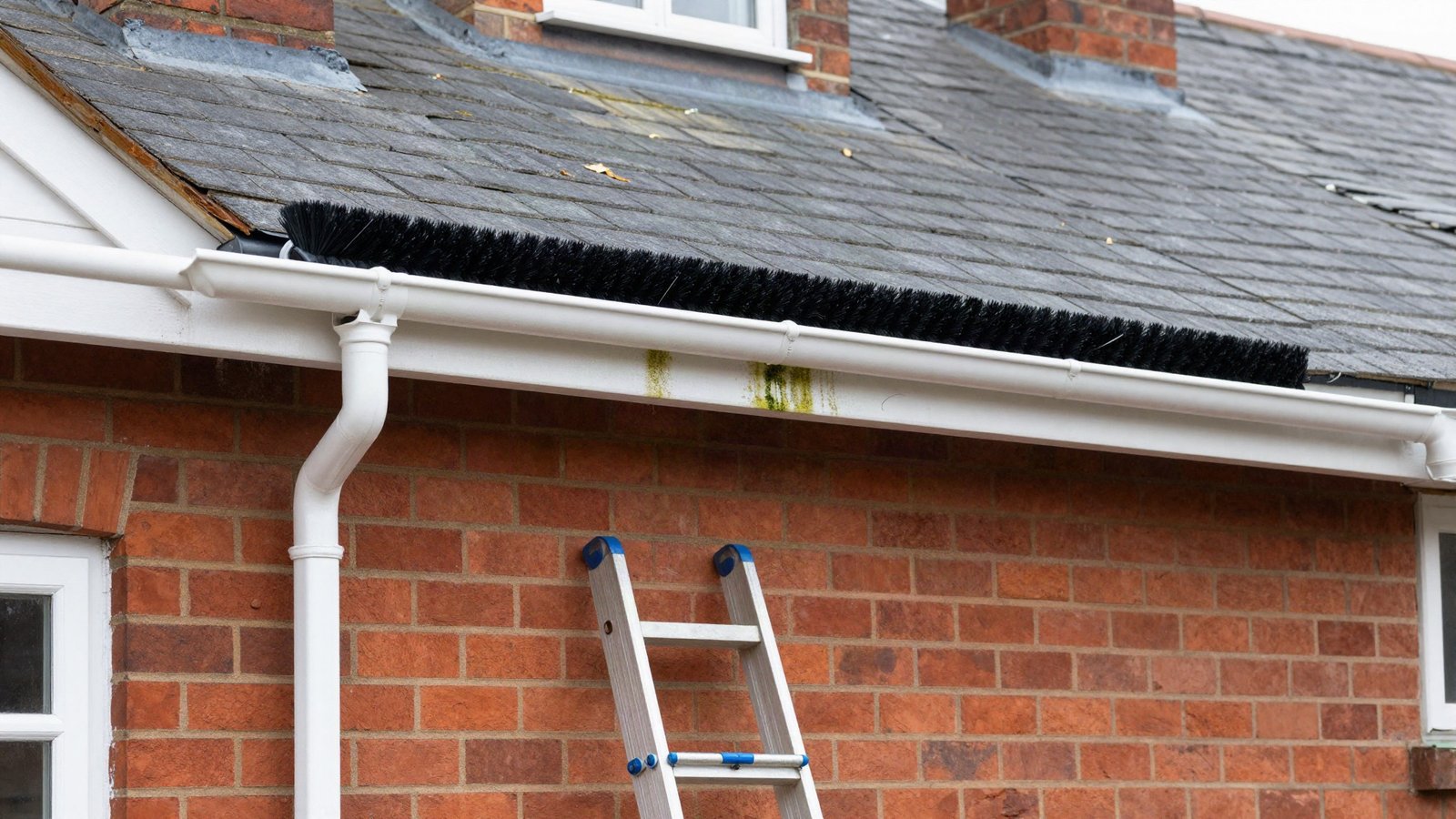
Hedgehog Gutter Brush (4m, 100mm)
~£25-30 per 4mA stiff polypropylene bristle core with a galvanised wire spine that sits inside the gutter and lets grit and moss silt wash through beneath it. Widely stocked at Screwfix, Toolstation and Wickes, and the only design that genuinely copes with a British wet winter.
Pros
- ✓ Moss and grit pass underneath rather than blinding the surface
- ✓ Cannot cause rainwater overshoot on steep roof pitches
- ✓ Lifts out and refits one-handed on a ladder
Cons
- ✗ Traps seeds that will sprout — expect greenery by year three
- ✗ Needs the correct diameter for deepflow or ogee profiles
- ✗ Not invisible from ground level on shallow half-round gutters
FloPlast Gutter Guard Mesh (4m clip-in)
~£8-12 per 4mA black polypropylene mesh strip that clips over standard FloPlast half-round and square line gutters, from one of the UK's main rainwater goods manufacturers. It is the cheapest credible option and fits the profiles most British houses actually have.
Pros
- ✓ Under £3 per metre, so a whole semi comes in around £70
- ✓ Designed around genuine UK gutter profiles, not imported sizes
- ✓ Simple to trim with scissors around brackets and outlets
Cons
- ✗ Moss builds on top and needs brushing off annually
- ✗ Clips can lift in high wind if not pressed fully home
- ✗ Plastic becomes brittle after roughly five UK winters
Easy On Gutter Guard (aluminium micro-mesh)
~£60-90 per 6mPowder-coated aluminium panels with a fine stainless mesh face, sold in the UK through Amazon and specialist merchants. It is the pick where conifers, birch seed or fine needle litter are the dominant nuisance and moss is not.
Pros
- ✓ Stops fine debris that brushes and coarse mesh let through
- ✓ Aluminium will not go brittle or sag over a decade
- ✓ Neat, low-profile appearance from ground level
Cons
- ✗ Fine mesh silts up with moss on shaded northern elevations
- ✗ Can cause overshoot on roof pitches above about 40 degrees
- ✗ Three times the cost per metre of a brush guard
Wire Balloon Downpipe Outlet Guard (68mm)
~£2-5 eachA galvanised wire cage that drops into the gutter outlet and keeps leaves, tennis balls and nesting material out of the downpipe. It solves the majority of genuine blockages we get called to, for the price of a coffee.
Pros
- ✓ Addresses the actual failure point on most UK gutter runs
- ✓ Fits standard 68mm round and 65mm square outlets
- ✓ Takes thirty seconds per outlet to fit
Cons
- ✗ Does nothing for debris sitting along the gutter run
- ✗ Cheap galvanised versions rust within four or five years
- ✗ Needs pulling and rinsing each autumn to stay effective
Who Gutter Guards Are Actually For
Guards are a maintenance-reduction tool, not a maintenance-elimination tool. Anyone promising you never have to look at your gutters again is selling something. Fitted well, a guard turns a twice-yearly clear into a two-yearly check, which on a three-storey terrace with awkward access is worth real money.
- •Worth it: mature trees within about 10 metres, especially sycamore, lime, silver birch or anything coniferous that drops needles year round.
- •Worth it: north-facing roof slopes with heavy moss growth on concrete or slate tiles, common across the Pennines, Wales and the South West.
- •Worth it: three-storey properties or dormers where you cannot safely foot a ladder — saved access costs repay the guard inside three years.
- •Probably not worth it: a modern estate house with no overhanging trees, where clearing them properly twice a year takes forty minutes and costs nothing.
- •Not yet: gutters that sag, leak at the joints or run the wrong way. Fix the fall first — see how to fix a leaking gutter — because a guard on a badly hung run only hides the problem.
How We Judge Them
Full disclosure on method: this is not a laboratory rig with calibrated rainfall. It is drawn from fitting, removing and cleaning behind these products on real UK roofs, cross-checked against manufacturer specifications and pricing at Screwfix, Toolstation, B&Q and Wickes as of spring 2026. Where a product has a known failure mode, we say so.
- •Moss and silt tolerance in a wet winter, weighted more heavily than leaf performance.
- •Overshoot in heavy rain, particularly on roof pitches above about 40 degrees where water leaves the tile fast.
- •Whether the guard can be lifted out and refitted by one person on a ladder without removing brackets.
- •UV and frost durability over five years — foam inserts routinely fail this and we do not recommend them.
- •Fit against genuine UK gutter profiles: 112mm half-round, 114mm square line, 106mm ogee and deepflow, not American K-style.
What to Look For on a UK Roof
Measure the gutter before you buy anything. Most post-1970 housing runs 112mm half-round uPVC; square line at 114mm and ogee at around 106mm are common on newer developments, and Victorian and Edwardian stock often still has 100mm or 115mm cast iron. Brush guards are sold by brush diameter, and a 100mm brush in a deepflow gutter simply floats about and does nothing.
Check the fall while you are up there. Rainwater goods should drop roughly 1:600 towards the outlet, with uPVC brackets at no more than 1 metre centres. Standing water in a level gutter is what turns leaf litter into the silt that defeats fine mesh. If the run is tired enough that you are weighing a guard against a replacement, check what a full replacement costs before spending on accessories.
One roof-pitch caveat: on steep slate at 45 degrees or more, water can jump a raised mesh guard entirely and land in the flower bed. Brush guards, which sit inside the gutter rather than over it, avoid that completely — our guards versus screens comparison goes deeper on the trade-offs.
Access, Regulations and the Bits People Forget
Gutter work on your own house is maintenance, not development, so no planning permission is involved. But several UK rules do bite, and ignoring them is how a £30 job becomes an enforcement letter.
Listed buildings and conservation areas are the big one. If your property is listed, altering the appearance of cast iron rainwater goods — including a visible aluminium guard along the front elevation — can require listed building consent, and proceeding without it is a criminal offence, not a fine-and-forget. In conservation areas under an Article 4 direction, swapping cast iron for uPVC while you are up there also needs permission. A call to the council conservation officer settles it.
Landlords have a statutory duty here. Section 11 of the Landlord and Tenant Act 1985 makes the exterior and structure, guttering included, the landlord's responsibility, and the Homes (Fitness for Human Habitation) Act 2018 gives tenants a direct route to act when an overflowing gutter causes damp and mould inside. Guards are cheap insurance against a disrepair claim.
On access: the Work at Height Regulations 2005 bind anyone doing this as a trade, and while they do not bind a homeowner on their own roof, the hierarchy still holds. Use a ladder stay so you never rest weight on a uPVC gutter — it cracks at the bracket — and pitch at 75 degrees, the one-out-four-up rule; our guide to a decent ladder covers class ratings. A tower or scaffold standing on the public footpath needs a licence from the highway authority under the Highways Act 1980, typically £60 to £200 for a few weeks.
Common Buying Mistakes
- •Buying by the metre without measuring the run. A typical three-bed semi has 22 to 30 linear metres of gutter, not the 8 people guess.
- •Choosing the finest micro-mesh available. Sub-millimetre apertures shed leaves brilliantly and then blind over with moss silt, at which point rain sheets straight over the front.
- •Foam wedge inserts. Cheap, easy, and they degrade in UV within three to five winters, then break up and block the downpipe outlet.
- •Ignoring the outlets. Most so-called gutter blockages we attend are actually the downpipe throat, solved by a £3 wire balloon.
- •Fitting guards and then never checking. Budget one inspection every two years, minimum.
- •Treating guards as a drainage fix. If water pools at the base of the wall, the problem is ground level, not the eaves.
The Verdict
For most UK homes, a bristle brush guard at £6 to £8 per metre is the right answer: it tolerates moss, cannot overshoot, and lifts out in seconds. Aluminium mesh earns its higher price only where pine needles or dense leaf fall are the dominant problem and the roof pitch is moderate. Professionally installed continuous systems at £15 to £30 per fitted metre — £450 to £900 on an average semi — make sense mainly when access costs are punishing.
What no guard does is remove the need to look. Every second autumn with guards fitted, plus ten minutes with binoculars from the garden after heavy rain, protects the wall more reliably than anything you clip into the gutter.
Found this useful?
There's plenty more — hundreds of guides and honestly-tested product reviews for every corner of your home.
Browse All Guides