Roofing & Exterior · 6 min read · 1 April 2026
Gutter Guards vs Gutter Screens: Costs, Performance and What UK Roofs Actually Need
Both are sold as gutter protection and both promise the end of autumn ladder work. The difference is hole size, and hole size decides what gets in, how often you climb, and whether you spend £60 or £1,400.
By the Nims Casa editorial team — written from professional cleaning experience and checked against our editorial standards.
Both products sit on the same shelf under the same label, and both promise no more October ladder work. The real difference is aperture size, and that quietly decides everything else: what gets through, how often you go up, and whether the bill is £60 or £1,400.
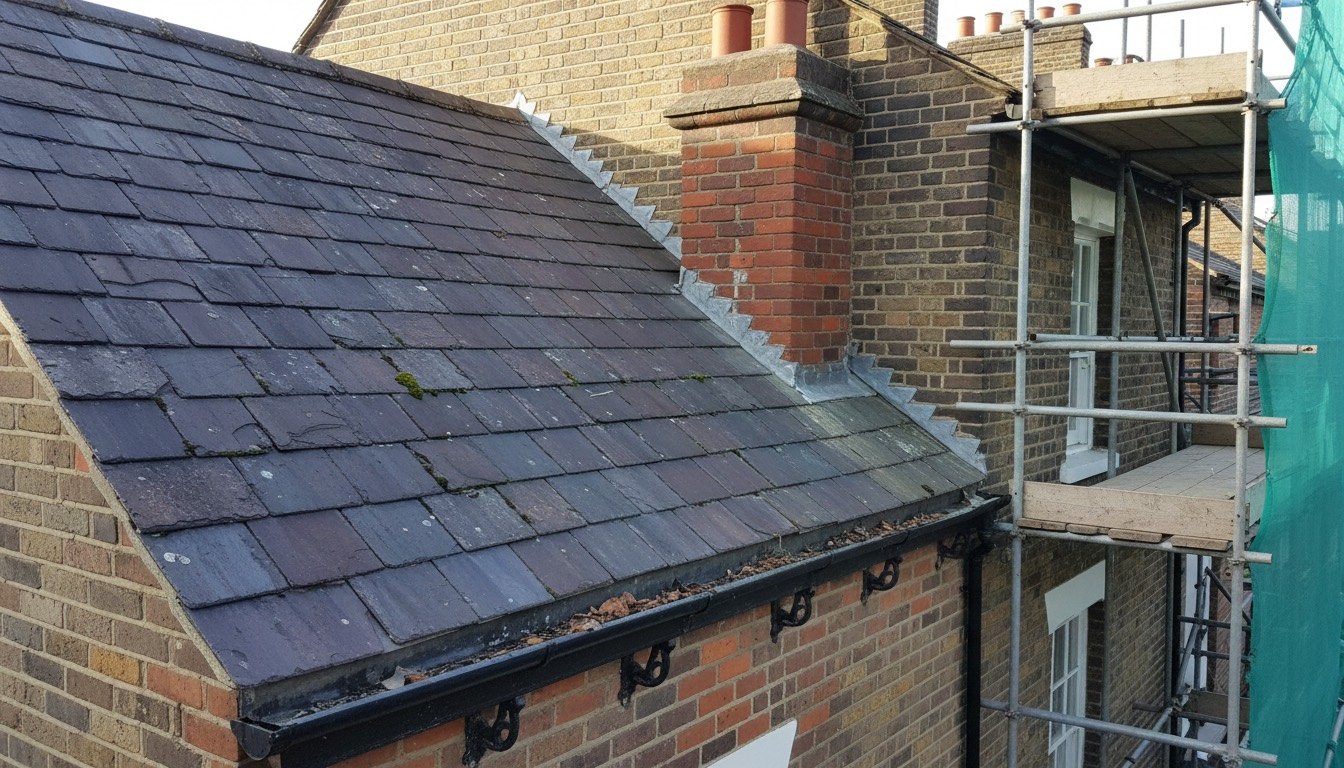
One thing first. What we actually pull out of UK gutters is rarely what the packaging shows. Far more often it is moss granules washed off concrete interlocking tiles, roofing grit, sycamore keys, birch seed and sticky lime honeydew — fine, heavy, wet material, not the crisp oak leaves in the brochure. That changes which of these is worth fitting on your house.
Screens and guards: what the two words mean
Gutter screens are simple inserts that sit in or across the channel: perforated plastic or aluminium panels, expanded mesh strips, bottle-brush inserts and foam wedges. Apertures run 4mm to 12mm, they cost £2–£8 per metre at Screwfix, Toolstation or B&Q, and they alter nothing about the roof itself.
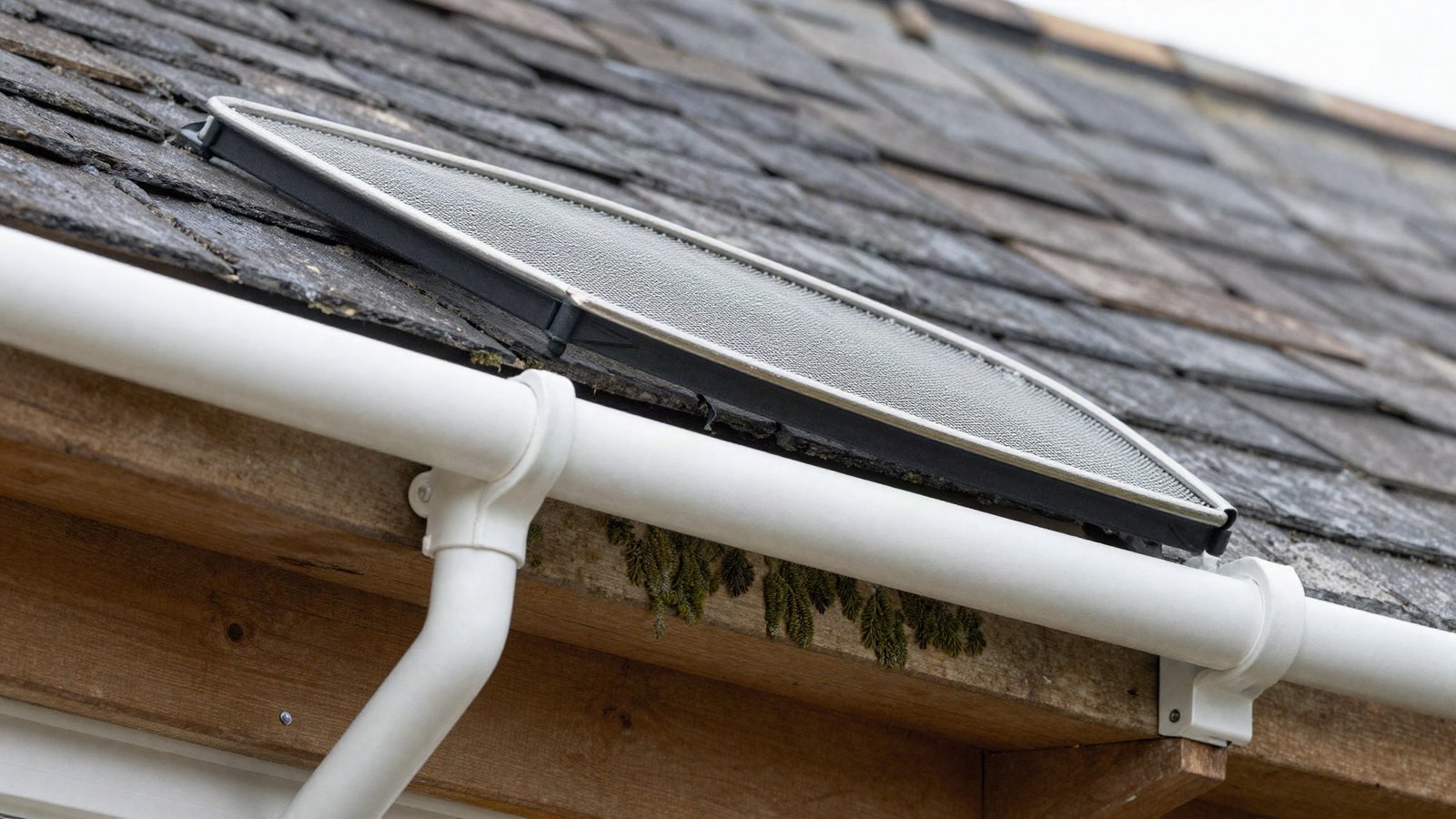
Gutter guards, as the trade uses the word, are engineered covers: stainless micro-mesh of 250–900 microns on an aluminium frame, or solid reverse-curve hoods that use surface tension to pull water round a lip while debris falls past. Side by side, on the specifications that matter:
- •Aperture: screens 4–12mm; micro-mesh guards 0.25–0.9mm; solid hoods have no aperture at all.
- •Cost: screens £2–£8 per metre supplied; DIY micro-mesh £12–£20 per metre; fitted micro-mesh £30–£55 per metre; reverse-curve hoods £70–£120 per metre.
- •Fitting: screens clip in from a ladder in an afternoon; guards need the gutter emptied, levelled and flow-tested first, and some designs want the bottom course of tiles lifted.
- •Service life: cheap plastic screen 3–6 years before UV makes it brittle; aluminium screen 10–15 years; stainless mesh on an aluminium frame 20 years plus, though steel frames rust at the fixings by year eight.
- •Defeated by: screens lose to moss granules, birch seed and pine needles; micro-mesh loses to roof grit and honeydew, which blind it from above rather than block it from below.
- •Access afterwards: screens lift out in thirty seconds; several guard systems are screwed down and awkward to lift again.
Performance: what each really keeps out
A screen stops the big stuff — sycamore, ash and oak leaves, twigs, nesting birds — and that is not nothing. It does not stop anything smaller than its holes, which in a British autumn is most of the volume by weight. Pine needles are the worst case: they spear through a 6mm aperture, mat underneath, and turn the screen into a lid over a blocked gutter you can no longer see into.
Micro-mesh at 0.3mm genuinely keeps the channel clean, and capacity is never the issue — a clean panel passes far more than the 30–50mm an hour of our heaviest downpours. The failure mode is blinding. Algae, moss spores and bitumen grit build a film on the top surface until water sheets across it and off the front edge, straight down the wall. On a north-facing elevation under a conifer that can happen inside two winters, and the giveaway is a brown tide-mark on the fascia, not a visibly full gutter.
Solid reverse-curve hoods are the weakest performer here. Surface tension works well in still, vertical rain and poorly in the wind-driven rain normal from Cornwall to Cumbria, where water overshoots the curve. Whatever you fit, clear and flow-test the run first; a system fitted over a partly blocked gutter bakes the problem in.
Fitting them, and where DIY has to stop
Screens are the only one of these two that is genuinely a DIY product, and even then only at the right height. Here is the boundary we would give a friend.
- •DIY, if you are competent: clipping screens into single-storey guttering — garage, porch, bungalow, kitchen extension — from an EN 131 Professional ladder pitched at 75 degrees on firm level ground, with a stand-off bracket so the stiles never bear on the uPVC. Buy a ladder rated for it rather than borrowing whatever is in the shed.
- •DIY: clearing, rinsing and flow-testing a run before anything goes over it; fitting a clip-on micro-mesh panel that grips the front lip and rests on the back edge; replacing a bracket or re-seating a union seal — all single-storey only.
- •Call a professional: any two-storey elevation, and any gutter above a conservatory roof, a lean-to, a lightwell or sloping ground. There is nowhere to safely foot a ladder. A mobile tower is £70–£120 a week to hire; a fall is not recoverable.
- •Call a professional: anything requiring slates or the bottom course of tiles to be lifted. Slates hang on nibs or nails and the eaves underlay is dressed into the gutter — lever a panel under there and you break the drainage path behind it, and it will show up on a survey.
- •Call a professional: cast iron guttering. A 1.8m length weighs 15–20kg, paint on pre-1980s cast iron may be lead-based, and some 1950s–70s rainwater goods are asbestos cement.
- •Call a professional: any roof carrying a solar array, and any elevation where the fascia feels soft under thumb pressure. At that point fit nothing — check the signs your gutters need replacing, because the run is coming down anyway.
The ten-year cost, honestly
Take a 1930s three-bed semi: roughly 26 metres of gutter, two downpipes, a mature sycamore eight metres away. Four realistic paths, priced over a decade.
- •No protection, paying for cleaning: two ground-based vacuum visits a year at £75–£95 each for a semi, £110–£160 for a two-storey detached — £1,500–£1,900 over ten years.
- •DIY plastic clip-in screens: £55–£70 materials, one replacement around year five at £120, plus an annual professional clean at £85 — roughly £1,030.
- •Aluminium screens on the reachable runs, professional attention to the rest: £180 materials plus £45–£60 a year — roughly £700, and the lowest-risk option for most people.
- •Professionally fitted stainless micro-mesh: £950–£1,400 to cover 26m at £36–£54 per metre, plus an inspect-and-rinse every third year at £90 — £1,220–£1,670.
Maintenance: neither is fit and forget
Those figures tell you something the sales patter does not. Micro-mesh is not the cheap option; it is roughly cost-neutral against simply paying someone to clean. What you are buying is the removal of ladder work and of the risk that a gutter overflows unnoticed between visits — and that second one is the real money, because damp spreading through a solid brick wall costs more than every option above combined.
Screens want lifting, tipping and rinsing twice a year: November after leaf fall, March after moss season. Allow 30–45 minutes for a semi. Micro-mesh wants its top surface brushed with soft nylon and rinsed from above — never a 100-bar pressure washer, which flattens the mesh and drives the frame off its clips. Either way the downpipe outlet still silts, so fit a leaf trap there and check the gully at ground level. Then tip ten litres from a watering can in at the far end and watch it leave the downpipe within 20–30 seconds, discharging clear of the brickwork.
Who each one suits
Screens suit bungalows and single-storey runs, budgets under £150, houses ringed by broad-leaved trees where debris is large, and any gutter you can already reach safely. Guards suit two- and three-storey houses where every clean is a £120 call-out, roofs shaded by pines where needle litter defeats screens outright, households where nobody should be climbing anything, and homes where a wall has already been soaked once.
Neither suits a gutter that is sagging, leaking at the joints or hung on rotten fascia — fix the guttering first, and budget with our gutter installation cost guide. And be realistic about a heavily mossed concrete tile roof: treat the moss before spending £1,200 on mesh that granules will blind within three winters.
The verdict, and the questions we get asked
If your gutters are within safe ladder reach from level ground, buy aluminium screens at £5–£8 a metre, fit them yourself and diary a March and November rinse — most of the benefit for a tenth of the cost. If they are not, pay for stainless micro-mesh on an aluminium frame, insist in writing that it clips to the gutter rather than tucking under the tiles, and get the workmanship warranty on paper. Avoid foam inserts, which hold water and rot, and walk away from any doorstep sale of a reverse-curve hood above £2,500 for a semi.
- •Do guards affect a roof warranty? They can, if the installer slides panels under the tiles or fixes into the roof deck. Ask how it is fixed before you sign.
- •Will a screen stop birds nesting? Yes — the one job every screen does reliably.
- •Can I fit micro-mesh to half-round guttering? Yes, but check the panel is sized for 112mm half-round rather than 114mm square line; the lip profile differs and a loose fit lets debris in at the front.
- •Is it worth it on a bungalow? Financially, usually not. The clean is a 40-minute job you can do safely yourself.
- •Next step: if you have settled on mesh, read our tested gutter guard picks; if not, the Roofing & Exterior hub covers the surrounding jobs.
Found this useful?
There's plenty more — hundreds of guides and honestly-tested product reviews for every corner of your home.
Browse All Guides