Product Reviews · 6 min read · 20 April 2026
The Best Laser Level UK (2026): Four Picks for Houses Where Nothing Is Square
A laser level does not make anything straight. It gives you one reference you can trust, then leaves you to decide how much of the truth about your house you want to build to.
By the Nims Casa editorial team — written from professional cleaning experience and checked against our editorial standards.
Affiliate disclosure: if you buy through links in this article we may earn a small commission at no extra cost to you. Our recommendations come from professional cleaning experience and are never influenced by retailers or brands.
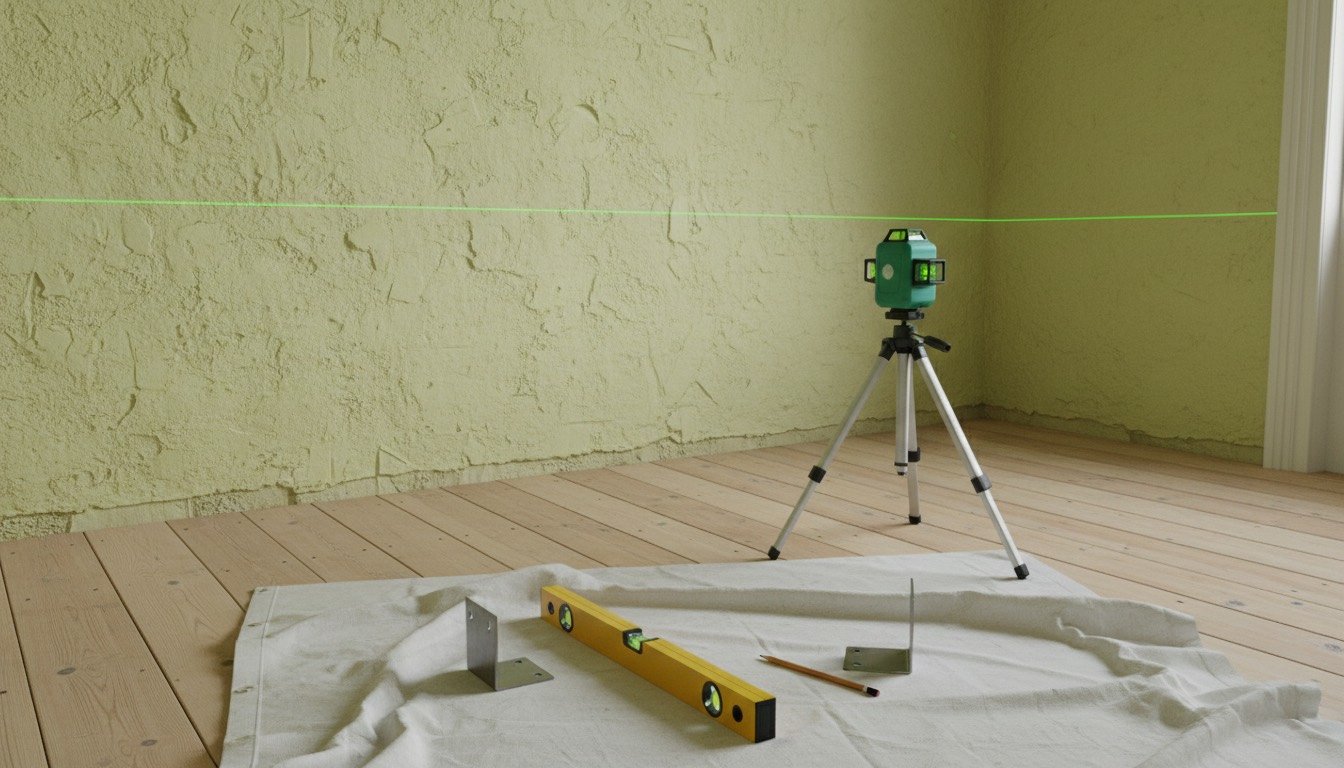
Throw a laser line across a Victorian back bedroom and it tells you something uncomfortable in four seconds: the floor drops 18 mm between skirtings, the chimney breast leans out at the top, the ceiling slopes towards the party wall. None of that is a fault in the tool. It is the house, and has been since the 1890s.
This guide comes from site use — shelving, kitchen runs, splashbacks and garden falls, mostly in pre-1930s stock where solid brick, lime plaster and lath make every fixing a negotiation — combined with published accuracy figures. We have not run UKAS-calibrated lab comparisons, and anyone claiming laboratory verification of a £90 unit deserves a raised eyebrow.
Our top picks at a glance
Bosch Professional GLL 3-80 CG
~£340–420Three 360-degree green planes at ±0.2 mm/m, so one tripod position covers floor, ceiling and both walls of an average UK room. The rechargeable pack runs a full fit-out day and it takes AA cells as a backup, which has saved more than one Sunday.
Pros
- ✓ Three full 360-degree planes mean no repositioning and no compounded error
- ✓ Green diode stays readable in a bright bay window at 8–10 m
- ✓ Bosch Professional three-year warranty on registration, with UK service centres
Cons
- ✗ Roughly four times the price of a competent DIY unit
- ✗ The RM 1 wall mount and BT 150 tripod are extra, and you genuinely need them
Huepar 903CG 3x360° Green Laser Level
~£90–130Three 360-degree green planes for under £130, which five years ago was a £400 specification. Accuracy is quoted at ±0.3 mm/m and in practice it holds a line across a 5 m room well enough for tiling and kitchen fitting.
Pros
- ✓ Full three-plane coverage at roughly a quarter of the professional price
- ✓ Bundle usually includes a bracket and rechargeable battery
- ✓ Pulse mode works with a third-party receiver for short outdoor runs
Cons
- ✗ Sold almost entirely online, so warranty service is post-and-hope
- ✗ Housing is lighter; one knock off a step ladder can cost you calibration
Stanley Cubix STHT77340 Cross Line Laser
~£35–50A red cross-line laser with a self-levelling pendulum and a small pivoting base, stocked by most UK merchants. For hanging pictures, a curtain pole or a single shelf run it is entirely sufficient and costs less than the fixings for a kitchen.
Pros
- ✓ Cheap enough to justify for one weekend job
- ✓ Simple pendulum lock and AA batteries, nothing to go flat mid-task
- ✓ Widely available on the high street if it fails
Cons
- ✗ Red beam is effectively invisible in daylight past about 2 m
- ✗ Cross-line only, so you reposition constantly around a room
Bosch Professional GRL 400 H with LR 1 Receiver
~£380–460A rotary laser with a receiver, which is the only sensible way to set falls outdoors in daylight. Working range with the LR 1 is around 400 m diameter, far more than any domestic garden, patio or drainage run will ever need.
Pros
- ✓ Receiver works in full sun where every visible beam fails
- ✓ Ideal for patio falls, drainage gradients and levelling a garden room base
- ✓ IP56 rated, so rain and brick dust are not a problem
Cons
- ✗ Overkill unless you are doing groundwork or landscaping
- ✗ Horizontal only in this model — no vertical plane for indoor work
Who this guide is for
Laser levels split by how often you use one, and buying above your tier is the commonest way to waste money on this tool.
- •The occasional DIYer hanging a gallery wall, a curtain pole or one shelf run a year. A £40 cross-line unit is genuinely enough.
- •The serious renovator doing a kitchen, bathroom, tiling and stud partitions over a year or two, or the landlord running several properties. This is where a 360-degree green unit earns its keep.
- •The period-property owner, with a problem the marketing never addresses: a perfect reference line in a house with no perfect surfaces.
How we judge a laser level
Accuracy is the headline, but mounting, beam visibility and self-levelling range decide whether a laser gets used or left in the van.
- •Stated accuracy: ±0.2 mm/m is professional, ±0.3 mm/m fine for domestic work. Across a 4 m room that is a 0.4 mm difference nobody will ever see.
- •Green versus red diode: green reads three to four times brighter to the eye. In a south-facing bay in June a red line vanishes past 2 m. Green costs £20–£40 more and earns it in a house with big sash windows.
- •Self-levelling range: usually ±4°. On a floor that has dropped 30 mm across 3 m you hit that limit sooner than you expect.
- •Mounting: magnetic brackets are useless here. UK homes have timber studs and solid brick, not steel framing, so you want a 1/4-inch thread and a proper tripod.
- •Warranty and sealing: IP54 minimum if it goes outdoors, and Bosch Professional's three years on registration against twelve months from most online brands.
The four we would actually buy
Our picks run from a £40 one-off tool to a rotary laser for garden levelling. The Bosch GLL 3-80 CG gets reached for most, because three 360-degree planes mean you set up once in the middle of a room and never move the tripod — which matters in an old house, where every repositioning starts a new argument about which surface you were referencing.
A laser is only half the job: you still need to find the timber before you drill. See our companion guide to choosing a stud detector, because lath-and-plaster ceilings defeat cheap capacitive models completely, and a cordless drill with a proper clutch saves fixings in soft lime plaster.
What changes in a solid-wall, lime-plaster house
The box assumes plasterboard on studs over a flat floor. Pre-1919 housing gives you none of that.
- •Solid nine-inch brick walls are rarely flat. A 3 m wall bowing 12 mm reads as a widening gap between line and wall — the laser is right, the wall is not.
- •Lime plaster is soft. Bracket clamps that grip modern skim will crush it, so clamp to timber or a tripod instead. If you do chip it, our guide to repairing old plaster walls covers making good properly.
- •Lath ceilings flex. A laser shows a 15 mm sag between joists; do not chase it out with filler, mount to the joists and pack down.
- •Sash window reveals are almost never square, so never take a level or plumb reference from a reveal, architrave or skirting.
- •Pre-1970s wiring runs at odd diagonals with no safe-zone discipline. A laser line tells you nothing about cables — always scan before drilling.
Working to a datum when nothing is square
The professional method is a single datum. Set the laser roughly 1 m above the highest point of the floor, pencil that line around the whole room, and measure everything from it — worktops, sockets, tile courses, shelf brackets. One reference, one set of errors, no compounding.
Then comes judgement, which most guides skip. Sometimes true level looks wrong: a splashback set dead level above a worktop that slopes 6 mm shows a tapering grout joint, and the eye reads that as a mistake.
- •Full-height elements — door linings, tall units, floating shelves — go to true plumb and level.
- •Anything sitting tight against a sloped surface gets split: take half the error out over the run so no joint looks wedged.
- •Tiling a splashback against a bowed wall means packing the batten to the laser and absorbing the difference in adhesive bed depth.
- •Never level a floor to the ceiling. In houses with the quirks common to century-old properties, the two disagree by 20 mm or more.
Outside: falls, gullies and Victorian drainage
Outdoors a line laser gives up and a rotary laser with a receiver takes over: daylight kills any visible beam within a couple of metres. Victorian drainage runs to open gullies and shallow salt-glazed pipe, and getting falls wrong leaves standing water against a solid wall with no damp-proof course.
- •Patios and paths: a fall of 1:80, roughly 12 mm per metre, running away from the house.
- •Foul drainage in 100 mm pipe: 1:40 to 1:80. Steeper than 1:40 and solids strand while the water runs away.
- •Finished ground level sits at least 150 mm below the DPC — and on solid-wall houses predating a DPC entirely, lower still and drained.
Buying mistakes we see again and again
Each of these costs more than the price gap between the tool bought and the tool needed.
- •Buying red to save £30, then working in a bright bay and never seeing the line.
- •Buying the laser and no tripod. A £400 unit balanced on an upturned bucket is a £40 unit.
- •Assuming a cross-line laser does the work of a 360-degree one. You will reposition four times a room and collect error each time.
- •Ignoring the pendulum lock. Carrying an unlocked self-levelling laser in a van is the fastest way to knock it out of calibration.
- •Trusting it forever. Check monthly: mark the line on a wall 5 m away, rotate the unit 180 degrees, re-level and mark again. More than 2 mm apart means recalibration.
The verdict
For most people renovating a UK home the Bosch GLL 3-80 CG is the right buy and will still be accurate in fifteen years. If the budget will not stretch, the Huepar 903CG gives roughly 90 per cent of the capability with 20 per cent of the service backup. Buy the tripod at the same time, keep the pendulum locked in transit, and accept that in an old house the laser is not there to prove the room is straight — it is there to show how crooked it is, so you can decide what to do about it.
Found this useful?
There's plenty more — hundreds of guides and honestly-tested product reviews for every corner of your home.
Browse All Guides