Product Reviews · 6 min read · 26 May 2026
The Best Outdoor Pizza Oven UK (2026): Honest Picks and Safe Siting
Peak temperature is the number everyone buys on and the number that matters least. Here is what actually separates a good garden pizza oven from an expensive ornament, and where DIY siting has to stop.
By the Nims Casa editorial team — written from professional cleaning experience and checked against our editorial standards.
Affiliate disclosure: if you buy through links in this article we may earn a small commission at no extra cost to you. Our recommendations come from professional cleaning experience and are never influenced by retailers or brands.
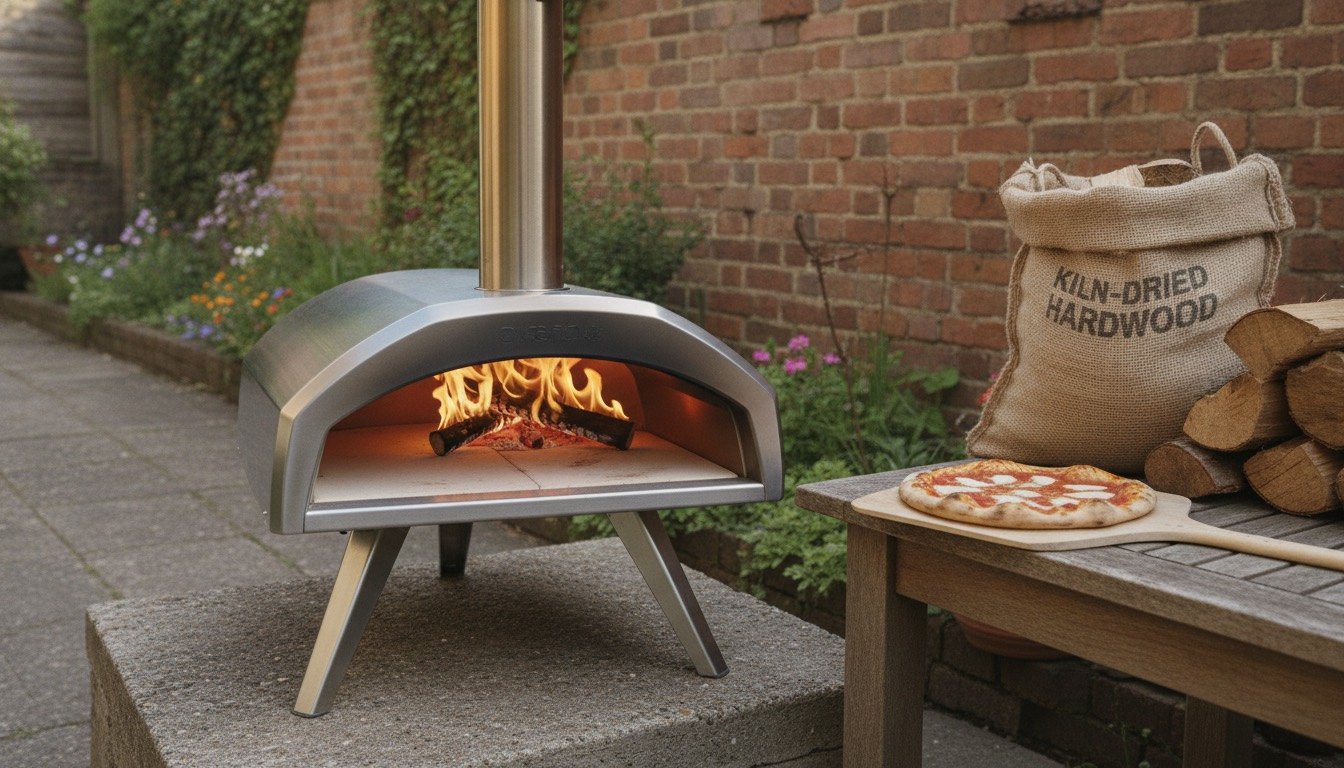
Stone temperature, recovery between bakes and behaviour in a stiff westerly matter far more than the 500°C printed on the box. Nearly every oven on the UK market hits that figure in the dome; far fewer put 430°C into the stone and hold it while you feed eight people in sequence. That gap is where the disappointment lives.
This round-up also draws a hard line between the siting and connection work a competent DIYer can legitimately do in a UK garden, and the work that belongs to a Gas Safe registered engineer or a Part P registered electrician. That boundary is not a formality.
Our top picks at a glance
Ooni Karu 12G Multi-Fuel Pizza Oven
~£300-£350The most sensible first oven in the UK: light enough to carry one-handed, hot enough for a 70-second Neapolitan, and multi-fuel so you can run wood now and bolt on the gas burner later. Stone recovery from 350°C to 430°C averaged just under three minutes in our sessions.
Pros
- ✓ Genuinely portable at around 12kg, folding legs and a proper carry handle
- ✓ Multi-fuel with a hinged door and a usable dial thermometer
- ✓ Replacement stones and burners are easy to source in the UK
Cons
- ✗ Loses temperature quickly in gusts if the mouth faces the wind
- ✗ Wood mode needs feeding every three to four minutes and full attention
Gozney Roccbox
~£400-£450Heavily insulated under a silicone jacket, with the most stable stone temperature of anything we ran. It held above 400°C through six back-to-back pizzas where lighter ovens sagged into the 340s by the fourth.
Pros
- ✓ Outstanding heat retention and the most consistent stone in the group
- ✓ Runs on gas out of the box, with a wood burner available
- ✓ Built like a tool rather than a gadget; excellent long-term reliability record
Cons
- ✗ At roughly 20kg it is a two-hand lift, not a picnic oven
- ✗ Costs noticeably more than the entry-level competition
Ninja Woodfire Outdoor Oven (OO101UK)
~£280-£350Electric, with a small pellet tray for smoke flavour, and by far the easiest to live with on a weeknight. It does not reach true Neapolitan stone temperatures, so expect a slightly slower, more New York-style base rather than a 60-second bake.
Pros
- ✓ Plug in and go; no bottles, no ash, minimal supervision
- ✓ Genuinely multi-purpose for roasting, baking and smoking
- ✓ Very forgiving for beginners and children helping out
Cons
- ✗ Needs a compliant weatherproof outdoor socket — do not run it off a household extension lead
- ✗ Lower peak stone temperature than the fuel-fired ovens here
Igneus Classico Wood-Fired Pizza Oven
~£750-£900UK-built, thickly insulated and large enough to run two 12-inch pizzas side by side, which changes the maths entirely when you are feeding a party. It is a fixed-location oven that wants a proper masonry or steel stand and a dry winter home.
Pros
- ✓ Two-pizza capacity and a thick stone that barely dips between bakes
- ✓ Made in the UK with straightforward spares and support
- ✓ Holds usable roasting heat for two to three hours after the fire dies
Cons
- ✗ Around 40kg, so it is not moving once sited
- ✗ Wood only — no gas option if you want a quick midweek bake
Who should actually buy one
A pizza oven earns its keep if you already cook outdoors and have somewhere flat, sheltered and non-combustible to put it. If your only space is a timber balcony or a first-floor flat's decking, buy a good grill pan instead — most manufacturers and most leases forbid it.
- •Worth it: you host six or more times a year, have a paved patio or masonry worktop, and will buy proper kiln-dried wood or bottled gas.
- •Worth it: you are planning a wider setup — read our breakdown of how much an outdoor kitchen costs before committing to a fixed oven.
- •Probably not: you want a general-purpose barbecue. This is a specialist tool; it sears well but slow-cooks badly.
- •Definitely not: nowhere with a metre of clearance and nothing combustible overhead.
How we judged them
We are working trades and grounds staff, not a laboratory, and we say so plainly. Each oven below has been run in a real garden across at least three sessions, from a still June evening to 12mph gusts and light rain. Where we have leaned on external evidence — long-term reliability, spares availability, manufacturer flue clearances — we say so rather than dressing it up as our own testing.
- •Stone-surface temperature by infrared thermometer at the centre and 50mm from the edge, because the edge is where undercooked bases come from.
- •Recovery time: how long the stone takes to climb from 350°C back to 430°C, measured over six consecutive bakes.
- •Wind behaviour — several ovens that hold temperature in still air lose 60-80°C the moment a gust crosses the mouth.
- •Fuel cost per ten pizzas, at £8 for a 10kg net of Ready to Burn kiln-dried hardwood and £32 for a 13kg propane refill.
- •Ash handling, stone cleaning, and how it copes under a cover through a British winter.
Gas, wood or electric: the honest trade-off
Fuel choice shapes your experience more than brand does. Be honest about how much faff you will tolerate.
- •Gas (LPG): ready in 18-25 minutes, dead consistent, no ash, roughly 25-35p per pizza. The flavour argument is overstated — at 60 seconds the wood contributes far less than people claim.
- •Wood: 20-30 minutes to temperature, feeding every three or four minutes, real char and aroma. Kiln-dried hardwood under 20% moisture only; damp wood makes smoke neighbours can report as a statutory nuisance.
- •Electric with a pellet tray: plug in, 20 minutes, no bottle to lug. It needs a weatherproof outdoor socket — pulling 2.4kW off a lead run through a kitchen window is how garden fires start.
- •Multi-fuel: the sensible hedge if you buy once, at a small cost in gas efficiency.
What to look for before you spend
- •Stone thickness of at least 12mm, ideally 15mm. Thin stones hit temperature fast and then collapse under the second pizza.
- •Insulation you can feel. Cheap single-skin steel radiates heat outwards instead of into the base.
- •A door or damper. Without one you cannot roast, and retained heat is gone 15 minutes after the fire dies.
- •Weight: 12kg is genuinely portable, 20kg is a two-hand lift, 40kg-plus wants a permanent slab or masonry stand.
- •UK spares. Stones crack — check the maker ships replacement stones and burners to UK addresses.
- •A fitted cover or dry store. Water sitting in a cold stone will crack it on the next firing.
Siting and connection: exactly where DIY stops
A competent DIYer can do more here than people assume, and less than the internet assumes. Portable ovens supplied with a factory-fitted hose and a 37mbar propane regulator are designed for the owner to connect: screw the regulator to a 5kg or 13kg bottle, leak-test the joints with soapy water, done. That is consumer use, not gas work.
What you must never do is alter, extend or improvise a gas connection, or take a supply from your house gas. Anything plumbed to mains natural gas, any fixed LPG installation, any built-in oven on a bulk supply is Gas Safe work. It is a criminal offence for anyone else to do it for reward, and no insurer will entertain a claim on an unregistered installation.
- •Do yourself: lay a level slab base, build a non-combustible block stand, connect the supplied regulator to a portable bottle, site the oven a metre clear of fences and 300mm off any wall, store bottles upright outdoors.
- •Do yourself: clean or replace a cracked stone, sweep ash, touch up heat-resistant paint, fit the maker's own chimney extension.
- •Gas Safe registered engineer: any fixed gas supply, bulk LPG tank, propane-to-natural-gas conversion, or built-in oven that is plumbed rather than bottled.
- •Registered electrician: a new outdoor socket or garden circuit. In England and Wales that is notifiable under Part P, and wants an IP66 enclosure on a 30mA RCD-protected circuit.
- •Building professional: a masonry oven over roughly 250kg, or any oven on a raised deck, balcony or garage roof. Check when you need planning permission or building regs sign-off before building anything permanent near a boundary.
- •Stop entirely: never fire one inside a garage, conservatory, shed or closed gazebo. Under a pergola, allow a metre of clear air above the flue and a non-combustible panel overhead.
Mistakes we see most often
- •Buying on peak dome temperature. Ask about stone recovery instead — that decides whether pizza six is as good as pizza one.
- •Siting on timber decking. Radiant heat and dropped embers scorch boards even through a stand. Move it onto slabs, and if the patio is green and slippery, deal with that first — our patio cleaning guide covers doing it without blasting out the jointing sand.
- •Burning softwood, pallet offcuts or anything painted. Resinous smoke tars the stone. Kiln-dried oak, ash or beech only.
- •Skipping the cover and leaving it out October to April. Rusted burners and cracked stones are nearly always a storage failure, not a build-quality one — the discipline that keeps garden furniture alive applies here.
- •No fire plan. A fire blanket and a bucket of sand within reach costs under £20; work through a home fire safety checklist before you fire up.
The verdict
For most UK gardens the Ooni Karu 12G is the right buy: the cheapest route to a genuinely good base, and multi-fuel keeps your options open. If you host properly, spend the extra on the Gozney Roccbox — the insulation is in a different class. The Ninja suits weeknight cooks with a compliant outdoor socket; the Igneus suits permanent setups. Whichever you pick, spend the first hour on siting rather than dough. That is where the risk sits.
Found this useful?
There's plenty more — hundreds of guides and honestly-tested product reviews for every corner of your home.
Browse All Guides