Product Reviews · 6 min read · 26 June 2026
The Best Water Leak Detector UK (2026): Spot Alarms vs Whole-Home Shut-Off
A weeping joint never floods a room — it just quietly rots the units for six weeks. Here is what actually catches that, from £15 pucks to valves that close the main, and who is allowed to fit each.
By the Nims Casa editorial team — written from professional cleaning experience and checked against our editorial standards.
Affiliate disclosure: if you buy through links in this article we may earn a small commission at no extra cost to you. Our recommendations come from professional cleaning experience and are never influenced by retailers or brands.
A 15mm compression joint weeping half a litre an hour behind a kitchen unit will never flood the room. Left alone for six weeks it swells the chipboard carcass, lifts the vinyl, wicks up into the plasterboard and turns a 40p olive into a four-figure repair. That gap — between a leak starting and somebody noticing — is the only thing any of these devices actually sells you.
Two families of product solve genuinely different problems here. Spot sensors are cheap battery pucks you drop where water will collect; they shriek when they get wet. Whole-home monitors clamp onto or plumb into the rising main, watch flow or pipe temperature all day, and on the better models close a motorised valve when the pattern looks wrong. Most UK homes want both. If you already suspect a leak rather than wanting to catch the next one, work through the professional's method for finding a water leak first — no detector tells you where the water is coming from.
Our top picks at a glance
Hero Labs Sonic Whole-Home Leak Detector
~£400–£600 fittedAn ultrasonic flow monitor with an integrated motorised valve that plumbs into the rising main just after the internal stopcock and learns your household's normal usage over a fortnight. It is the only sort of device here that will actually stop a burst at 3am in an empty house, and several UK insurers recognise it for premium discounts.
Pros
- ✓ Closes the main automatically on an abnormal flow pattern
- ✓ Detects continuous flows well under a litre an hour, so it catches weeps and not just bursts
- ✓ Ultrasonics read through the pipe wall, so nothing intrudes into the water itself
Cons
- ✗ Needs a plumber and a mains socket at the stopcock, which many UK kitchens do not have
- ✗ The learning period throws false alerts if you fill a paddling pool in week one
LeakBot Smart Water Leak Detector
~£150–£200Clips around the incoming main and infers a leak from the temperature difference moving water creates, so fitting takes five minutes and involves no plumbing whatsoever. Widely supplied free or heavily discounted by UK insurers, which makes it the sensible first call before you spend anything.
Pros
- ✓ Genuinely tool-free: clamps on, with no isolation or drain-down
- ✓ Often free through home insurance, with a plumber visit included on many schemes
- ✓ Sees leaks anywhere on the supply side, including under floors
Cons
- ✗ Alerts only — it cannot shut the water off
- ✗ Needs a consistent length of exposed pipe near the stopcock to read reliably
Aqara Water Leak Sensor T1
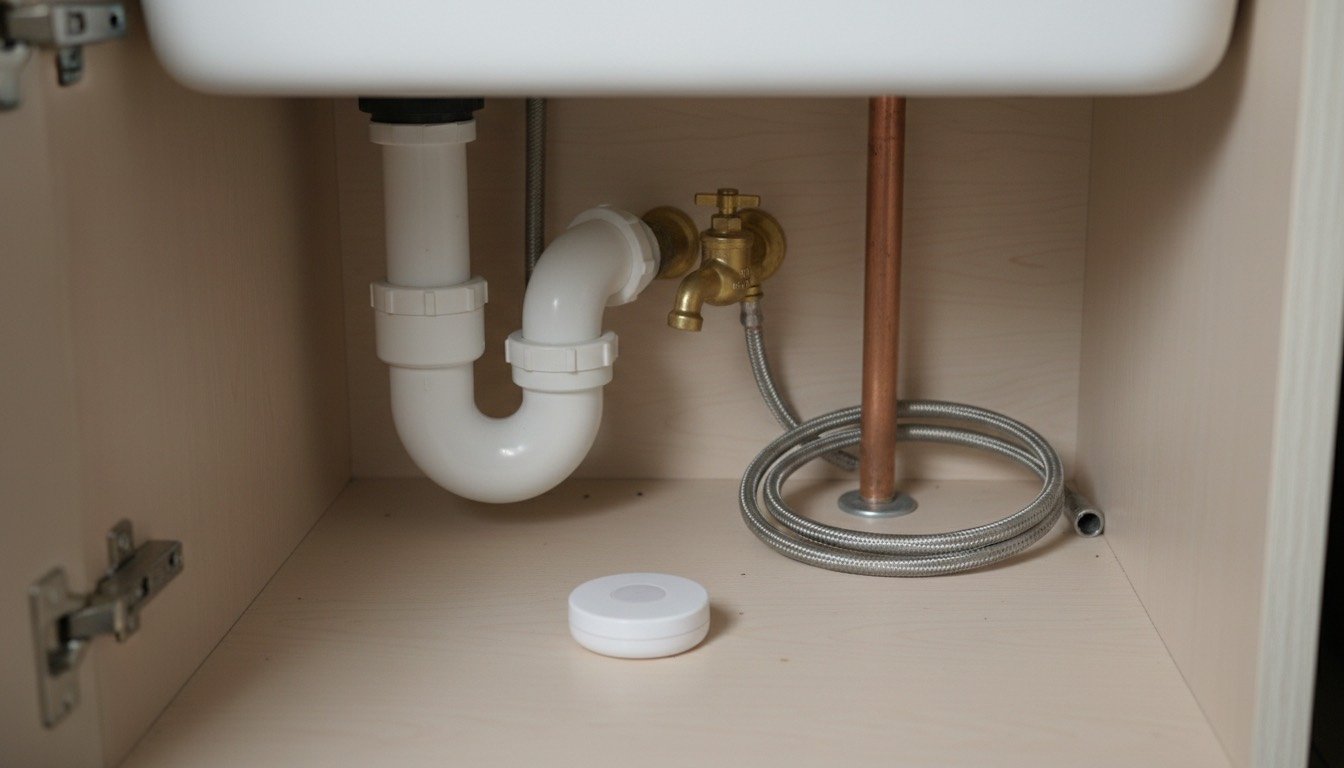
~£15–£20 eachA small IP67 puck that sits on the cupboard base and reports within a second or two of the contacts wetting, with a local buzzer plus a push notification through the hub. At this price you buy four and cover the sink, washing machine, dishwasher and cylinder for less than one call-out.
Pros
- ✓ Fast, reliable trigger even on a thin film of water
- ✓ Two years and more from a single CR2032 cell
- ✓ Cheap enough to deploy properly rather than sparingly
Cons
- ✗ Requires an Aqara hub for remote alerts, which adds to the true cost
- ✗ Local buzzer is quiet — fine in a kitchen, inaudible from upstairs
Ring Alarm Flood & Freeze Sensor
~£30–£40Combines a flood probe with a temperature alarm that fires as the surrounding air drops towards freezing, which is the warning that matters in an uninsulated loft or outbuilding. Sensible if you already run a Ring Alarm base station and want cold-weather cover as well as leak cover.
Pros
- ✓ Freeze alert gives you notice before pipes actually burst
- ✓ Long range from the base station, so it reaches lofts and detached garages
- ✓ Sits happily in unheated, damp spaces without corroding
Cons
- ✗ Useless without a Ring Alarm base station, so it is not a standalone buy
- ✗ Dearer per point than a plain leak puck
Who Actually Needs One — and Who Can Skip It
Escape of water is consistently among the most expensive categories of UK home insurance claim, and the reason is rarely the burst itself. It is the slow ones: a washing machine fill hose seeping at the collar, a cylinder gland weeping into an airing cupboard, a bath waste that only leaks when somebody lies in it. Several insurers now discount premiums or supply a monitor free, which changes the maths.
- •Worth it: any flat above another dwelling, where a leak becomes someone else's ceiling and your liability
- •Worth it: houses left empty for weeks — holiday lets, second homes, anyone working away
- •Worth it: screeded floors, underfloor heating or a bathroom over a plastered ceiling, where water stays hidden until it stains
- •Worth it: 1960s–1980s copper showing green verdigris at the joints, or a loft whose pipework has just been disturbed
- •Skip the whole-home version: a small terrace with suspended floors and somebody home most days. Buy three £15 pucks instead
How We Judge Them, and What We Have Not Bench-Tested
Be clear about what this is. We have fitted whole-home units on domestic rising mains and lived with spot sensors under our own sinks and washing machines for several winters, so the judgements on installation, false alarms, battery life and how fast an alert reaches a phone come from use rather than a spec sheet. We have not run a controlled laboratory comparison, and we do not claim to have.
What we weight, in order: does it catch a slow weep rather than only a burst; does the alert arrive when you are 200 miles away; can it shut the water off unattended; and is it still reporting in month eighteen. Anything that only screams locally is a smoke alarm for water — no use in an empty house, which is exactly when the worst leaks happen.
The Four We Would Actually Fit
Prices are what UK retailers were asking in mid-2026, excluding fitting. The two whole-home units are a different purchase from the pucks: they protect the pipe you cannot see, not the appliance you can. If the utility room flooded once, a £15 puck under the machine already solves that.
Where DIY Stops and a Plumber Starts
This is the part the packaging stays vague about. In England and Wales, everything downstream of your internal stopcock is yours to work on; the supply pipe up to and including the communication pipe belongs to the water undertaker, and cutting into it is not a homeowner job. Any new fitting on the drinking-water main must comply with the Water Supply (Water Fittings) Regulations 1999 — in practice, use a WRAS-approved device, because a non-approved valve on the rising main can undermine your insurance.
A competent DIYer — someone who has made off a compression joint before and knows where the stopcock is — can reasonably do all of this.
- •Place, pair and test every spot sensor: no tools, no risk, 20 minutes for a whole house
- •Fit a clamp-on external monitor, which touches nothing wet at all
- •Site the hub, change batteries, and run a monthly wet-cloth test on each puck
- •Lag the pipe either side of a new device so it does not become the cold spot that freezes — see how to prevent and safely thaw frozen pipes
- •Cut into and rejoin a 15mm or 22mm rising main to insert a flow monitor, but only if you can isolate, drain down and remake joints confidently
Call a Plumber Without Arguing If
There is no pride in a wet loft. Bring in a WaterSafe-registered plumber when the rising main is lead, iron or unidentifiable; when the only cut-in point is inside a wall, a floor void or under a concrete slab; when the stopcock is seized, as many pre-1990 stopcocks are, because you find that out only after the pipe is open; when the unit wants a 230V spur rather than batteries, which in a room containing a bath or shower is notifiable under Part P; or when you are on a shared riser and cannot isolate your own supply. Reckon on £150–£280 for a half-day fit including the valve union — check current rates against what a plumber costs by job.
If water is already coming out, close the stopcock and follow the emergency steps for a burst pipe. Buy the detector afterwards.
What to Look For Before You Pay
One more: check whether the shut-off valve fails open or closed on power loss. A valve that shuts itself every time the router reboots gets unplugged within a fortnight.
- •Automatic shut-off, or just an alert? An alert to a phone nobody is holding stops nothing — if the house is ever empty for a weekend, pay for the valve.
- •Sensitivity to slow flow: good units flag under a litre an hour, poor ones only see a burst.
- •Pipe size and material. Most whole-home units suit 15mm or 22mm copper or plastic; 28mm, lead or old iron is a different conversation.
- •Freeze warning. A sensor that alarms at 4°C in a loft or garage buys you the evening you need to get heat in there.
- •Battery life, and what happens when it dies. Two years is the realistic floor, and a unit that silently stops reporting is worse than none.
- •Insurer status. Some monitors are free or discounted through your policy, so ring your insurer before buying anything.
The Mistakes We See Most
- •Putting the puck in the wrong place. Water runs to the lowest point, not to the appliance — sit it flat on the cupboard base, not on the pipe.
- •Buying one sensor. Three cheap pucks under the sink, machine and cylinder beat one expensive one by the boiler.
- •Fitting the monitor upstream of the outside tap, so every hose fill looks like a leak and the alerts get muted.
- •Treating it as damp-proofing. A detector sees free water, not humidity — for tide marks and soft plaster, work through the signs of hidden water damage instead.
- •Assuming it covers the drains. Every device here watches the supply side; a leaking waste pipe or failed shower tray seal never registers.
Found this useful?
There's plenty more — hundreds of guides and honestly-tested product reviews for every corner of your home.
Browse All Guides