Heating & Cooling · 5 min read · 1 April 2026
Tumble Dryer Not Heating? Diagnosing Vented, Condenser, Heat Pump and Gas Models
The load comes out damp and cold after ninety minutes and the machine hasn't flagged a fault. On most dryers we open up, nothing has actually failed — the airflow has been strangled.
By the Nims Casa editorial team — written from professional cleaning experience and checked against our editorial standards.
The load comes out cold and heavy after ninety minutes, the drum is still turning, and there is no error code. On most dryers we open up, nothing has failed. Airflow has been strangled, the machine has sensed itself overheating, and it has cut the heat to protect itself — a safety device doing its job, not a breakdown.
A tumble dryer is a fan and a heat source in a metal box. Nearly every no-heat complaint traces to air that cannot move, a cut-out already tripped, or a component gone open circuit. Work through them in that order and you will either fix it in twenty minutes or know exactly what to tell the engineer.
How Your Dryer Makes Heat — It Depends on the Type
You cannot diagnose this until you know which of the four UK dryer types you own. The wrong assumption sends people buying elements for machines that never had one.
- •Vented: a 2.3-2.7 kW element behind the drum, air pushed through the load at 65-75°C, damp air out via a hose to a wall vent.
- •Condenser: same element and temperatures, but moist air is cooled in a heat exchanger at the base and water collects in a tank.
- •Heat pump: no conventional element. A sealed refrigerant circuit recycles air at 50-55°C for a third of the electricity. Now the dominant type sold new in the UK.
- •Gas: a burner, valve, igniter and flame sensor replace the element. Rare in British homes; common in launderettes and gyms.
Heat Pump Dryers Are Meant to Feel Cool
Many "not heating" call-outs on heat pump machines are not faults. Drum air never exceeds about 55°C, so the load comes out barely warm and a cycle legitimately takes two to two and a half hours. That gentler heat is why they suit wool and elastane, and why they lead our tumble dryer recommendations. Genuinely faulty: a cycle past three and a half hours, or one ending with the load still visibly wet.
Causes, in the Order We Actually Find Them
Across hundreds of domestic dryer jobs, the distribution barely shifts:
- •Fabric conditioner film glazing the lint filter — a third of cases. The mesh looks clean but water beads on it instead of running through.
- •A blocked condenser heat exchanger or heat pump evaporator — about a quarter. Owners clean the filter religiously and never touch the block behind the flap.
- •A crushed, kinked or lint-packed vent hose, or a wall vent with a seized flap — one in six vented machines.
- •A tripped one-shot thermal cut-out, almost always a consequence of the three faults above.
- •A heating element gone open circuit — often the second one eaten because the airflow was never fixed.
- •Thermostat, NTC sensor, door switch or control-board relay. Uncommon, and worth a paid diagnosis.
- •On gas models: igniter, flame sensor or gas valve coils — engineer only, for the legal reasons below.
Checks You Can Safely Do Yourself
Pull the plug from the wall socket first; switching off at the machine's button is not isolation. Let the element cool for half an hour. Check too that the dryer runs straight off a wall socket — 2.3 kW on a coiled extension lead is a real fire risk. Past these checks, you are into electrical repairs you should never DIY.
- •Wash the lint filter under a hot tap with washing-up liquid and a soft brush, then hold it to the light — you should see daylight through the whole mesh.
- •Condenser models: release the lower flap, slide the heat exchanger block out and rinse it until the water runs clear — every two to three months.
- •Heat pump models: brush the evaporator fins with a soft paintbrush, never a screwdriver. Bent aluminium fins are permanent damage.
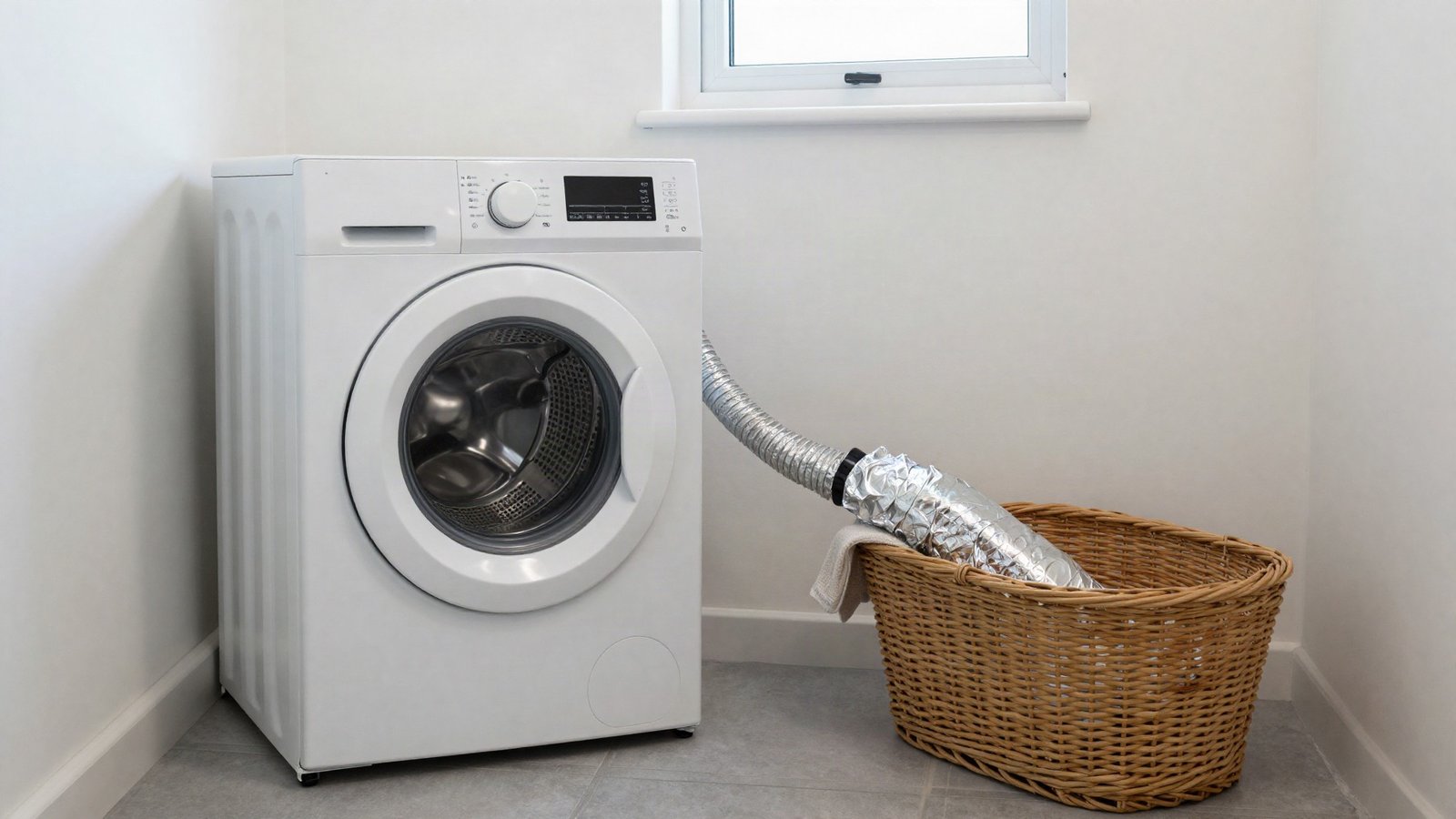
- •Vented models: run the machine two minutes with the hose off. If it heats fine like that, the hose or wall vent is your fault. Keep the run under 2.4 m and two gentle bends.
- •With a multimeter, machine unplugged: a healthy one-shot cut-out reads close to 0 Ω, and a 2.3 kW element on 230 V should measure roughly 23 Ω.
- •Replace a blown cut-out only after clearing the restriction that blew it, or it goes again within a fortnight.
Where UK Rules Say You Must Stop
Gas dryers are a hard boundary. Under the Gas Safety (Installation and Use) Regulations 1998, only a Gas Safe registered engineer may work on the burner, gas valve, flue or supply. Doing it yourself is a criminal offence and voids your home insurance. Ask for the ID card: the back lists the categories that engineer actually holds, and dryers are not automatic.
Electrically, swapping a like-for-like part inside the appliance is not notifiable. Running a new dedicated circuit or spur for the dryer in England and Wales is: that falls under Part P of the Building Regulations, so it needs a registered electrician who self-certifies, or building control notified first.
Cutting a new external vent is normally permitted development, but a listed building needs consent. If you let the property, a gas dryer must appear on the annual CP12, supplied appliances must be safe under the Homes (Fitness for Human Habitation) Act 2018, and fixed wiring needs an EICR every five years. Lint fires are a real category in UK fire statistics, so never run a dryer overnight or while out — a point we labour in our home fire safety checklist.
What It Costs to Put Right
Parts are cheap; labour and the call-out are what you pay for. Typical 2026 UK figures:
- •Replacement lint filter, vent hose or external cowl: ~£8-£30
- •Thermal cut-out and thermostat kit: ~£10-£25 in parts, £90-£150 fitted
- •Heating element: ~£25-£60 in parts, £110-£180 fitted
- •Independent engineer diagnostic call-out: £60-£95, or £85-£120 inside the M25
- •Manufacturer fixed-price repair: £130-£200 including parts and a 12-month guarantee
- •Heat pump refrigerant leak or compressor failure: £280 upwards, if the part exists
Repair or Replace?
Our working rule is the 40 per cent test: if the quote exceeds 40 per cent of a like-for-like replacement and the machine is past eight years old, put the money towards a new one. A sealed-system fault on a heat pump dryer nearly always fails that test — £280 or more against roughly £450 for a decent new machine. An element on a five-year-old vented dryer nearly always passes. Check the age question against typical appliance lifespans and rates against our appliance repair costs guide.
One closing note: if loads reach the dryer spun at only 800 rpm, the spin speed is the real problem. While it is out of action, see drying clothes indoors without causing damp.
Questions We Get Asked Most
- •Why does a load take three hours, or heat then go cold mid-cycle? Both are restricted airflow: the machine cycles on its thermostat because air cannot carry the heat away. Filter, heat exchanger, hose — in that order.
- •Can I fit an element myself? Straightforward on most vented machines, but you void any warranty and, without testing the cut-out too, you will be back inside a month.
- •There is a scorched smell. Stop, unplug at the wall, and do not run it again until the lint path is cleared.
- •Is a heat pump cheaper to run? Roughly 1.5-2 kWh a load against 3.5 kWh or more — about 40-50p each time.
Found this useful?
There's plenty more — hundreds of guides and honestly-tested product reviews for every corner of your home.
Browse All Guides