Electrical · 6 min read · 5 July 2026
Electrical Repairs You Should Never DIY (UK Part P Rules and the Jobs That Kill)
Some household electrical jobs are fine for a careful amateur. Others are notifiable under Part P, uninsurable, or simply lethal. Here is where the line actually sits in a UK home.
By the Nims Casa editorial team — written from professional cleaning experience and checked against our editorial standards.
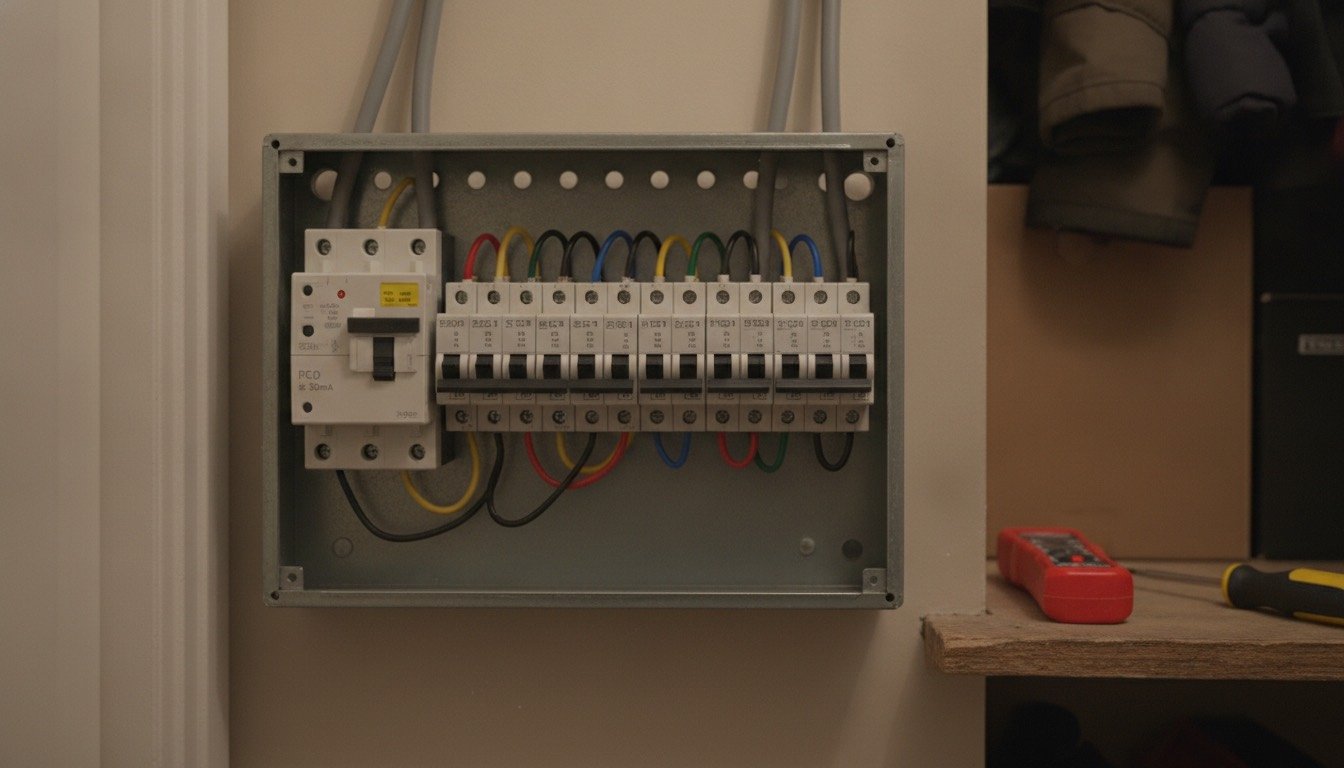
Every sparks has a story about the socket that was "only a swap". Mine is a 1930s semi in Bristol where the owner changed a double socket in the hall and, without realising it, turned a spur into a second spur feeding the landing. No earth sleeving, no trip, no smell. It sat there eleven years until an EICR coded it C2 — potentially dangerous.
Unlike a leaking tap or a botched tile, bad electrical work usually looks completely fine. The risk only appears when someone touches a fault path, or when a loose terminal has been quietly heating a back box for a decade. The useful question is not "can I do this?" but "what happens if I get it slightly wrong, and would anyone find out in time?"
First, the law: Part P and notifiable work
In England and Wales, electrical work in dwellings falls under Part P of the Building Regulations. No rule says only an electrician may pick up a screwdriver — a householder can legally do non-notifiable work. But notifiable work must either be carried out by someone registered with a competent person scheme (NICEIC, NAPIT, ELECSA, STROMA) who self-certifies it, or be notified to local authority building control before you start.
In England, notifiable means three things: a new circuit, a consumer unit replacement, and any alteration or addition inside a special location — in practice, a room containing a bath or shower. Wales kept the wider pre-2013 list, which also catches kitchens and outdoor circuits. Scotland runs on Building Standards and a building warrant; Northern Ireland uses Technical Booklet P. Everywhere, the installation must comply with BS 7671. Retrospective regularisation typically costs £250–£500 plus inspection and remedials, and building control can ask you to open up finished walls — see when you need an electrical permit.
The repairs to leave alone, ranked by consequence
Ranked by what happens when it goes wrong, not by how difficult the job looks:
- •Touching the service head, cut-out fuse or meter tails. Unfused, permanently live, no isolation available to you. This is the one that kills electricians — only the DNO or your supplier may break the seal.
- •Replacing a consumer unit. Notifiable, requires testing of every existing circuit afterwards, and a wrong RCD arrangement can leave a whole floor unprotected.
- •New or altered circuits in a bathroom or shower room. Notifiable in England and Wales; zone rules dictate IP ratings, cable routes and supplementary bonding.
- •Electric shower and cooker circuits. A 10.5kW shower needs 10mm² cable and a 45A or 50A supply. Undersized cable does not trip — it cooks inside the wall until the insulation fails.
- •Outdoor circuits, garden sockets, sheds and EV chargers. SWA cable, correct earthing arrangement, and for chargers, Part S and DNO notification.
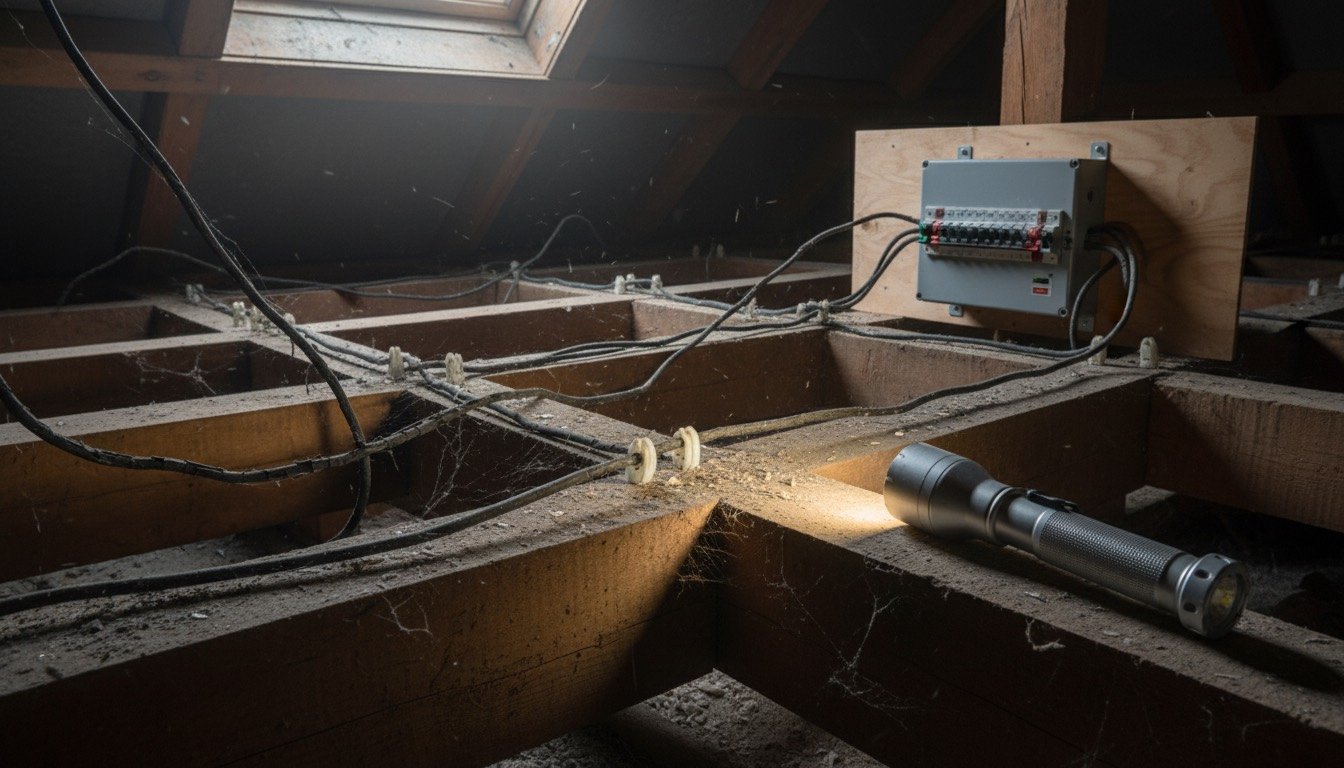
- •Anything on rewireable fuses, rubber or lead-sheathed cable, or a lighting circuit with no earth — a system meeting no current standard.
- •Extending a ring final circuit. Spurring off a spur, or breaking the ring and not reconnecting both legs, is invisible until a continuity test finds it.
Why capable people still get this wrong
None of it happens through carelessness. It happens because domestic wiring gives almost no feedback. Three failure modes recur:
The deeper problem is confidence built on the wrong evidence. A circuit that has "worked fine for years" tells you nothing about earth continuity, loop impedance, or whether the RCD trips at 30mA. Only test instruments answer that — a DIY-shed socket tester will happily show a healthy pattern on a circuit with a high-resistance earth. If a socket has died, work through the dead socket troubleshooting order first.
- •Isolation that isn't. Switching off an MCB proves nothing. Lock off, then prove dead with a GS38-compliant two-pole voltage indicator checked against a proving unit before and after. Non-contact volt sticks give false negatives.
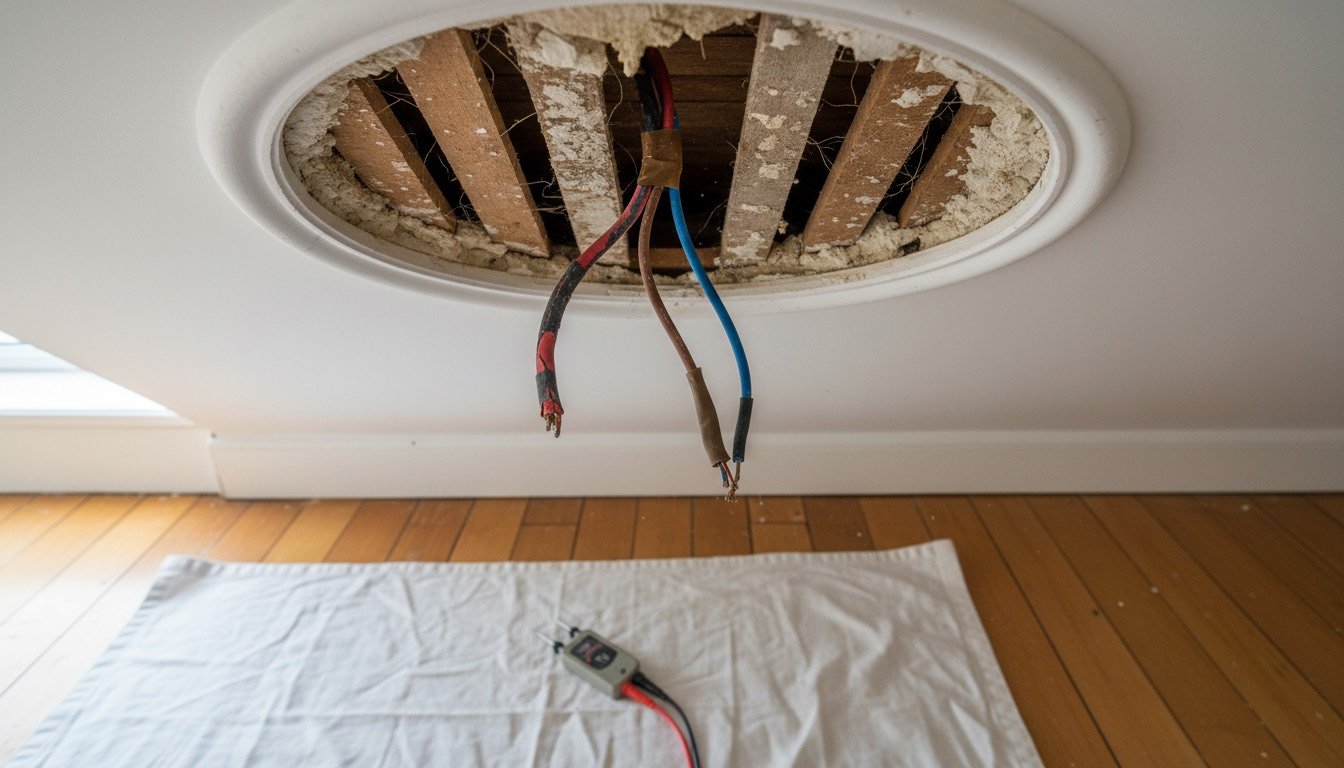
- •Colour confusion. Pre-2006 UK cable is red and black; after 2006, brown and blue. In a partly rewired house you meet both in one box, and black can be a switched live — see identifying UK wire colours.
- •Terminals that feel tight. Solid conductors relax after thermal cycling, and a terminal torqued by feel is the commonest cause of that burnt smell behind a front plate.
What you can safely do yourself
Plenty. Non-notifiable maintenance outside special locations, done competently and to BS 7671, is legitimate DIY.
- •Like-for-like replacement of a socket front plate, switch or ceiling rose on an existing circuit outside a bathroom, where the cabling is modern and earthed.
- •Changing plug tops and BS 1363 fuses — 3A for most electronics, 13A for kettles and heating loads.
- •Replacing lamps, LED panels and pendant fittings on an existing lighting point.
- •Resetting an MCB or RCD once and investigating the cause — read why a circuit breaker keeps tripping before pushing the lever back up again.
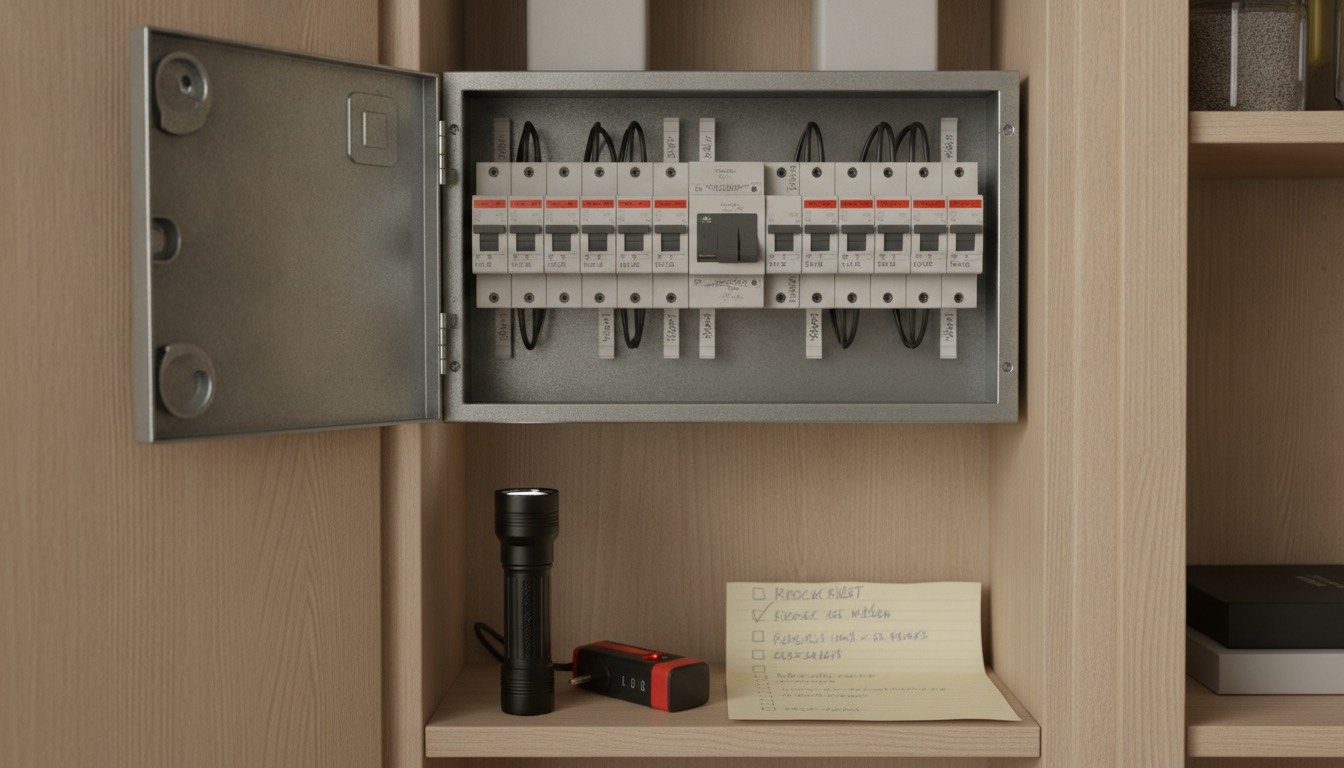
- •Testing the RCD button quarterly — it should trip instantly, and if it does not, that is a call-out. And label your consumer unit properly: free, and it saves an electrician half an hour of your money.
Landlords, sellers and the paper trail
If you let property in England, the Electrical Safety Standards in the Private Rented Sector Regulations 2020 require an EICR at least every five years by a qualified and competent person, with a copy to tenants within 28 days. Any C1, C2 or FI code must be remedied within 28 days with written confirmation, and councils can impose penalties up to £30,000 per breach. Wales has an equivalent duty under the Renting Homes (Wales) Act; Scotland has required five-yearly EICRs since 2015. DIY work in a let property does not merely fail the inspection — it puts the landlord on the wrong side of a statutory duty.
Owner-occupiers have no equivalent obligation, but it surfaces at sale. Conveyancers routinely ask for Building Regulations compliance certificates for consumer unit changes and new circuits; without one, buyers want an indemnity policy (£30–£150) or a price reduction. For bigger projects, the cost of rewiring a house anchors most of these decisions.
When to stop, and what calling someone costs
Stop and call a registered electrician if you find scorching at an accessory, an RCD that will not stay in, a burning or fishy smell from the consumer unit, a socket warm to the touch, a tingle from a tap or appliance, or cable you cannot identify. Stop too if you opened something and found more conductors than expected — that means a junction, a loop-in arrangement or a borrowed neutral, and it is no longer a swap.
The costs are less frightening than people assume. Registered electricians charge roughly £45–£65 an hour or £280–£400 a day across most of the UK, nearer £60–£90 an hour in London and the South East. A minimum call-out covering a socket or switch is typically £80–£120, an EICR on a three-bedroom house £150–£300, and a certified consumer unit replacement £450–£850 — our electrician cost breakdown has the regional detail. Check the scheme register before booking, and ask which certificate you will receive: an Electrical Installation Certificate for new circuits and consumer units, a Minor Works Certificate for alterations. Anyone who cannot answer that should not be doing notifiable work in your house.
Found this useful?
There's plenty more — hundreds of guides and honestly-tested product reviews for every corner of your home.
Browse All Guides