Roofing & Exterior · 6 min read · 14 August 2026
How to Clean Render and External Walls: Algae, Red Stains and Grime
Green film and pink-orange blooms on modern render are algae, and a pressure washer will ruin the wall trying to shift them. Here is the soft-wash method the professionals use, with UK costs.
By the Nims Casa editorial team — written from professional cleaning experience and checked against our editorial standards.
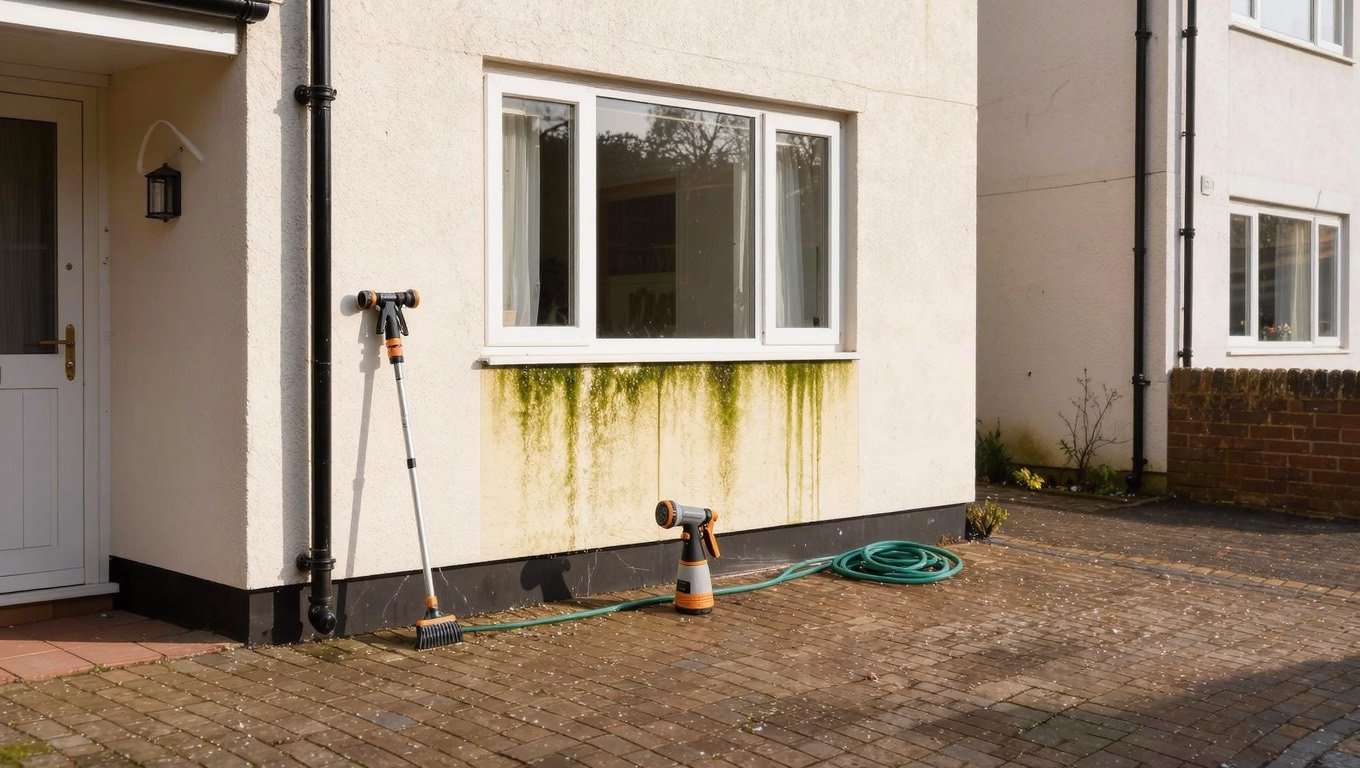
The green film creeping up the north elevation and the pink-orange blotches spreading across a ten-year-old K Rend job are both algae. The green sort is a general surface growth that thrives on any damp, shaded wall; the red sort (Trentepohlia) has a particular appetite for modern silicone and monocouche renders and is far more stubborn, because its pigment stains the textured surface rather than just sitting on it. Neither is eating the render, but both hold moisture against the wall and make a £10,000 render system look tired within a decade.
Cleaning render properly is mostly patience and chemistry, not muscle — and the obvious tool, a pressure washer, is exactly the wrong one. Walls that someone has already 'cleaned' with a lance never fully lose the stripes.
Why you must not pressure wash render
Thin-coat silicone renders and coloured monocouche renders like K Rend carry their finish in the outer couple of millimetres. A pressure washer at close range blasts off that surface, leaving pale lance stripes and a roughened texture that regrows algae faster than before. Worse, high pressure drives water through hairline cracks into the substrate, where trapped moisture can take months to dry — a shortcut to the problems covered in our guide to damp and mould in UK homes. K Rend and most other manufacturers explicitly warn against pressure washing, and doing it can void the render warranty.
Save the pressure washer for the patio. Render gets soft washing: a biocide applied at low pressure, allowed to dwell so the chemical kills the growth, then either rinsed gently or left for the weather to finish the job.
Safety first
The two real hazards here are ladders and chemicals. Work from the ground with a telescopic lance or pump-up sprayer wherever possible; most two-storey elevations can be reached with a 6-9 m pole. If you must climb, use a properly footed ladder with a standoff so you are not leaning against the render — our ladder buying guide explains what to look for. Professionals are bound by the Work at Height Regulations 2005; you are not, but the physics of falling is identical, so borrow their rules.
On chemicals: only use biocides authorised under the GB Biocidal Products Regulation — reputable products state their HSE authorisation number on the label. Wear gloves and goggles, keep pets and children off treated areas until dry, and pre-soak then rinse any plants below the wall. Never let runoff reach ponds or surface-water drains; sodium hypochlorite is highly toxic to aquatic life, and polluting a watercourse is a prosecutable offence.
Tools and materials
For a DIY soft wash of an average three-bed semi you need surprisingly little:
- •Benzalkonium chloride (quaternary ammonium) biocide concentrate — a 5 L jug at £20-£40 treats roughly 150-300 m² diluted
- •Garden pump sprayer, 5-8 L (£15-£30), or a telescopic soft-wash lance kit (£40-£120) for first-floor walls
- •Hosepipe with a gentle fan spray for pre-wetting and rinsing — never a pressure lance
- •Soft-bristle brush on a pole for heavy localised growth
- •Gloves, goggles, plastic sheeting for plants, and a bucket for diluting
- •Optional for red algae: a hypochlorite-based render cleaner, used strictly to the label dilution
Realistic time and cost
DIY, expect half a day for a typical semi — most of that is masking plants and moving the sprayer. Materials come in at £40-£80 all told. The catch is patience: leave-on quat biocides kill the algae within days, but the dead growth weathers off over 2-6 weeks of rain. It looks worse before it looks better.
Professional soft washing typically runs £8-£15 per m², so a rendered three-bed semi lands around £450-£900, rising towards £1,500 where access needs a tower. That usually buys a hypochlorite wash for instant results plus a residual biocide, holding for 2-4 years. If the render is beyond cleaning — chalky, cracked or patch-repaired — check the cost of painting a house exterior before paying for repeated cleans.
Step-by-step: soft washing render
Pick a dry, still day between 5°C and 25°C — wind carries spray onto cars, and rain within 6 hours washes the biocide off before it works.
- •1. Inspect the wall first. Fill any cracks wider than a hairline and fix the source of any leak stains before cleaning — a wet wall regrows algae in months.
- •2. Protect the surroundings: sheet or thoroughly pre-soak plants, close windows, move cars, and cover pond edges.
- •3. Brush off any loose, heavy growth with a soft pole brush. Dry brushing first means the biocide reaches the wall, not a mat of algae.
- •4. Dilute the biocide to the label rate — typically 1:5 to 1:10 for benzalkonium chloride products — and apply from the bottom of the wall upwards in even passes. Bottom-up prevents clean streaks running through dry grime.
- •5. Let it dwell. Quat biocides stay on: do not rinse. If you are using a hypochlorite render cleaner for red algae, keep the surface wet with product for 15-30 minutes, never letting it dry on.
- •6. Rinse hypochlorite off with low pressure only — a hose fan spray or a soft-wash lance under about 7 bar, held a metre back. Quat-treated walls just get left for the rain.
- •7. Rinse all plants and paving below, then re-treat the wall lightly every 12-18 months to stop regrowth establishing.
Troubleshooting
If green growth dies but pink-orange staining survives, that is red algae pigment bonded into the render texture. It needs a hypochlorite-based treatment, sometimes two rounds a fortnight apart, and on badly stained silicone render even professionals only get 90-95% of it out. Brown vertical streaks that ignore biocide are usually rust from embedded fixings, not algae. White fluffy bloom on newish render is lime efflorescence — mineral, so biocide will not touch it; brush it dry and let it weather out.
A wall that regrows within a year is telling you it is being kept wet. Follow the staining upwards: nine times out of ten it ends at a dripping joint, a blocked outlet or an overflowing hopper. Fixing a leaking gutter costs pennies compared with annual wall cleaning, and routine gutter cleaning and maintenance is the single cheapest way to keep render clean, because every algae colony needs a steady water supply. Cutting back shrubs and trees that shade the wall helps too.
When to call a professional
Hand the job over when a wall needs work above what your pole reaches from the ground, when red algae covers a large area, or when overspray and runoff need containing near a road or a neighbour's garden. Three-storey gable ends are scaffold or cherry-picker work, full stop. Landlords: keeping external walls in repair falls under section 11 of the Landlord and Tenant Act 1985 — algae is cosmetic, but the cracked render and failed gutters feeding it are not.
Choose a contractor who says 'soft wash' unprompted, names the biocide they use and quotes per square metre. Anyone who turns up to render with only a pressure washer should be sent to clean the drive instead.
Found this useful?
There's plenty more — hundreds of guides and honestly-tested product reviews for every corner of your home.
Browse All Guides