Energy & Insulation · 6 min read · 21 May 2026
How to Reduce Water Use at Home: A UK Step-by-Step With Real Costs
Most water-saving advice ignores the part that actually costs you money: heating it. Here are the jobs in order of payback, with real UK part prices and plumber rates.
By the Nims Casa editorial team — written from professional cleaning experience and checked against our editorial standards.
The average person in England and Wales gets through roughly 140 litres a day, and about a third of it is heated first. That is why a metered household doing this properly saves more on gas than on the water bill — the bit most leaflets skip.
This is the running order we use in customers' houses: jobs ranked by payback, with real part prices, plumber rates, and the two big measures that never pay back.
Safety first: five things that go wrong
Saving water sounds harmless. Several of these measures are not.
- •Never drop a hot water cylinder below 60°C. Legionella multiplies between 20°C and 45°C, so stored water needs 60°C and distribution above 50°C.
- •Do not fit a restrictor or aerating head to an electric shower — the unit meters its own flow, and choking the outlet makes it trip.
- •Gravity-fed systems (loft tank, cylinder in the airing cupboard) run at 0.1 to 0.3 bar; most aerating heads need 1 bar and will dribble.
- •Never connect rainwater or greywater to a mains pipe. The Water Supply (Water Fittings) Regulations 1999 require physical separation, backflow protection and marked pipework.
- •Butt water is not drinking water. Keep it off salad crops within a fortnight of harvest.
Tools and materials, with prices
This is hand-tight work; the skill level is low and the list short.
- •Adjustable spanner, water pump pliers and a cloth for the chrome — £15 to £30
- •Tap aerators, £3 to £8 each (M22 male or M24 female fits most UK taps)
- •Aerating shower head, £15 to £45 hand-held or £60 to £120 fixed
- •Inline 8 l/min shower flow regulator, £8 to £15
- •Cistern displacement bag — free from most water companies
- •Replacement flush valve or dual-flush conversion, £15 to £35
- •210-litre water butt, stand and diverter kit, £35 to £70
- •Battery leak alarm for the stopcock cupboard, £20 to £45
Realistic time and cost, and the labour split
A full pass through a three-bedroom house takes a Saturday morning and £70 to £120 in parts. On the DIY jobs, materials are 90 to 100 per cent of the cost; with a plumber that flips. On a £120 running-toilet repair, £22 is the part and £98 is labour — which is why you bundle small jobs into one visit.
Three worked examples at a combined water and wastewater rate of about £3.50 per cubic metre; check your own bill, as regional rates run £2.80 to £4.60.
- •Four tap aerators: £20, 20 minutes, no labour. A family of four saves 8 to 12 m³ a year — £28 to £42, plus the gas that heated it. Payback: one summer.
- •One shower head swap: £35, ten minutes. Taking a mixer shower from 12 to 8 l/min across four eight-minute showers a day saves 47 m³ — £165 of water and 1,600 kWh of gas, another £95.
- •A leaking loo repaired: £22 for the valve, or £90 to £150 with a plumber. A failed flush seal loses 200 to 400 litres a day — £250 to £500 a year metered — and makes no noise.
The step-by-step, in order of payback
Work down this order, not from easiest. Steps 1 and 2 find waste; the rest reduce it.
- •1. Read the meter last thing at night and again at dawn with everything off. Movement over eight hours is a leak — trace it first, using our method to find a water leak in your house.
- •2. Dye-test every toilet: food colouring in the cistern, no flushing for 30 minutes, then look in the pan. Colour there means the flush seal has gone — see our running toilet repair. Add a displacement bag to any pre-2001 cistern too.
- •3. Change the kitchen and basin aerators: unscrew anticlockwise with a cloth around the chrome, then hand-tighten. Basin taps drop to 4 to 5 l/min.
- •4. Time your shower by filling a 10-litre bucket. Under 50 seconds means over 12 l/min, and a low-flow shower head is the best £35 here.
- •5. Kill every drip. A tap dripping once a second wastes 5,500 litres a year, and on the hot side you pay to heat it — see our dripping tap guide.
- •6. Run washing machines and dishwashers full and on eco. A dishwasher on eco uses 9 to 11 litres; the same load under a running tap uses 60-plus.
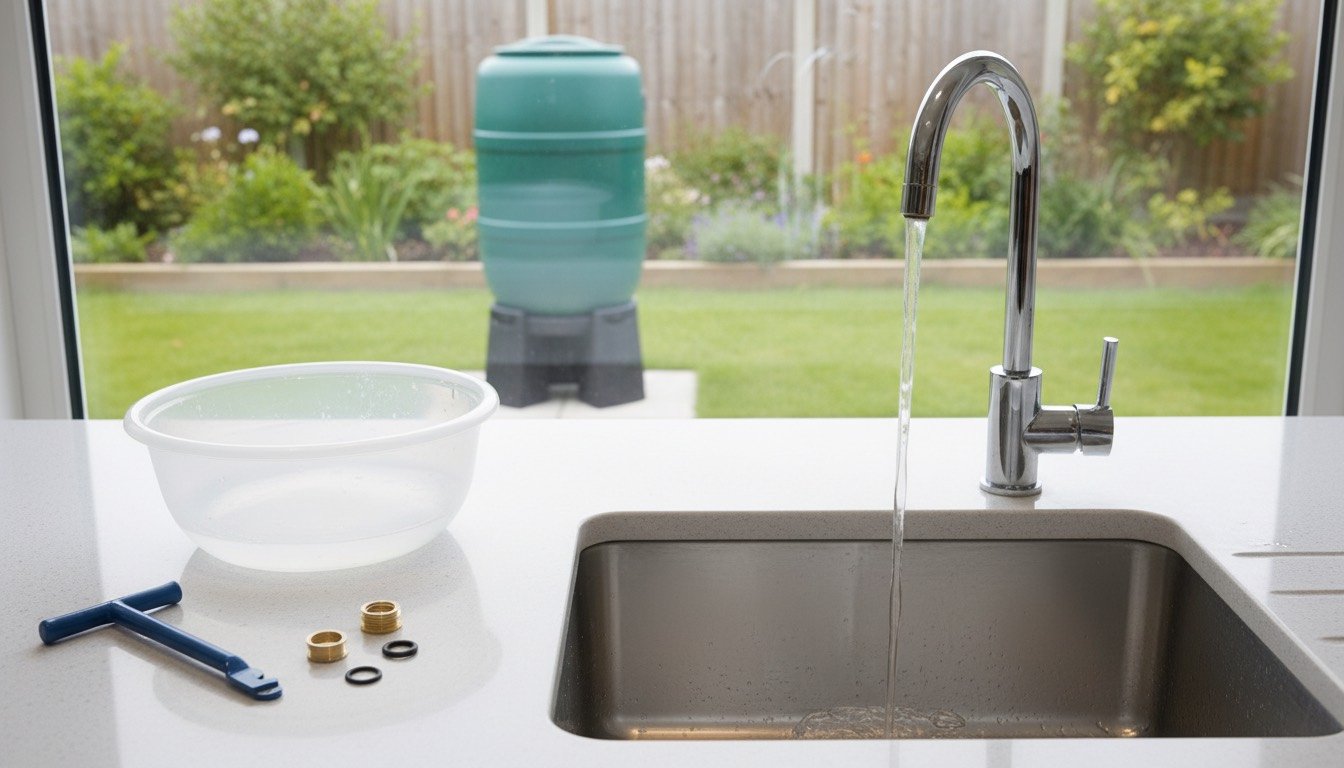
- •7. Fit a water butt on the downpipe nearest the garden tap and water at 6am, at the roots. A sprinkler throws 500 to 1,000 litres an hour; a soaker hose on a timer uses far less.
- •8. On rateable value with more occupants than bedrooms? Ask for a meter: fitting is free and you can switch back within two years.
Rainwater and greywater: honest payback
Two products get sold hard on water anxiety and deserve real scrutiny.
- •Underground rainwater harvesting — tank, filter, pump, controls, mains top-up — runs £2,500 to £6,000 installed on a four-bed. Supplying every flush saves 40 to 55 m³ a year, or £140 to £250: a 15 to 30 year payback against a pump lasting 15. Our rainwater harvesting cost breakdown itemises it.
- •Greywater recycling costs £1,500 to £4,000 plus annual servicing, and needs BS 8525 compliance and a disinfection stage. It cuts demand 20 to 30 per cent and almost never pays back at UK prices.
- •A quote is reasonable when tank, filter, pump, excavation and pipework are priced separately, the tank volume is named and payback is quoted in decades. Suspect any five-year payback claim.
Troubleshooting: when savings do not show up
Give it one billing quarter, then work through these.
- •Bill unchanged: check you are metered, not on a fixed assessed volume charge that no amount of saving will move.
- •New shower head dribbles: measure pressure at the outside tap with a £10 gauge. Below 1 bar you need a low-pressure head.
- •Aerator sprays sideways: the washer is pinched or the mesh limescaled. Soak in one part white vinegar to four parts water.
- •Meter creeping with the stopcock closed: the leak is on the buried supply pipe — usually yours, though many companies offer a leak allowance.
- •Toilet refilling briefly every hour: the fill valve diaphragm is passing, not the flush valve. A £12 part.
When to stop, and what a fair quote looks like
Call someone for any leak you cannot isolate at the stopcock, anything on the buried supply pipe, and any work joining a non-mains source to internal pipework.
Be wary of a quote that prices 'water saving' as an unlisted package, insists the supply pipe needs replacing before the leak has been isolated, or comes from a detection firm that also sells the repair. Ask for a meter reading before and after — a real fix shows on the dial within the hour.
- •Plumber rate: £45 to £75 outside the South East, £70 to £110 in London, one-hour minimum — see our plumber costs by job
- •Replace a flush or fill valve: £90 to £160 all in
- •Fit an outside tap with a double check valve: £120 to £220
- •Acoustic leak detection on a buried supply: £250 to £600
- •Supply pipe replacement by mole plough: £900 to £2,200
Found this useful?
There's plenty more — hundreds of guides and honestly-tested product reviews for every corner of your home.
Browse All Guides