Laundry & Fabric Care · 6 min read · 11 April 2026
Top Load vs Front Load Washer: The UK Truth About Cost, Space and Reliability
Almost every top-load versus front-load comparison online describes an American machine you cannot buy here. This is what the choice actually looks like in a British kitchen, priced over ten years.
By the Nims Casa editorial team — written from professional cleaning experience and checked against our editorial standards.
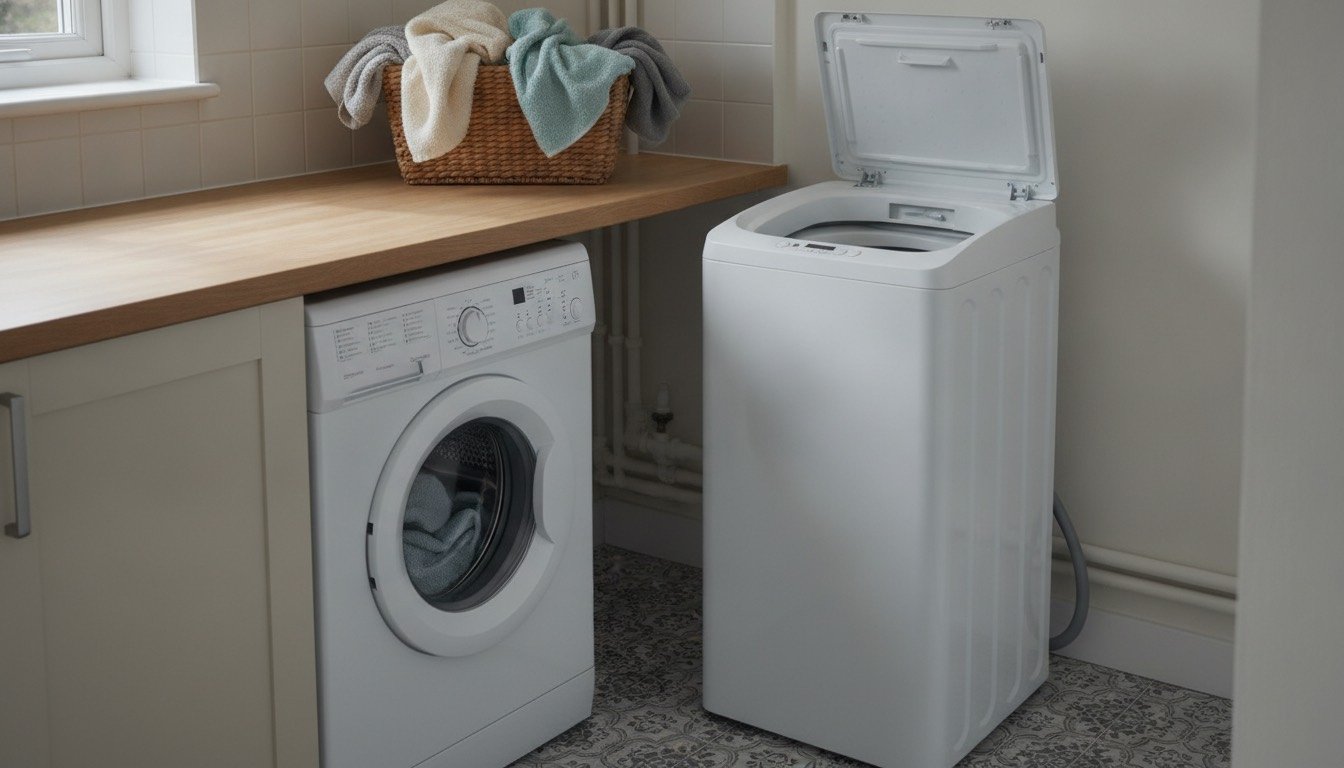
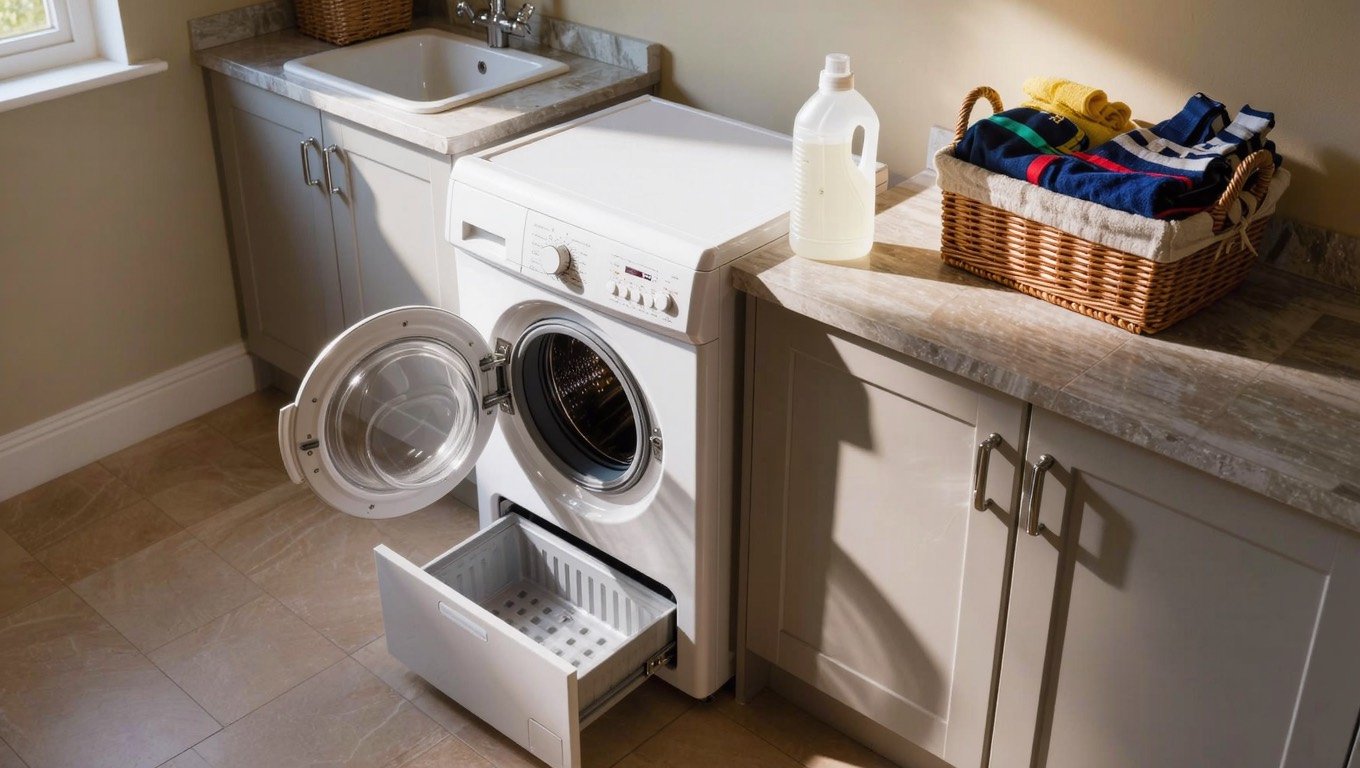
Walk into a UK appliance showroom and you might find two top-loading machines standing against forty front-loaders. That ratio is not fashion. British worktops sit at 900mm and every appliance is expected to slide underneath one, so most advice written on this subject describes a machine barely sold here.
The American top loader — vertical drum, central agitator, over 100 litres of water a cycle — is not a realistic purchase in Britain. What UK retailers call a top loader is something else entirely, which makes the real question narrower than the one the internet keeps answering.
What a "top loader" actually means in a UK kitchen
A British top loader is typically 40cm wide, 60cm deep and 88 to 90cm tall, from names like Candy, Hoover, Zanussi and Indesit. Inside sits a normal horizontal drum on two bearings, reached through sprung hatch doors. It washes exactly as a front-loader does, using 40 to 55 litres a cycle rather than the 100-plus an American agitator machine gets through. That kills most of the imported arguments: these are not water hogs and not rougher on fabrics. The trade-off is geometry, capacity and choice.
- •Width: 40cm against 59.5 to 60cm.
- •Drum axis: horizontal on both, so wash mechanics are identical.
- •Capacity: 6 to 8kg top loading, most at 6 to 7kg; 7 to 12kg front loading, 8 and 9kg the volume sellers.
- •Maximum spin: 1000 to 1400rpm against 1200 to 1600rpm.
- •Price new: £299 to £479 against £249 for a budget 8kg, up to £1,400 for a Miele.
- •Under a 900mm worktop: the front loader fits; the top loader needs clear air above the lid.
- •Stacked dryer or integrated door: front loader only.
- •Models on UK sale: roughly twenty against several hundred.
Performance: where the difference actually shows
Because both tumble a horizontal drum, wash results are close enough that we would never choose between them on cleaning alone. Spin is where the money hides. A 1400rpm machine leaves cotton at 52 to 55 per cent residual moisture; 1000rpm leaves it nearer 62 to 65 per cent. Across an 8kg load that is close to a litre of extra water still in the fabric — twenty to thirty minutes more tumble-drying every time, or another day on the airer. Our guide to heat pump tumble dryers explains why that compounds; if the airer is your dryer, read how to dry clothes indoors without damp first.
Capacity is the second gap: slimline top loaders stop at 8kg, and a 6 or 7kg drum will not take a 10.5 tog double duvet — that wants 9kg. Note too that the A to G rating is measured on Eco 40-60, a three-to-four-hour programme. Use Quick 30 and you will never see the sticker's numbers.
The ten-year cost, priced honestly
At 25p per kWh, £3.70 per cubic metre for metered water and sewerage, and 208 washes a year — four a week for ten years — purchase, energy, water and one realistic repair land like this:
- •Mid-range 8kg front loader, B-rated at 0.50 kWh: £520 to buy, £260 energy, £370 water, £150 for one out-of-warranty repair. About £1,300.
- •7kg slimline top loader, D-rated at 0.68 kWh: £399, £354 energy, £385 water, £200 repairs — fewer engineers, scarcer parts. About £1,340.
- •Budget 8kg front loader, E-rated at 0.72 kWh: £269, £374 energy, £370 water, £250 repairs. About £1,260, but expect to replace it at year seven.
- •Premium 9kg front loader, A-rated at 0.44 kWh: £999, £229 energy, £385 water, £120 repairs. About £1,730 — though these routinely run fifteen years, which inverts the sums.
Scaled to a real household
A family of four runs seven washes a week on a 6kg drum against five on a 9kg one — 104 extra cycles a year, about £35 in energy and water plus a hundred hours of your own time. Where the top loader wins money back is floor space, not electricity: in a 40cm gap beside a fridge a front loader will not go at all, and a laundrette at £6 a load costs a family £1,250 a year.
Installation, plumbing and the UK rules that apply
Plumbing is identical for both and it is the part people get wrong. The waste hose must discharge into a trapped standpipe of 32 to 40mm internal diameter, the hose end 600 to 900mm above the floor and never sealed in — that air gap stops dirty water siphoning back into the drum. One appliance per trap spigot, too: teeing a machine and a dishwasher into the same 40mm connection causes most "grey water in my machine" callouts. If a joint weeps, fix the leaking pipe joint before it reaches the ceiling below.
Electrically, both plug into a 13A socket, which is not notifiable. Adding a socket is where Part P of the Building Regulations bites, and the nations diverge: in England, extending an existing kitchen circuit stopped being notifiable in 2013, but a new circuit from the consumer unit still is. Wales kept kitchens as a special location; Scotland and Northern Ireland run their own standards. Notifiable work needs a registered competent person or building control sign-off — check what an electrician charges first.
Landlords carry more: the Electrical Safety Standards in the Private Rented Sector (England) Regulations 2020 require an EICR every five years, and this socket forms part of it. Where there is no extract ventilation and the tenant dries every load indoors, the mould is a hazard you own.
Maintenance and lifespan: which asks more of you
A front loader carries its drum on one bearing assembly at the back — a cantilever with a soaking 9kg load on it. Slimline top loaders support the drum at both ends, which is kinder to bearings. When a front-loader's bearings go, usually between years six and ten, the spin noise is unmistakable and a sealed-tub repair runs £220 to £350; on a £400 machine that is the end of it. The top loader trades that for hatch latches, springs and a lid interlock. Expect eight to eleven years either way — see how long appliances actually last.
- •Monthly: a 90°C maintenance wash on an empty drum with soda crystals.
- •Monthly: clean the pump filter behind the bottom flap; both types have one.
- •Quarterly: scrub the detergent drawer housing, where mould starts.
- •Front-loaders only: wipe the gasket dry and leave the door ajar between washes.
- •Every five years: replace the fill hose regardless of condition. A burst one is the most expensive laundry failure there is.
Who each suits, and the verdict
For most UK homes the front loader wins, and not narrowly. It fits the kitchen you already have, gives you the whole market, every engineer knows it, and the best energy and spin classes exist only in that format. The top loader is not a worse machine — it solves a specific problem. Choose one if the space is under 50cm wide, you are a household of one or two, or bending to a low door is painful. Otherwise our pick of the best UK washing machines covers what to buy.
- •American agitator top loaders are not sold through mainstream UK retail. Grey imports exist; parts and engineers do not.
- •Neither type washes more gently — same horizontal drum, same tumbling, same detergent chemistry.
- •Top loaders run slightly louder on spin: less mass and less insulation in a 40cm cabinet.
Found this useful?
There's plenty more — hundreds of guides and honestly-tested product reviews for every corner of your home.
Browse All Guides