Laundry & Fabric Care · 6 min read · 14 August 2026
Laundry Detergent Sheets vs Liquid vs Pods: The Honest UK Comparison
Detergent sheets promise no plastic and no mess, but do they actually clean? We compare sheets, liquid and pods on stain power, cost per wash and cold-cycle performance — with a verdict for each household.
By the Nims Casa editorial team — written from professional cleaning experience and checked against our editorial standards.
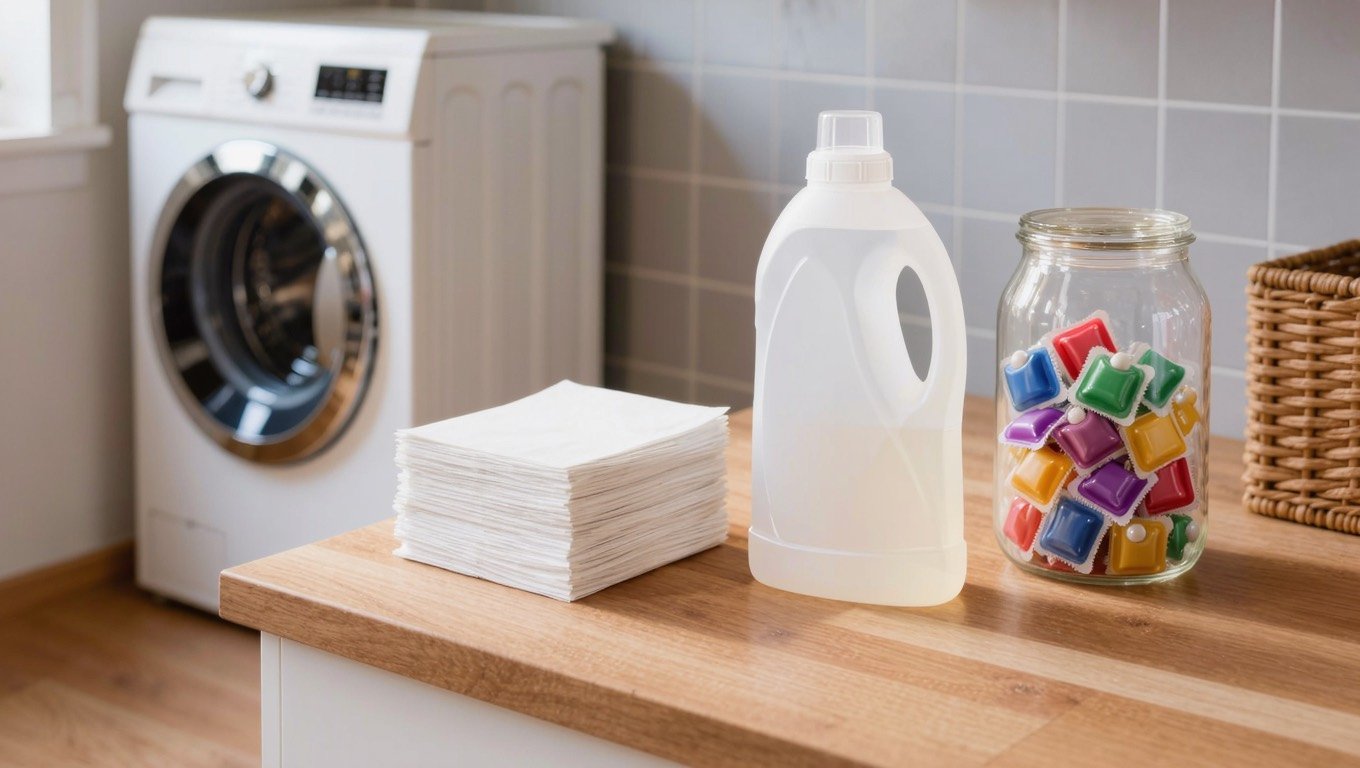
Detergent sheets have gone from crowdfunding curiosity to supermarket shelf in about three years, and UK searches for brands like Dip have surged since spring. The pitch is genuinely appealing: a paper-thin strip that weighs a few grams, posts through a letterbox, and replaces a 2kg plastic bottle sloshing about under the sink.
We ran all three formats through identical loads — school uniforms, gym kit, tea towels, grubby white pillowcases — at 20, 30 and 40 degrees. The short version: sheets are the weakest cleaners, liquid is the best value and most controllable, and pods are the most convenient but least forgiving. The detail matters, especially in hard-water areas and older houses.
Sheets, Liquid and Pods Side by Side
Here is how the three formats stack up on the things that actually decide whether your washing comes out clean.
- •Cleaning power: liquid and pods carry full enzyme packages and win comfortably; most sheets rely on surfactants alone and trail on protein and oil stains
- •Cost per wash: own-brand liquid 10-14p; branded liquid 18-26p; pods 24-35p; sheets 20-35p depending on brand and subscription
- •Cold-wash performance: liquid dissolves and works from 15C; pods can leave undissolved film below 20C on quick cycles; sheets dissolve readily but clean poorly whatever the temperature
- •Dosing control: liquid is fully adjustable for soil level and water hardness; sheets can be torn in half; pods are fixed-dose, like it or not
- •Storage and mess: sheets win outright — a slim card envelope in a drawer; pods are compact but must be locked away from small children; liquid is heavy, bulky and drips
- •Plastic and packaging: sheets ship in card; pods and most liquids come in plastic tubs and bottles, though refill schemes are spreading
- •Safety: pods account for the large majority of UK detergent poisoning calls involving toddlers and people with dementia; sheets and liquid are lower risk
Cleaning Performance: Where Sheets Fall Short
A 35ml dose of a decent bio liquid delivers roughly 25-35g of active ingredients, including proteases for blood, egg and grass, amylase for starchy food and lipase for body oils. A detergent sheet weighs 3-5g in total, and a chunk of that is the polyvinyl alcohol carrier that makes it a sheet in the first place. There is a hard physical ceiling on how much cleaning chemistry fits in the format, and it shows: several sheet brands list no enzymes at all.
In our loads, sheets handled lightly worn office clothes and bedding perfectly well. On collar grime, tomato-sauce cuffs and a week of gym kit they left shadows that liquid and pods shifted first time. If you deal with proper marks regularly, you will end up pre-treating by hand — our guide to removing every common stain explains which chemistry each mark needs, and sheets carry little of it.
The slow failure is the one to watch. Underdosed surfactant lets soil redeposit wash after wash, which is why long-term sheet users complain of whites turning grey within months. Hard-water areas — most of London, the South East and East Anglia — fare worse still, because sheets rarely carry enough water-softening builders, while good liquids and pods do.
Cost Per Wash and the 10-Year Picture
A family of four running five washes a week gets through about 260 cycles a year. At 12p a wash, supermarket own-brand bio liquid costs roughly £31 a year — call it £310 over ten years. Branded pods at 28p run to £73 a year, or £730 a decade. Sheets at 25p sit around £65 a year, £650 over ten — pod money, for noticeably less cleaning power.
The honest caveat: pods and branded liquid are almost permanently on promotion at Tesco, Sainsbury's and Asda, and buying only on offer can halve those figures. Sheets are mostly subscription-priced and stable. And if a sheet fails on a load and you rewash it, its real cost per clean load doubles.
Eco Claims vs Reality
The plastic-free claim needs unpicking. Sheets and pod film are both made with polyvinyl alcohol (PVA/PVOH), a water-soluble polymer. Industry testing shows it biodegrades in wastewater treatment given time; independent researchers dispute how completely that happens in real UK works. Sheets eliminate the bottle — they are not chemistry-free.
The genuine wins are less glamorous: sheets are light, so a year's supply ships at a fraction of the transport weight of liquid, which is mostly water. But the biggest lever in laundry is behaviour, not format — full loads at 20-30C, correct dosing, and line-drying or drying indoors without causing damp instead of tumble-drying. A correctly dosed liquid wash at 20C beats an overdosed eco sheet wash at 40C on carbon every time.
Older Homes: Cold Water, Damp Sculleries and Victorian Drains
If your machine lives in a Victorian scullery, a solid-walled rear addition or an unheated outbuilding — common across UK terraces and pre-war semis — the formats behave differently again. Incoming mains water in January can be 6-8C, and on a 30-minute quick cycle a pod dropped in the drum may not fully dissolve, leaving sticky film on door glass and dark clothes. Liquid disperses at any temperature; sheets dissolve readily too, one of their few cold-weather advantages.
Storage is the catch. In a damp, lime-plastered utility space, sheets in their card envelope wick moisture and fuse into a useless brick — decant them into an airtight tub. Old houses also mean old drains: shallow-fall Victorian clay pipes and original gullies scale up with the greasy residue of overdosed liquid and fabric softener far faster than modern plastic waste runs. Whatever the format, dose properly and clean the washing machine monthly at 60C, or low-temperature residue becomes black gasket mould and a smell you cannot shift.
Who Each Format Suits
There is no single winner — the right answer depends on your loads, your water and your storage.
- •Sheets suit: singles and couples with lightly soiled loads, small flats, travellers and students using laundrettes, and anyone prioritising letterbox delivery over stain power
- •Liquid suits: families with real stains, hard-water postcodes, budget shoppers, and anyone who wants to adjust the dose — still the best all-rounder
- •Pods suit: shared houses where nobody measures anything, chronic liquid-overdosers, and warm-cycle households — kept locked away from children
- •Nobody is well served by: sheets on heavily soiled washing, pods on sub-20C quick cycles, or any format overdosed into a sluggish old drain
The Verdict
Bio liquid remains the best detergent for most UK households: the strongest stain removal per penny, full enzyme and builder content for hard water, and a dose you control. Pods are a legitimate second for convenience, provided you run mostly 30-40C standard cycles. Sheets, as currently formulated, are situational — excellent for light loads, travel and tiny flats, but not good enough to be a family home's only detergent.
A practical compromise: sheets for barely worn clothes and guest bedding, bio liquid for towels, sports kit and anything stained. Pair that with a sensible schedule — see how often things actually need washing — and you cut plastic and detergent costs without greying your whites.
Found this useful?
There's plenty more — hundreds of guides and honestly-tested product reviews for every corner of your home.
Browse All Guides