Product Reviews · 6 min read · 14 July 2026
The Best Flooring for Pets in UK Homes (2026): What Survives Claws, Accidents and Old Floorboards
Pet floors fail in predictable places. Four picks that hold up to claws and accidents, plus the old-house rules that decide which of them you can actually lay over Victorian boards.
By the Nims Casa editorial team — written from professional cleaning experience and checked against our editorial standards.
Affiliate disclosure: if you buy through links in this article we may earn a small commission at no extra cost to you. Our recommendations come from professional cleaning experience and are never influenced by retailers or brands.
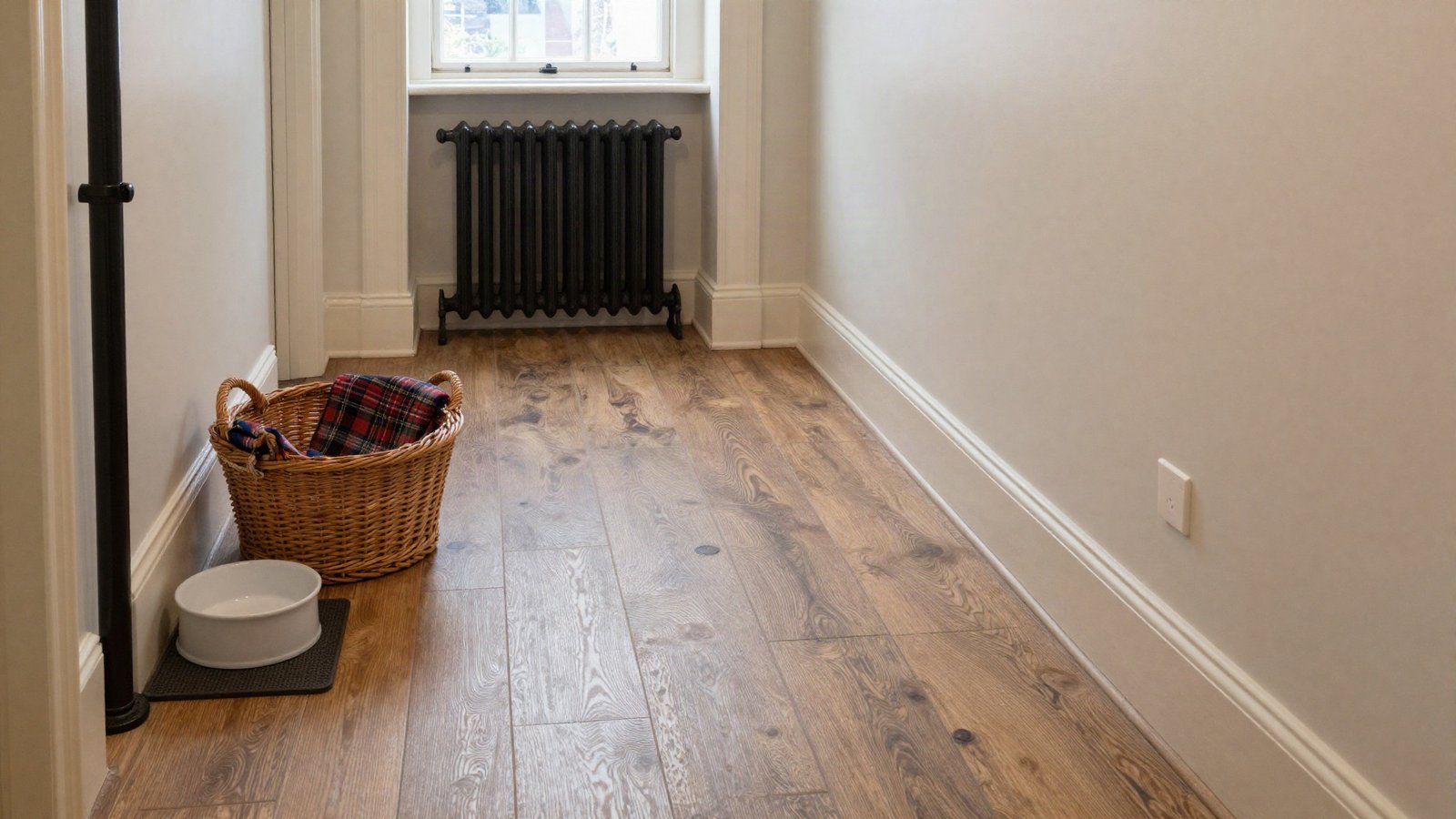
Pet floors fail in the same three places every time: the traffic line from the back door, the black tide mark round a water bowl, and the joint that swelled into a permanent ridge because nobody found the puddle for six hours.
Most flooring advice assumes a flat, dry, modern subfloor. Plenty of UK pet owners do not have one. If your house went up before about 1970 you are standing on suspended softwood boards over a ventilated void, or on a solid ground floor laid without a damp-proof membrane. That changes which floors are safe to fit, and it is why the obvious pet-proof choice in a new-build becomes the most expensive mistake in a Victorian terrace.
Our top picks at a glance
Karndean Van Gogh (glue-down LVT)
~£40-50 per m²A 2.5mm glue-down vinyl plank with a 0.7mm wear layer, roughly twice what most high-street LVT offers. Bonded to a plywood overlay there are no joints for urine to travel through, and a damaged plank can be heat-lifted and replaced on its own.
Pros
- ✓ 0.7mm wear layer shrugs off claws on a busy hallway route
- ✓ Fully bonded, so accidents stay on the surface rather than reaching the subfloor
- ✓ Single planks can be replaced without disturbing the rest of the floor
Cons
- ✗ Needs a properly prepared, level subfloor and is not a sensible DIY glue-down job
- ✗ Not suitable over an unmembraned solid floor
Polyflor Camaro
~£22-32 per m²A commercial-specification vinyl tile that ends up in vets' surgeries and dog daycare units for good reason. The designs are plainer than the premium ranges, but the 0.7mm wear layer and R10 slip rating are exactly the specs a pet household should be shopping on.
Pros
- ✓ Commercial durability at a domestic price per square metre
- ✓ R10 slip rating gives ageing dogs real traction
- ✓ Widely stocked, so matching planks are still available years later
Cons
- ✗ Plainer, more contract-looking designs than premium ranges
- ✗ Still needs a full plywood overlay on old boards, which adds to the cost
Original Style Victorian Floor Tiles
~£55-80 per m²Geometric encaustic-style tiles laid on a lime-based bed let an old solid floor keep breathing while being completely indifferent to claws and urine. In a Victorian hall it is also the historically correct floor, which helps at resale.
Pros
- ✓ Genuinely urine-proof and effectively unscratchable
- ✓ Vapour-open when bedded in lime, so ground moisture is not driven into the walls
- ✓ Will outlast every other option here by decades
Cons
- ✗ Cold and hard underfoot without insulation or underfloor heating below
- ✗ Grout lines need sealing and skilled fitting; labour is the biggest line on the bill
Woodpecker Harlech Engineered Oak (brushed and oiled)
~£55-85 per m²If nothing but real timber will do, a brushed and oiled engineered oak with a 4mm wear layer is the honest choice. It will mark, but an oiled finish can be spot-repaired with a pad and a wipe rather than sanding the whole room.
Pros
- ✓ Damage can be repaired locally instead of replacing the floor
- ✓ Brushed grain and matt oil disguise claw marks well
- ✓ Stable over suspended timber floors when acclimatised properly
Cons
- ✗ Oak is soft enough that a large dog will dent it within a year
- ✗ Standing urine reacts with the tannins and leaves black stains that only sanding removes
Who this guide is for
This is for anyone choosing a hard floor for a hallway, kitchen or through-lounge that a dog or cat will use daily, in an existing house rather than a new one. You want something you can mop, that will not stain when an accident goes unnoticed overnight, and that still looks acceptable in eight years.
- •Dogs over about 15kg: scratching, denting, and claw noise drumming through old joists.
- •Cats: urine is the real problem. It wicks into joints, sits under the plank and returns every warm week.
- •Older or arthritic dogs: grip matters more than scratch resistance, and a glossy floor is a welfare issue rather than a cosmetic one.
How we judge a pet floor
We are not a laboratory and will not pretend otherwise. This guide is built on what fitters and cleaners see going back to the same houses: which floors generate call-backs, which stains never came out, and which sales claims fall over in year three. Quoted specifications come from published manufacturer data.
- •Wear layer in microns. We would not fit luxury vinyl below 0.55mm in a pet house, whatever the total plank thickness says.
- •Liquid tolerance: what happens after eight hours of standing urine, and whether the joints let it reach the subfloor.
- •Grip: an R10 slip rating or a deep emboss, so an ageing dog is not scrabbling on the turn.
- •Repairability: one plank swapped in twenty minutes, or a full-room lift?
- •Old-house tolerance: whether it can go over suspended timber, and whether it traps ground moisture in an unmembraned solid floor.
Why an old house changes the answer
Solid ground floors laid before the mid-1960s usually have no damp-proof membrane. Ground moisture rises through the slab and evaporates harmlessly, provided the surface can breathe. Seal it with glued vinyl and the moisture does not stop; it moves sideways to the nearest escape route, which is the base of your solid walls. Six months later you have salting and blown lime plaster at skirting level, and everyone blames rising damp. Our guide to damp and mould in UK homes covers the diagnosis; the flooring rule is blunt. Either dig the floor out and rebuild with limecrete and insulation, or fit something vapour-open such as quarry tile bedded in lime mortar.
Suspended timber floors have their own rules. The void beneath is ventilated by airbricks and must stay that way; choked airbricks remain the commonest cause of rot in period ground floors. Victorian boards are rarely flat either: 20-25mm softwood over joists at roughly 400mm centres, cupped, springy, with 3-5mm gaps. Nothing rigid goes straight onto that. Screw down 6mm exterior-grade plywood at 150mm centres for a glue-down floor, or use a 3mm acoustic underlay if you are clicking planks. Lift a couple of boards first and check the joist ends at the wall, because the signs of subfloor damage are far cheaper to deal with before a new floor covers them.
One more period quirk: if underfloor heating has been retrofitted between old joists, check the surface temperature your floor is rated for. Most cap at 27°C, as our underfloor heating and flooring guide explains.
Our picks, and which house each one suits
These four are chosen for four different houses rather than ranked one to four. If your ground floor is dry, level and overlaid with plywood, glue-down luxury vinyl is the default. On a Victorian solid floor breathing through a lime screed, the tile is not a style choice, it is the only correct answer.
- •Dry, level subfloor with a plywood overlay: glue-down LVT with a thick wear layer.
- •Busy family hallway on a budget: commercial-specification LVT in a plain plank.
- •Solid floor with no damp-proof membrane: quarry or geometric tile in a lime bed.
- •Real timber, accepting some marking: brushed and oiled engineered oak, never lacquered.
What to look for before you buy
Two floors that look identical in a showroom can be a decade apart in real life, and the numbers that separate them sit on the technical data sheet rather than the sample board.
- •Wear layer, not total thickness. A 4mm plank with a 0.3mm wear layer fails long before a 2.5mm plank with 0.7mm.
- •For laminate, AC4 is the minimum and AC5 is what you want with dogs. Anything less is a two-year floor.
- •Glue-down beats click wherever urine is likely: a clicked joint is a capillary route straight to the subfloor.
- •Matt, deeply embossed finishes hide scratches and give traction. High-gloss shows every claw mark within a fortnight.
- •A scotia bead over an expansion gap is a urine trap; an undercut skirting is not.
- •Read the warranty exclusions. Plenty of domestic guarantees exclude pet claws and standing liquids.
Common buying mistakes
Almost every pet-floor failure we get called to comes down to one of these, and most were decided before anything was fitted.
- •Buying laminate because it is scratch-resistant. It is, but it is an HDF board that swells irreversibly when liquid sits on a joint overnight, as our comparison of LVT, laminate and engineered wood sets out.
- •Fitting straight onto old floorboards. Every board gap telegraphs through within a season and the joints lift at the ends.
- •Choosing the palest oak effect. Mid-tone, varied planks hide hair, mud and scratches best.
- •Assuming a new floor cures an existing smell. If urine reached the boards it stays there, and the chemistry in our pet urine smell guide applies to timber as much as to carpet.
- •Not buying two spare boxes. Batch colours drift, and swapping a ruined plank in three years is worth £70 today.
Costs, and when to hand it over
In mid-2026, budget £28-£50 per m² supplied for vinyl worth fitting in a pet house, £20-£30 per m² labour for glue-down, £14-£22 per m² for a plywood overlay supplied and fitted, and £6-£10 per m² for uplift and disposal. A 20m² hall and kitchen lands around £1,400-£1,900; our flooring installation cost guide breaks the rates down by floor type.
Click LVT and engineered wood over a sound, level subfloor are realistic weekend jobs. Glue-down is not: the adhesive open time is unforgiving and a badly rolled floor telegraphs every crumb underneath it forever. Call someone if a screed reads above 75% relative humidity, if joist ends feel soft at the wall, if there is no membrane under a solid floor, or if the level is out by more than 3mm over a 2m straightedge.
Found this useful?
There's plenty more — hundreds of guides and honestly-tested product reviews for every corner of your home.
Browse All Guides