Product Reviews · 6 min read · 18 April 2026
The Best Home Tool Organiser of 2026: Our Picks and What They Really Cost
Most tool storage is bought for the kit you own, not the kit you actually use. Here are four organisers worth the money in a UK garage or shed, with real 2026 prices and an honest look at fitted-storage quotes.
By the Nims Casa editorial team — written from professional cleaning experience and checked against our editorial standards.
Affiliate disclosure: if you buy through links in this article we may earn a small commission at no extra cost to you. Our recommendations come from professional cleaning experience and are never influenced by retailers or brands.
Most tool storage fails for the same reason. It gets bought to hold everything a household owns, when in practice the same eight items come out every week and the rest sits untouched for years. The organiser that works puts those eight within arm's reach and the other ninety percent out of the way — which in a British home means designing around a 2.4-metre stretch of garage wall or the end of a shed.
Every price below is 2026 UK retail, cross-checked across Screwfix, Toolstation, B&Q and the main online sheds. We have also broken down what fitted garage storage costs and how it splits between labour and materials, because plenty of people weigh a £150 tool chest against a £2,200 install without seeing what the £2,200 buys.
Our top picks at a glance
Milwaukee PACKOUT Compact Tool Box
~£90–£400A modular case system where every module, wall bracket, trolley and van rack shares the same cleat, so the setup grows without anything being replaced. Expensive to enter, but the platform has the deepest UK availability of any modular range.
Pros
- ✓ IP65-rated seal keeps damp garages and rained-on drives out
- ✓ Genuinely expandable — wall mounts, trolley and van racking all interoperate
- ✓ Metal-reinforced latches survive repeated 20kg-plus loads
Cons
- ✗ Highest cost per litre in this list
- ✗ A full three-piece stack is heavy and awkward on stairs
Stanley FatMax Cantilever Tool Box
~£45–£65The default correct answer for a household with one drill and a hand-tool kit. Cantilever trays present everything at once, and the deep bottom well swallows a combi drill and charger.
Pros
- ✓ Metal latches at a price where most rivals use plastic
- ✓ Everything visible in one movement — no digging
- ✓ Widely stocked across UK merchants, so replacements are easy
Cons
- ✗ Not weather-sealed; poor choice for an unheated garage
- ✗ Cantilever arms flex if the top trays are overloaded
DeWalt TOUGHSYSTEM 2.0 DS400 with DS450 Trolley
~£150–£300Built for site abuse and it shows: the seal is real, the latches are auto-connecting, and the trolley pulls a 60kg stack across gravel without drama. Overkill for a cupboard, ideal if tools go in and out of a car boot weekly.
Pros
- ✓ Auto-connect latches make stacking genuinely one-handed
- ✓ Trolley handles rough ground and kerbs well
- ✓ IP65 sealing verified across the range
Cons
- ✗ Bulky footprint that eats floor space in a small garage
- ✗ Fewer small-parts organiser options than rival systems
Magnusson 5-Drawer Roller Cabinet
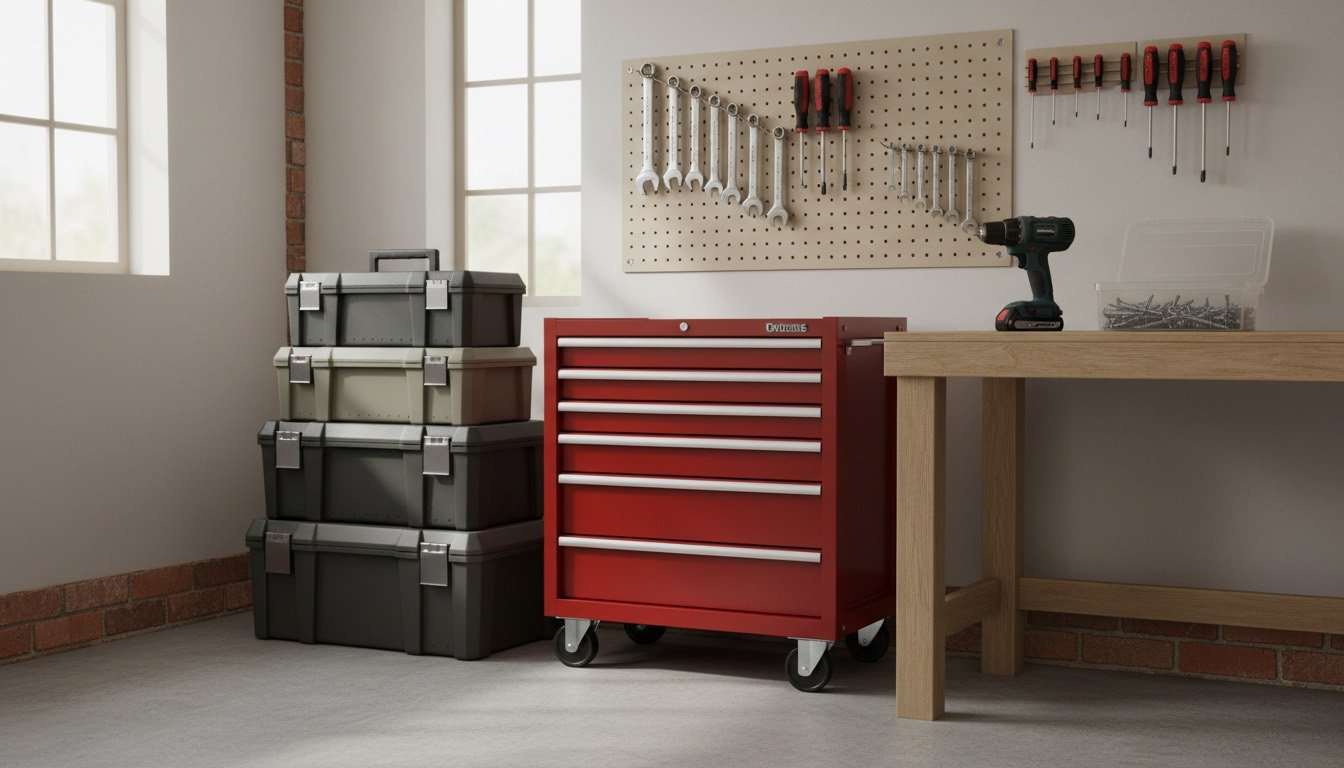
~£130–£220For tools that never leave the building, a steel roller cabinet beats plastic on capacity, access and price per litre. Full-extension runners mean the back of the drawer is usable rather than a graveyard.
Pros
- ✓ Excellent cost per litre of organised, visible storage
- ✓ Ball-bearing full-extension runners on every drawer
- ✓ Worktop-height lid doubles as a small bench surface
Cons
- ✗ Not portable and not sealed against damp
- ✗ Castors struggle on uneven or unsealed garage floors
Who this guide is for
There is no single right answer, because the amount of kit you own changes the sensible spend by a factor of ten. Work out which of these you are first.
- •The occasional DIYer: one combi drill, a screwdriver set and a tub of fixings, under about 15kg. One cantilever box is enough; anything larger becomes a dumping ground within a year.
- •The committed home DIYer: several cordless tools on one battery platform, hand tools and consumables, typically 30–60kg. This is where a modular stacking system or a roller cabinet pays for itself.
- •The side-trader: kit that leaves the house most weeks. Wheels, weather seals and one-handed latches stop being luxuries.
- •The space-constrained: no garage, so tools live under the stairs. Shallow and wall-mounted beats deep and stackable — the same logic behind most small-space storage ideas that work in UK homes.
How we judge, and what "tested" means here
We are not a laboratory and will not pretend otherwise. These verdicts come from contributors who use this kit for a living — joiners, decorators and maintenance engineers — plus hands-on handling of current models in UK stores, published load ratings, and verified owner reviews read at twelve months rather than the first week. The criteria that separate good from bad are unglamorous.
- •Latch and hinge integrity under load. Cheap over-centre catches distort at around 15kg, and a lid that no longer seats means damp tools by February.
- •Wet performance. UK garages sweat, so we want a moulded gasket and a lid that sheds water rather than pooling it.
- •Handling when full, not empty. A 25kg loaded case will not go up a loft ladder.
- •Platform longevity. You buy into a cleat pattern; if the range is discontinued you cannot expand it.
- •Cost per litre of organised volume, not raw capacity. A big empty void is not storage.
The picks, and who each one suits
Milwaukee PACKOUT takes best overall because you are not buying a box, you are buying a mounting standard. The same cleat carries wall brackets, a trolley base and van racking, so a £90 compact case grows into a £400 rolling three-piece with nothing wasted. Expensive to enter, cheapest way to still be happy in 2031.
The Stanley FatMax cantilever box is the value pick and the right answer for most households. Around £45–£65 buys metal latches, a deep bottom well and trays that show everything at once — which matters more than volume if your kit is the core tool set most homeowners actually need. DeWalt's TOUGHSYSTEM 2.0 is the choice if the kit travels: the IP65 seal is real and the trolley drags a loaded 60kg stack over a rough drive.
For a garage that will never move, a Magnusson-style steel roller cabinet at £130–£220 beats plastic on everything except portability: full-extension runners, drawer liners, one glance to find a 10mm spanner. Pair it with a wall panel above the bench for the layout we recommend for organising a workshop from scratch.
What this actually costs in the UK
Tool storage spans two orders of magnitude. Realistic 2026 UK prices, including VAT.
The step most people misjudge is the jump from portable boxes to a fitted system. A single garage fitted professionally lands between £1,200 and £3,500. Materials are typically 55–70% of that and labour 30–45%: two fitters for one day at roughly £180–£250 each, so £360–£500 of labour on a straightforward install. If you are adding shelving above, read our garage shelving comparison before committing to a supplier's own units.
To sanity-check a quote, divide the total by the linear metres of run. Supplied and fitted, expect £180–£450 per linear metre for cabinets and worktop. Anything near £700 a metre needs justifying with something specific: solid worktop, powder-coated steel carcasses, added electrics. A quote arriving as a single lump with no per-metre rate, no fixing specification and no VAT position is not a quote, it is a number. Be wary too of three days' labour billed for one garage.
- •Single cantilever or organiser box: £20–£65
- •Modular stacking case, per module: £25–£120 (a workable three-box stack, £180–£350)
- •Pegboard or French cleat wall, DIY materials for a 2.4m x 1.2m run: £40–£120
- •Proprietary steel wall track system: £90–£250 per metre, supplied only
- •Homeowner 5–7 drawer roller cabinet: £130–£400
- •Fitted single-garage storage, supplied and installed: £1,200–£3,500
What to look for before you buy
Once the budget is set, these details decide whether it still works in three years.
- •Check the wall first. Many UK garages are single-skin blockwork or have a plasterboard partition to the house — block takes an 8mm frame fixing happily, plasterboard needs rated cavity anchors and a strict load limit.
- •Weigh your kit. A loaded three-box stack runs 40–60kg, more than a plasterboard-only fixing should carry.
- •Insist on metal latches above 30 litres. Plastic catches are the first failure point.
- •Favour shallow and visible over deep and stacked. Two 100mm drawers beat one 200mm drawer for everything except power tools.
- •Keep guards and PPE with the tool, not in a separate box — our power tool safety checklist explains why.
- •Leave 20% empty on day one. A system bought at capacity is full within a month.
Common buying mistakes, and the verdict
The commonest error is solving a decluttering problem with a purchase. If tools are scattered across three rooms, no box fixes that until the sorting is done — the sequencing that makes reclaiming garage and shed space work at all.
The verdict: if the budget allows, start with one Milwaukee PACKOUT compact case and build on it. If £60 is the number, the Stanley FatMax cantilever box is not a compromise, it is the correct product. And unless you truly need fitted storage, spend £250 on a roller cabinet and a wall panel — the £2,000 saved buys a lot of tools.
- •Buying for aspiration, not the kit you own. The empty half fills with tins, cables and mystery brackets.
- •Committing to a modular platform on price alone, then finding the brackets and trolley discontinued.
- •Fixing heavy storage to plasterboard without finding a stud or using a rated cavity anchor.
- •Leaving tools in an unheated garage without a sealed lid, losing chisels and bits to rust over one damp winter.
- •Accepting a lump-sum fitted quote with no linear-metre rate, no materials spec and no clear VAT position.
Found this useful?
There's plenty more — hundreds of guides and honestly-tested product reviews for every corner of your home.
Browse All Guides