Organisation & Storage · 6 min read · 10 May 2026
Garage & Shed Storage: Reclaiming the Most Wasted Space You Own
Most UK garages store everything except a car — badly. Walls, not floors, are the answer, plus the damp rules that decide what survives storage at all.
By the Nims Casa editorial team — written from professional cleaning experience and checked against our editorial standards.
Ask most UK homeowners what actually lives in their garage and the honest answer is rarely 'the car'. Bikes, half-used paint tins, the good camping gear, a folding table nobody's touched since 2019 and at least one appliance box kept 'just in case' all compete for the same stretch of concrete, until there's a single winding path from the up-and-over door to the freezer. Sheds fill up the same way in smaller gardens, absorbing whatever doesn't have a home indoors.
The fix isn't a bigger garage — it's a different relationship with the floor. Once everything usable is on a wall, a rack or a hook, even a single-car garage holds roughly double what it did, and you can actually find things without excavating. This guide covers zoning the space before buying anything, the wall and overhead systems worth the money, exactly what damp storage ruins, and the seasonal habits that stop the whole system sliding back into chaos by spring.
Zone the space before you buy a single shelf
Buy shelving before deciding what it's for and you end up with several identical units and no real system — just a tidier version of the same chaos. Sketch the walls first and assign each stretch to one activity, the same zoning principle that works for a kitchen cupboard: everything gets a fixed address, so putting things away is as quick as getting them out.
- •Garden and outdoor zone: mower, hose reels, pots and compost bags, nearest the door that leads to the garden.
- •Tools and DIY zone: workbench, power tools, fixings and paint, kept clear of the car doors so dust and splashes don't reach the paintwork.
- •Sport and bikes zone: bikes on wall hooks, boots and rackets on a rack, balls in a single net bag rather than loose.
- •Decorating and household overflow zone: spare tiles, wallpaper offcuts, suitcases and anything the house genuinely has no room for.
- •Seasonal zone: one shelf or crate row reserved purely for whatever's about to come into rotation.
Wall-mounted shelving and slat-wall: what it actually costs
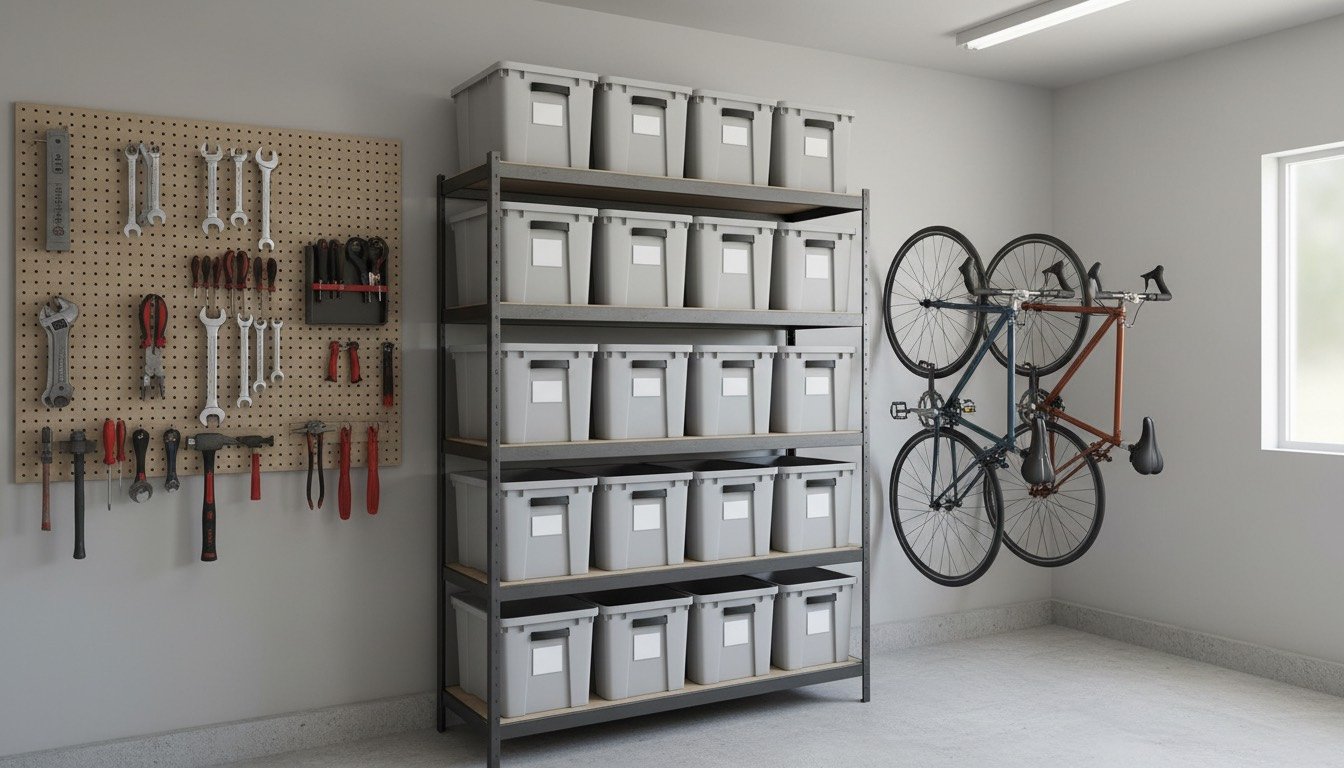
Once the zones are marked, fit shelving to suit each one rather than running an identical system along every wall. Heavy items need boltless steel units fixed into solid brick or block; lighter, frequently used tools do better on slat-wall or pegboard where you can see and reach them in seconds. For fixings, stud-finding and safe load limits on garage and shed walls, this guide to building shelves that actually hold weight is worth reading before you drill anything.
If you're setting up a proper bench alongside the shelving rather than just storage, organising a workshop properly covers lighting, power and bench height — details that matter as much as the shelves themselves.
- •Boltless steel shelving units: roughly £35-£75 each depending on load rating — stack three or four levels and label every crate on the end facing outward.
- •Slat-wall or pegboard panels for the workbench zone: around £25-£50 per sheet, hooks and bins sold separately from about £2 each.
- •Wall brackets for ladders and hose reels: £8-£20 a set, fitted at a height that clears the car bonnet.
- •Magnetic tool strips: £10-£18, so chisels and screwdrivers stop vanishing into the bottom of a toolbox.
Vertical and overhead storage: bikes, ladders and the ceiling void
Bikes and ladders are the two items most likely to be permanently in the way, and both have a simple vertical fix. Wheel-mounted bike hooks (£10-£25 a pair) take a bike off the floor and onto the wall in seconds; angled ladder brackets do the same job for extension ladders, which otherwise end up leant across a whole run of shelving.
The ceiling void above a garage is usually wasted entirely. Overhead racks bolted into at least two joists — never just the plasterboard or roof felt — typically cost £30-£90 and hold 60-90kg, enough for roof boxes, camping kit and the empty boxes kept in case something needs returning. This is genuinely once-a-year storage: anything reached for monthly belongs on a wall shelf instead.
What damp storage destroys, and what's genuinely safe out there
Unheated garages and sheds swing through condensation cycles that ruin far more than any mouse does. Some categories simply shouldn't go out there at all: books, photographs and textiles (a mould and moth buffet), electronics, and anything leather. Paint is a special case — a single hard frost kills emulsion stone dead, so it's effectively single-use once frozen. Fine to store: metal tools kept lightly oiled, plastics, garden kit, and sealed crates of genuinely robust items.
Use lidded plastic crates rather than cardboard — cardboard wicks up moisture and makes ideal bedding for anything that gets in, worth knowing if mice have ever been a problem in the house. Raise fabric-adjacent crates onto a pallet or battens, clear of the slab. A cheap hygrometer (under £10) shows which category a space falls into; a reading persistently above 70% means tackling ventilation, or a small dehumidifier, before anything precious goes back in. If damp keeps recurring, solve it properly — see how to get rid of damp and mould, or for a longer-term fix, insulate the garage or insulate a shed rather than fighting condensation every winter.
The seasonal swap-shelf system that keeps it working
Two habits keep a garage or shed working long after the initial sort-out. The first is the seasonal swap: garden furniture cushions come in as Christmas decorations go out, using one shelf or crate row reserved purely for whatever the current season needs, so nothing gets dug out from behind everything else. The second is treating the space as a one-way valve rather than somewhere decisions go to hibernate — a broken item gets a repair deadline or a tip run, and 'might be useful' boxes get the same three-month rule as any other room being decluttered. A garage stays useful for exactly as long as it isn't allowed to become the house's guilt cupboard.
Common garage and shed storage mistakes to avoid
- •Storing anything 'temporarily' on the floor — it never actually moves, and the floor is the first place damp and spiders reach.
- •Using cardboard for long-term storage — it wicks up moisture and becomes bedding for mice within a season.
- •Screwing shelving into plasterboard, thin shed cladding or roof felt instead of studs, joists or a proper batten frame.
- •Filling every wall before zoning the space — you end up checking five shelves to find one tin of paint.
- •No lighting plan beyond a single bulb over the door, so the back wall and corners never get used properly.
- •Forgetting the car and the door swing when positioning shelving, so nothing fits once the car's actually parked inside.
Frequently asked questions
**Do I need planning permission to fit shelving in a garage or shed?** No. Shelving, slat-wall and overhead racking are internal fixtures, not structural changes, so they don't need planning permission or building control sign-off provided the building's walls, structure and roofline are left alone.
**How much weight can a garage ceiling actually hold?** It depends on the joists, not the plasterboard between them. A rack bolted into at least two joists with the correct fixings typically holds 60-90kg safely; anything heavier is worth checking with a builder first.
**What's the best flooring for a garage used mainly for storage?** Sealed concrete is the practical baseline — it resists damp and sweeps clean. Epoxy or resin coatings (roughly £15-£25 per square metre fitted) look sharper, but they're a finishing touch, not a damp fix.
**Can a spare fridge or freezer run safely in an unheated garage?** Most modern appliances have a minimum operating temperature, often around 10°C, and struggle below that in a cold snap — check the appliance's climate class before relying on it through winter.
**Is it worth insulating a garage just for storage, or only for a habitable room?** Insulation earns its keep even for pure storage, because it narrows the temperature swings that cause condensation — the thing actually damaging stored goods. It becomes essential rather than optional once the space is used as a room.
Found this useful?
There's plenty more — hundreds of guides and honestly-tested product reviews for every corner of your home.
Browse All Guides