Product Reviews · 6 min read · 13 July 2026
The Best Garage Shelving UK (2026): What It Costs and What Actually Holds
A typical UK single garage gives you about 600mm of usable depth down each side once the car is in. Here is what fits, what it costs, and which load ratings are honest.
By the Nims Casa editorial team — written from professional cleaning experience and checked against our editorial standards.
Affiliate disclosure: if you buy through links in this article we may earn a small commission at no extra cost to you. Our recommendations come from professional cleaning experience and are never influenced by retailers or brands.
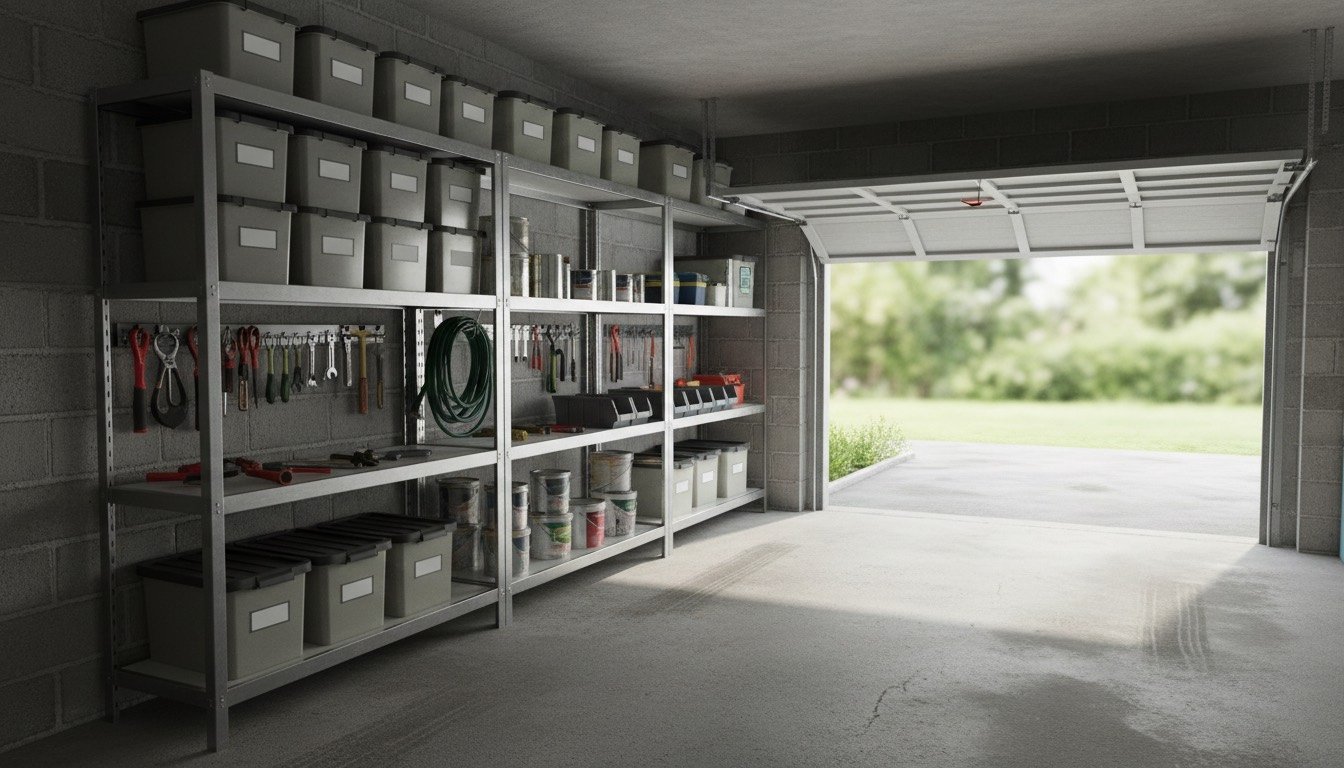
A standard UK single garage is roughly 2.5m wide by 5m long. Put a modern hatchback in it and you have perhaps 600mm of usable depth down one side and a strip at the back — which is why so many garages end up with collapsing flat-pack units and bags leaning against the partition to the house.
What follows comes from fitting storage in everything from 1930s detached garages in single-skin brick to integral garages built in aircrete block, with prices checked in 2026 across B&Q, Screwfix, IKEA, BiGDUG and Amazon UK. This is install experience and expert research rather than laboratory load testing, and we will say plainly where a headline figure flatters the product.
Our top picks at a glance
BiGDUG Clicka 350 Boltless Shelving Bay (1800 x 900 x 450mm)
~£90–£140A genuinely commercial boltless bay at a domestic price, rated 350kg UDL per level with galvanised steel decks that shrug off a damp garage. Assembly is rubber-mallet only and takes about 25 minutes per bay once you have built the first.
Pros
- ✓ Galvanised decks resist condensation far better than powder-coated mild steel
- ✓ Beam heights adjust in 25mm increments, so you can size levels around paint tins and toolboxes
- ✓ Bays can be joined in a run, sharing uprights and cutting the cost per metre
Cons
- ✗ Heavier and bulkier to get through a standard garage side door
- ✗ Anti-tip wall fixings are not supplied and must be bought to suit your wall type
IKEA HYLLIS Galvanised Shelving Unit
~£20–£30The cheapest galvanised steel unit worth owning, and the reason it survives garages is the finish rather than the strength. Treat it as a home for bulky, light items and it will outlast units costing three times as much.
Pros
- ✓ Genuinely rust-resistant indoors or in a covered garage
- ✓ Narrow 270mm depth suits tight side walls where a full bay will not fit
- ✓ Assembles in under ten minutes with no tools
Cons
- ✗ Rated for light loads only, roughly 25kg per shelf in practice
- ✗ Open wire-style shelf slots let small items fall through without a liner
Keter 5-Tier Freestanding Plastic Shelving Unit
~£55–£85Moulded polypropylene cannot rust, which makes it the sensible choice for the cold corner where condensation runs down the wall. It is stiffer than it looks thanks to ribbed shelf undersides, but it does not like heat or point loads.
Pros
- ✓ Completely immune to rust and easy to wipe down after a spill
- ✓ Shelves wash clean, so it suits garden chemicals and car-care bottles
- ✓ Light enough to reposition single-handed when you reorganise
Cons
- ✗ Around 45–75kg per shelf and it sags under concentrated weight
- ✗ Plastic goes brittle after several years of UV exposure near a glazed door
FlexiMounts GR48 Overhead Garage Storage Rack (1.2 x 2.4m)
~£140–£200Height-adjustable ceiling rack that turns the dead space above the bonnet into real storage for suitcases, camping kit and roof bars. Fitting is the whole story — into timber joists or structural concrete only, never into plasterboard or a lightweight truss without checking the load path.
Pros
- ✓ Reclaims storage without losing any floor or wall space
- ✓ Adjustable drop of roughly 560–1,000mm works around most up-and-over door gear
- ✓ Supplied fixings suit timber joists; masonry anchors are a straightforward substitution
Cons
- ✗ A two-person fit, and awkward enough that many people should budget for a tradesperson
- ✗ Anything stored up there needs a stepladder, so it is unsuitable for items you want weekly
Who this is for — and who should skip it
Buy garage shelving if you keep a car in there and need the walls to work, if the garage is unheated and things are going mouldy in cardboard on the floor, or if you have already thinned out what you own. If you have not done that thinning, buy nothing yet — shelving bought before a clear-out just preserves clutter at eye level, and decluttering room by room is the faster win.
Skip freestanding racking in two cases: garages under 2.2m wide, where a 450mm-deep bay leaves you unable to open a car door, and garages you are about to convert. If a conversion is on the cards, read garage conversion vs home addition before you drill into the walls.
How we judge garage shelving
Four things decide whether a unit is still standing in five years, and only one appears in the marketing. Quoted loads are almost always UDL — uniformly distributed load, spread evenly across the shelf. Stack a 25kg tub of tile adhesive in one corner of a 350kg shelf and you are nowhere near 350kg, but well past what that deck can carry at a point. Halve the headline number in your head.
- •Realistic load: rated UDL per level, and how the deck behaves under a concentrated point load.
- •Corrosion resistance: an unheated UK garage crosses dew point most winter mornings. Galvanised steel and polypropylene survive it; thin powder coat over mild steel blisters at the shelf lips within two or three winters.
- •Footprint efficiency: usable storage per square metre of floor lost, which is where 450mm-deep bays beat 600mm bays.
- •Fixability: whether the unit ties back to the wall, and what fixing that needs in brick, dense block or aircrete.
Our four picks and what each one is for
No single unit suits a whole garage. The best set-ups mix boltless steel bays along the long wall, plastic units in the corner where the roof drips, and an overhead rack above the bonnet. Prices and full pros and cons are below; our garage and shed storage guide covers zoning first.
- •Best Overall — boltless steel bay, 1,800 x 900 x 450mm: heavy, wet, oily, awkward. Paint, tools, spares.
- •Best Budget — galvanised light-duty unit: bulky but light items such as bedding bags and sports kit.
- •Best for Damp Garages — moulded plastic unit: anything you would hate to find rusted, in the coldest corner.
- •Best Overhead — ceiling rack: seasonal items, above the car rather than beside it.
What garage shelving really costs in the UK
Freestanding racking is materials-dominated: the shelving is 85 to 100 per cent of the spend, because most people assemble it themselves in an afternoon. Fitted joinery flips that ratio, with labour at 50 to 60 per cent of a bespoke garage-cabinet quote.
A tradesperson charges £180 to £280 a day outside London and £280 to £400 inside the M25, or £35 to £55 an hour, plus VAT if registered. Four boltless bays take one competent person two to three hours to build, so a day rate there is poor value. An overhead rack is different — two people, joist detection, correct fixings — and £120 to £220 labour for a pair is fair.
- •Light-duty galvanised unit (600 x 270 x 1,400mm): £20–£30 each.
- •Five-tier moulded plastic unit: £55–£85 each.
- •Boltless steel bay, 250–350kg UDL per level: £85–£150 per bay — around £95 per linear metre of wall.
- •Heavy-duty boltless, 500kg+ per level, 600mm deep: £180–£300 per bay.
- •Twin-slot wall shelving: uprights £12–£20, brackets £4–£9, 2.4m board £15–£30 — roughly £45–£70 per linear metre.
- •Ceiling-mounted overhead rack, 1.2 x 2.4m: £140–£220.
- •Bespoke fitted garage cabinetry, single garage: £1,800–£5,000 supplied and fitted.
- •Fixings and sundries, which most quotes forget: £25–£60 for a full run.
Sanity-checking a quote, and the warning signs
Price the materials yourself first: cost the bays on the manufacturer's own site, add 10 per cent for fixings, then compare. On a supply-and-fit racking job, materials should land at 55 to 70 per cent of the total. If labour outweighs materials on freestanding units, something is wrong — either the day rate is padded or they are charging a full day for three hours.
Red flags: a per-bay price with no UDL stated anywhere; a supply-and-fit quote that does not name the wall type or the fixing; a deposit over 25 per cent on stock racking sitting in a warehouse; and any quote describing shelving only by tier count. Two five-tier bays can differ by 400kg per level and £150 in price. A good quote reads like a spec sheet.
What to look for before you buy
Depth first: 450mm is the sweet spot in a single garage, because 600mm bays swallow the walking gap and force you to stack two rows deep, which is how things get lost. Height second: fill to 1,800mm and keep the top level for light items. Chipboard decks swell irreversibly once wet, so choose galvanised steel or plastic trays near the door threshold.
The wall matters more than the shelf. Solid brick and dense concrete block take an 8 x 80mm frame fixing happily, into the brick face rather than the perp joints. Aircrete and thermalite block, common in integral garages built since the 1990s, strips a standard plug out under load — use aircrete-specific fixings or resin with a mesh sleeve, and expect roughly a third of the pull-out strength of dense block. Never hang weight from the plasterboard partition between an integral garage and the house; that is a fire-resisting element, not a structure.
If the garage runs cold and wet, treat the cause too. Insulating a garage and running a small dehumidifier over winter does more for stored goods than any shelf finish; our notes on damp and mould explain why condensation forms on cold steel first.
Common buying mistakes
Almost every failed garage storage job we are called to repeats one of these.
- •Buying to the headline load figure. Rate for point loads, not UDL, and keep the heaviest items on the bottom two levels.
- •Not tying tall bays back to the wall. Any unit over 1,500mm loaded high needs an anti-tip fixing — non-negotiable if children use the garage.
- •Storing on the floor. Keep the lowest shelf 150mm clear so driven rain under an up-and-over door does not write off the bottom row.
- •Ignoring petrol rules: 30 litres maximum in approved containers, two 10-litre metal and two 5-litre plastic, never beside a boiler or consumer unit.
- •Blocking the door gear. Measure spring gear and track travel before setting shelf heights near the opening.
- •Buying before sorting; see garage organisation ideas for a workable sequence.
Found this useful?
There's plenty more — hundreds of guides and honestly-tested product reviews for every corner of your home.
Browse All Guides