Product Reviews · 6 min read · 22 May 2026
The Best Smart Light Switch UK (2026): What Actually Works With No-Neutral Wiring
Nearly every smart switch buying guide assumes American wiring with a neutral in the switch box. British homes usually don't have one, and that single fact decides which products can go on your wall.
By the Nims Casa editorial team — written from professional cleaning experience and checked against our editorial standards.
Affiliate disclosure: if you buy through links in this article we may earn a small commission at no extra cost to you. Our recommendations come from professional cleaning experience and are never influenced by retailers or brands.
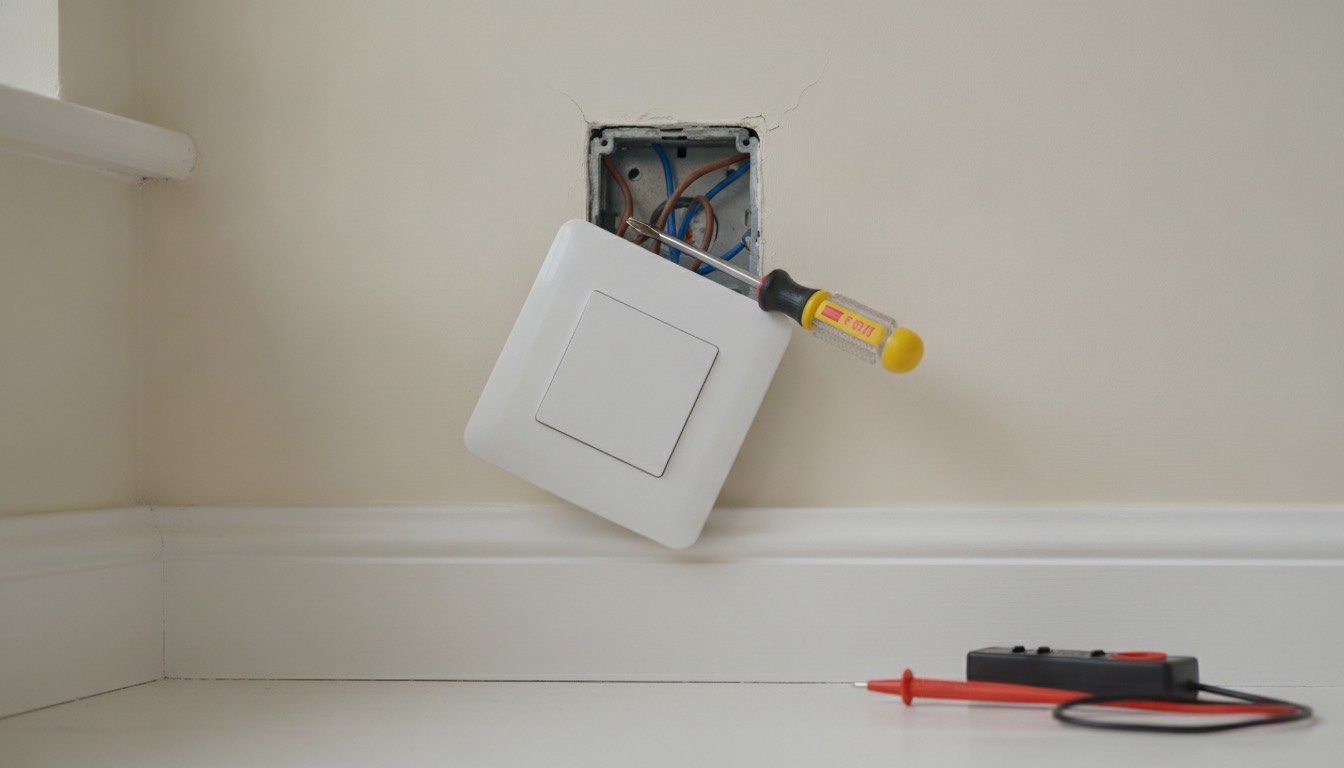
Almost every smart switch guide is written around American wiring, where a neutral conductor sits in the switch box as standard. In a typical British house it does not. Our lighting circuits are usually looped in at the ceiling rose, so the cable dropping to your switch carries a permanent live and a switched live, and nothing else. Buy the wrong device and you will discover, faceplate in hand, that there is physically nowhere for it to go.
So this is not a list of the four prettiest plates. It is a route through the decision: find out what is behind your existing switch first, then buy for that wiring, that room and that bulb. Diagnose correctly and fitting takes twenty minutes.
Our top picks at a glance
Shelly 1 Mini Gen3 / Shelly Dimmer 2
~£12-40A postage-stamp-sized module that hides behind your existing faceplate and turns any switch smart, with genuine local control that survives a broadband outage. The Dimmer 2 adds trailing-edge dimming and will run without a neutral if you add a bypass.
Pros
- ✓ Fits behind a standard 25mm UK back box and keeps your existing faceplate and finish
- ✓ Works locally over Wi-Fi with MQTT and Home Assistant support, no cloud dependency
Cons
- ✗ The plain 1 Mini needs a neutral at the switch, which many UK lighting drops don't have
- ✗ Setup and configuration is fiddlier than a consumer app; expect to read the manual
Lightwave L21 Smart Dimmer (1 Gang)
~£70-85A British-made replacement faceplate designed from the start for UK lighting circuits with no neutral, which is why it costs three times what an import does. Trailing-edge dimming, a proper physical button, and it still works as a dumb switch if the hub dies.
Pros
- ✓ Genuinely needs no neutral, so it fits the standard UK loop-at-the-rose lighting drop
- ✓ Looks deliberate on the wall rather than like a gadget, with matching multi-gang plates
Cons
- ✗ Needs the Lightwave Link Plus hub for remote access and Apple Home, adding roughly £100
- ✗ Wants a 35mm back box; a 16mm box means swapping it or chasing out the wall
Sonoff ZBMINI-L2 Extreme
~£12-16A tiny Zigbee module that runs without a neutral and squeezes into a 25mm box behind your existing plate. On/off only, no dimming, but for a landing light or a porch it does everything most people actually want.
Pros
- ✓ No neutral required and small enough to fit boxes that defeat every rival module
- ✓ Zigbee, so it keeps working through a broadband outage and extends the mesh
Cons
- ✗ Needs a Zigbee coordinator or hub, so it's poor value as a one-off purchase
- ✗ Minimum load means a single low-wattage LED may glow or flicker without a bypass capacitor
Philips Hue Wall Switch Module
~£35-55Not a switch at all but a battery module that sits behind your existing plate, keeps permanent power to Hue bulbs and converts the wall switch into a Hue controller. It solves the single biggest smart-bulb annoyance: someone flicking the switch off.
Pros
- ✓ No mains rewiring of the switch itself and the battery runs for roughly five years
- ✓ Keeps the original faceplate, so period and designer plates stay exactly as they are
Cons
- ✗ Only useful inside the Hue ecosystem, and needs a Hue Bridge to do anything
- ✗ Doesn't switch the mains, so the bulbs draw standby power permanently
Start Here: Work Out Which Problem You Actually Have
Before spending anything, spend ten minutes with the faceplate off. Switch off the lighting MCB at the consumer unit, tell the house, and prove the circuit dead with a two-pole voltage tester rather than a neon screwdriver. Then undo the retaining screws and pull the plate forward on its tails.
What you find puts you in one of four camps, and each has a different answer. If you are unsure which conductor is which, our guide to identifying electrical wire colours covers both the pre-2006 red-and-black and current brown-and-blue systems, including why a blue conductor sleeved brown is a switched live and not a neutral.
- •One cable, two conductors used, terminals marked COM and L1: a one-way switch with no neutral. The most common British scenario. You need a no-neutral module, a kinetic system, or smart bulbs.
- •Spare conductors parked in a connector block that never touch the switch, usually blues joined together: you have a neutral, and can fit almost anything including the cheap and capable modules.
- •Two cables into COM, L1 and L2: a two-way circuit, typically hall and landing. Smart it at one end and convert the other, or you will create a state mismatch that drives everyone mad.
- •Back box depth, measured: British flush boxes are 16mm, 25mm, 35mm or 47mm. Modules want 25mm minimum; a smart faceplate wants 35mm. A shallow box in plasterboard is a £2 dry-lining swap; in solid brick it means an SDS drill, a bolster and making good.
- •Bulb load: add up the wattage on that switch. A single 4W LED downlight is a problem for no-neutral devices. Six of them are not.
How We Judge These, and What We Do Not Test
Be sceptical of anyone claiming laboratory testing of smart switches. We do not run a photometric lab and will not pretend to. These picks come from repeated installation in British properties by contributors who fit them for a living, and from reading the datasheets for the numbers that matter and are usually buried.
We weight, in order: does it fit a standard UK back box; does it work without a neutral; what is the honest minimum load before it flickers; does it survive a broadband outage; and can a visitor turn the light on without a phone. That last test fails more products than any spec sheet does.
The Four We Would Fit, and Who Each Suits
The picks below map onto the four camps above rather than a simple ranking. With a neutral, take the Shelly. Without one, choose between a hidden module that keeps your existing faceplate and a replacement plate that looks deliberate.
For a whole-house rollout rather than one room, read how to set up a smart home first, because your hub and protocol choice constrains everything afterwards.
The Five Specs That Actually Decide It
Most of what is printed on the box is marketing. These five are not, and three are usually in the datasheet rather than the listing.
- •Minimum load. No-neutral devices power themselves by trickling current through the lamp. Below roughly 2W to 5W, LEDs glow faintly when off or flicker when on. A bypass capacitor at about £5 fixes it, but needs somewhere to live. If the light flickers after fitting, check this first.
- •Leading edge versus trailing edge dimming. Trailing edge is what LEDs want. Leading edge was designed for filament and halogen loads and will buzz and step badly with modern lamps. Cheap smart dimmers are often still leading edge.
- •Retractive versus latching input. Shelly and Sonoff modules can be set for a momentary switch, which is what you need for short-press on and long-press dim. A standard rocker is latching and behaves differently.
- •Local control when the hub or router fails. Zigbee and Matter-over-Thread devices keep working; some cloud-only Wi-Fi switches genuinely stop responding. Ask before you buy, not during an outage.
- •Faceplate size and finish. British plates are 86mm square, so European round imports will not fit. Smarten one switch in a room of brushed chrome and you will notice the mismatch daily. Modules dodge this entirely.
Where DIY Stops: Part P, Bathrooms and Certification
Replacing a like-for-like switch on an existing lighting circuit is not notifiable under Part P of the Building Regulations in England, and most competent DIYers manage it safely. Wales retained a wider scope, and Scotland and Northern Ireland work to their own building standards, so check locally. Either way the work must comply with BS 7671.
Two hard boundaries. Rooms containing a bath or shower are a special location: switches there should be pull-cord or sited outside the door, and fitting a smart faceplate inside one is not a DIY job. And if the back box has no earth terminal, or the insulation crumbles when flexed, stop and book an EICR rather than a switch. Our list of electrical repairs you should never DIY sets out the line, and what an electrician costs is typically £60 to £90 for the first hour.
Never had a faceplate off? Do the swap once with a plain switch first. Our step-by-step on replacing a light switch covers isolation, testing and terminal torque with less at stake.
Common Buying Mistakes We See
Each of these has cost somebody a return, a wasted evening or a call-out fee.
- •Smartening a two-way hall-and-landing pair at one end only, so the mechanical switch can still cut power and strand the smart device offline.
- •Fitting a no-neutral dimmer to one low-wattage LED, then blaming the bulb. Check minimum load first.
- •Obsessing over control while ignoring colour temperature. A perfectly automated 6500K lamp still feels wrong in a sitting room: 2700K for living rooms and bedrooms, 3000K to 4000K for kitchens and utilities.
- •Choosing a system that needs a proprietary hub for a single switch. The hub often costs more than the switch and only makes sense if you intend to expand.
The Verdict
If your switch box has a neutral, buy a Shelly module, keep your existing faceplate and get change from £20. If it does not and you want dimming from a proper wall switch, the Lightwave dimmer is the tidiest British answer despite the price. For plain on and off on an existing Zigbee mesh, the Sonoff ZBMINI-L2 costs less than a takeaway. And if you already own Hue bulbs, your real problem is people cutting power to them, which the wall module solves for £35.
Found this useful?
There's plenty more — hundreds of guides and honestly-tested product reviews for every corner of your home.
Browse All Guides