Product Reviews · 6 min read · 8 May 2026
The Best Smoke Detector for UK Homes (2026): Alarms We'd Fit in Our Own Houses
A smoke alarm is the cheapest life-saving kit in the house and the one most homes get wrong. Here are the four we fit, what the law requires across the UK, and how tenants can add cover without a screw.
By the Nims Casa editorial team — written from professional cleaning experience and checked against our editorial standards.
Affiliate disclosure: if you buy through links in this article we may earn a small commission at no extra cost to you. Our recommendations come from professional cleaning experience and are never influenced by retailers or brands.
In the houses we work in, the commonest alarm fault is not a broken alarm. It is an alarm in the wrong room, an alarm past its tenth birthday, or one sitting on the kitchen worktop with the battery out because the grill set it off in February. None of those cost money to fix, and all of them end with a household having no working cover on the night it matters.
Prices in 2026 run from about £15 for a sealed-battery optical alarm to roughly £110 for a three-unit interlinked kit. Spending more buys interlinking, a longer sealed cell and better rejection of cooking fumes — not a fundamentally better sensor, since every alarm legally sold here meets the same standard. Below: what we fit, what the law requires where you live, and how a tenant can improve cover without a screw in anyone's ceiling.
Our top picks at a glance
Aico Ei3016 Optical Smoke Alarm
~£45–55The mains-powered optical alarm most UK electricians reach for, built in Ireland with a sealed 10-year rechargeable backup and an Easi-fit base that lets you swap heads without touching the wiring. AudioLINK pulls the alarm's own event history to a phone, which is unusually useful for landlords and letting agents.
Pros
- ✓ Sealed rechargeable backup means no battery access for ten years
- ✓ Easi-fit base makes future replacement a two-minute head swap
- ✓ Accepts a RadioLINK module for wireless interlinking without rewiring
Cons
- ✗ Needs a mains supply and a Part P-compliant installation
- ✗ Roughly double the price of a comparable sealed-battery alarm
FireAngel ST-622T Thermoptek Smoke Alarm
~£18–25A sealed 10-year lithium alarm from a British manufacturer, using combined optical and thermal sensing to cut the false alarms that plague hallways beside open-plan kitchens. Fitting is two screws and a twist, with no battery to remove, borrow or forget.
Pros
- ✓ Sealed decade-long cell with no annual battery cost
- ✓ Noticeably fewer cooking-related nuisance alarms than plain optical units
- ✓ Cheap enough to cover a whole house properly
Cons
- ✗ No interlinking in this model — each alarm sounds alone
- ✗ Whole unit must be replaced at ten years
X-Sense XS01-WR Wireless Interlinked Alarm (3-pack)
~£90–110Radio-interlinked sealed-battery alarms that talk to each other without a metre of cable, which makes them the practical answer for Scottish compliance and for tenants who cannot alter the wiring. Pairing is a button hold on each unit and takes a couple of minutes.
Pros
- ✓ Whole-house interlinking with no wiring and no landlord permission
- ✓ Ten-year sealed cells at a per-unit price close to standalone alarms
- ✓ Units can be unpaired and taken to the next property
Cons
- ✗ Radio range can struggle through thick Victorian party walls
- ✗ Support and spares less established than the trade brands
FireAngel Pro Connected FP2620W2-R
~£60–75A Wi-Fi connected optical alarm that pushes an alert to your phone when it sounds, which is the one smart feature that genuinely matters if you leave a property empty, let it out, or care for a relative living alone. It still works as an ordinary alarm if the broadband drops.
Pros
- ✓ Phone alerts when nobody is in the house
- ✓ Interlinks wirelessly with other FireAngel Pro units
- ✓ Useful low-battery and fault reporting for landlords
Cons
- ✗ Depends on stable Wi-Fi and an app account
- ✗ Overkill for a straightforward owner-occupied house
Who this is for — and the rules you can't opt out of
This is for owner-occupiers replacing tired alarms, tenants who want more than the bare minimum, and anyone who has just moved in and found two yellowing units of unknown age. The legal position differs by nation and is genuinely enforced — a landlord in England can be fined up to £5,000. Work out which applies before you buy.
- •England, rented homes: since October 2022, at least one smoke alarm on every storey of living accommodation, plus a CO alarm in any room with a fixed combustion appliance other than a gas cooker. The landlord must repair or replace a faulty alarm once reported.
- •Scotland, every home including owner-occupied: since February 2022 alarms must be interlinked — one in the main living room, one in every hallway and landing, a heat alarm in the kitchen. One sounds, they all sound.
- •Wales, rented homes: since December 2022, mains-wired interlinked smoke alarms on each storey under the Renting Homes (Wales) Act.
- •New builds and major alterations: Building Regulations point at BS 5839-6 Grade D1 — mains-powered, interlinked, tamper-proof backup cell. Electrician territory.
- •All alarms: look for BS EN 14604 on the box, ideally with a BSI Kitemark or LPCB mark. Anything without it goes back.
How we judged them
To be straight: we do not run a certified smoke box, and no one should trust a burning-toast test as evidence of sensor performance. Certification to BS EN 14604 already covers detection sensitivity using calibrated aerosols; repeating it badly adds nothing.
What we can judge is what the lab does not: how an alarm behaves over years in a real British house. These picks come from units we have installed and maintained in rented flats, Victorian terraces and new builds, plus published certification and warranty terms. We scored nuisance alarms near kitchens, ease of fitting, interlink reliability through 1930s brick, and ten-year cost. No manufacturer supplied units or saw this piece.
What to look for before you spend
Five decisions cover almost everything; get these right and the brand matters far less than the internet suggests.
- •Sensor type: optical alarms are better at smouldering fires — sofas, bedding, overloaded extension leads — which is what kills people at night. Ionisation reacts faster to flaming fires but triggers on cooking constantly and is being phased out.
- •Heat, not smoke, in the kitchen: a heat alarm fires at around 58°C, so it ignores the toaster. A smoke alarm there is the fastest route to a disabled alarm.
- •Power: a sealed 10-year lithium cell means no annual battery hunt and nothing to borrow for the TV remote. Mains units with rechargeable backup are the Grade D standard.
- •Interlinking: if a fire starts in the downstairs hall, an upstairs-only alarm buys you nothing. Radio interlinking gets the benefit without lifting a floorboard.
- •Date of manufacture: printed on the back. Sensors drift, so replace the whole unit ten years from that date — not from when you fitted it.
The renter-safe version: cover you can take with you
Your landlord must provide and maintain alarms, but the duty stops at the minimum — one per storey in England, which in a two-bed flat can mean a single hallway unit and nothing near the bedrooms. You may add your own, and it is one of the few genuinely worthwhile upgrades a renter can make. Do it reversibly, like any rental-friendly change that shouldn't cost you the deposit.
Never touch the landlord's alarms beyond testing them. Pulling a battery or unclipping a unit is a tenancy breach and can complicate a contents claim after a fire. If one chirps or fails a test, report it in writing — it helps to decode what the chirping means first.
- •Fit sealed-battery alarms with heavy-duty mounting strips rated well above the unit's weight — most alarms are 150–250g, so a 0.9kg pad is ample. They peel off cleanly and move house with you.
- •Test the adhesive on a hidden patch first. Fresh emulsion and textured ceilings lift, and peeled paint is a deduction where two filled screw holes would not have been.
- •Choose radio-interlinked units so a hall alarm wakes you in the back bedroom. No wiring, no permission, no marks.
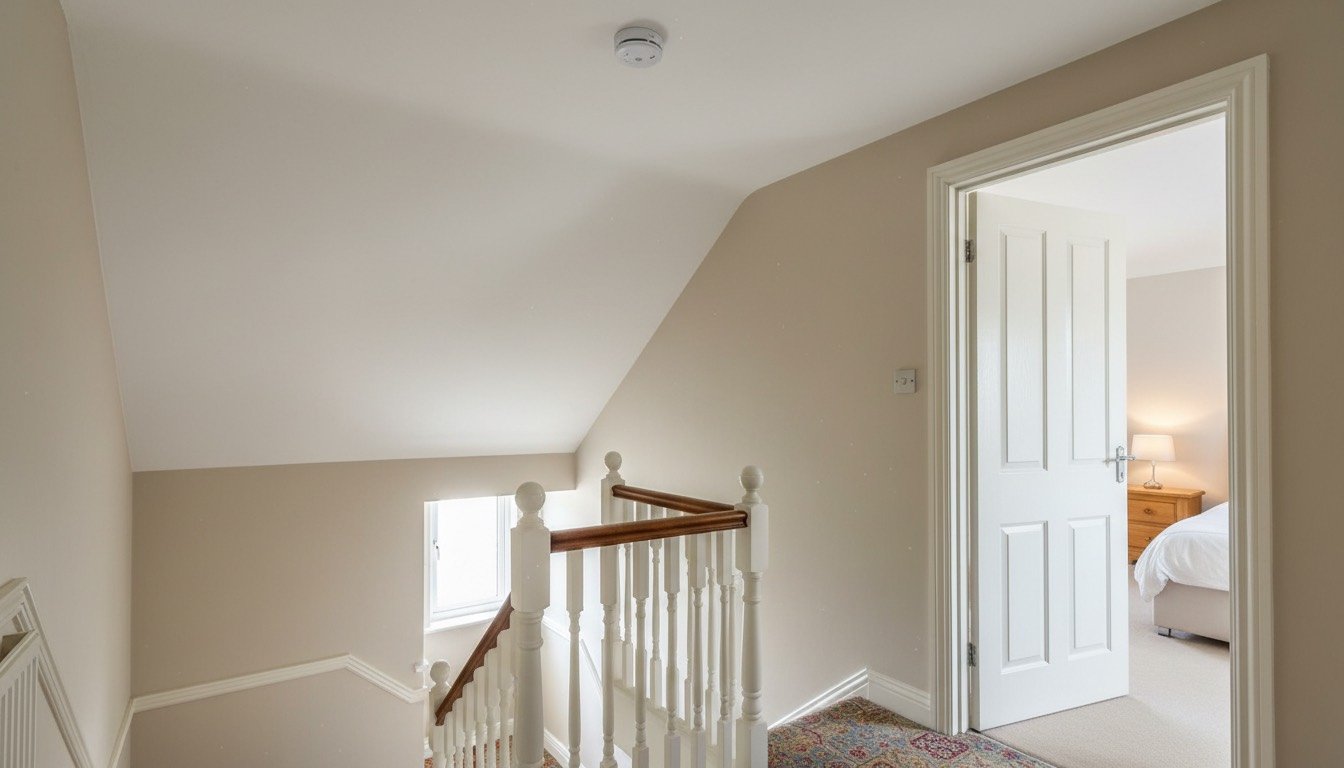
- •Site alarms at least 300mm from walls and light fittings, within 3m of bedroom doors. Never in a bathroom or directly outside one — steam reads as smoke.
- •In an HMO the rules are stricter and usually require a mains-wired system under the licence. Ask the landlord or the council rather than improvising.
Buying mistakes we still see every year
These cost nothing to avoid, and come up on nearly every job where we review a household's cover as part of a wider home fire safety check.
- •Buying one alarm for a three-storey house. Cover is per storey, and stairwells carry smoke.
- •Assuming a smoke alarm detects carbon monoxide. It does not — separate sensor, separate risk, worth reading up on if you have a boiler, wood burner or gas fire and want to prevent carbon monoxide poisoning.
- •Unbranded marketplace alarms with no BS EN 14604 marking, no importer address and a suspiciously long stated life.
- •Replacing the battery in a twelve-year-old alarm. The sensor, not the cell, is what has expired.
- •Paying for a smart alarm and never enabling notifications. If it is not on your lock screen, you paid extra for nothing.
Fitting, and where DIY properly stops
Sealed-battery and radio-interlinked alarms are a real DIY job: mark the ceiling, two screws into a joist or plugs in the plasterboard, twist the head onto the base, test. Fifteen minutes a unit. Vacuum the vents monthly, test weekly, and note the manufacture dates somewhere you will find them in 2036.
Mains-wired alarms are different. They run off a dedicated circuit, must be interlinked correctly, and in England and Wales the work falls under Part P of the Building Regulations — one of the electrical jobs you should not attempt yourself. Expect £150–£300 to swap three existing mains alarms on the same wiring, and £400–£800 for a fresh Grade D system in a three-bed house; sanity-check that against what an electrician costs in 2026. Ask for the installation certificate — a landlord or a buyer's solicitor will want it.
Found this useful?
There's plenty more — hundreds of guides and honestly-tested product reviews for every corner of your home.
Browse All Guides