Product Reviews · 6 min read · 14 May 2026
The Best Stair Lift UK (2026): Straight, Curved and What They Actually Cost
Two identical-looking terraces, one straight flight and one winder, and the quotes differ by £4,000. Here is what really separates the makes, what UK rules require, and where the money goes.
By the Nims Casa editorial team — written from professional cleaning experience and checked against our editorial standards.
Affiliate disclosure: if you buy through links in this article we may earn a small commission at no extra cost to you. Our recommendations come from professional cleaning experience and are never influenced by retailers or brands.
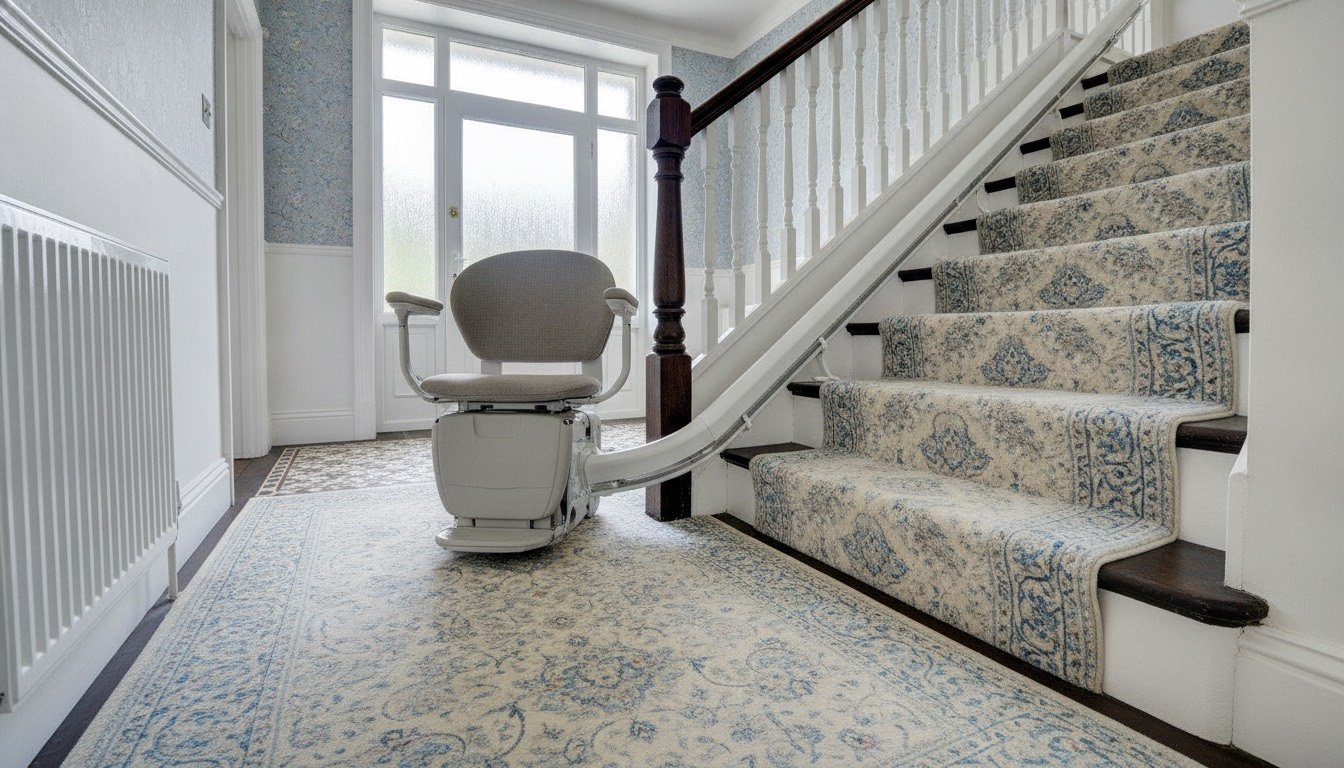
Two houses on the same Victorian terrace, same 13 steps, same stair width — one stairlift quote lands at £2,400, the other at £6,800. The difference is almost never the chair. It is whether the flight runs straight or turns through a winder, because a curved rail is made to measure and can never be reused.
Get the survey right and any of the four machines below will run twelve to fifteen years on an annual service. Get it wrong and you are arguing about a bespoke rail you have no right to return.
Our top picks at a glance
Stannah Siena Straight Stairlift
~£2,600-£3,600Built in Andover and backed by the densest engineer network in the UK, which matters far more at year eight than any specification sheet. A slim parked footprint and a powered swivel seat make it the safest bet on a standard terraced or semi-detached staircase.
Pros
- ✓ UK-wide engineer coverage with same or next-day call-out on a service contract
- ✓ Powered swivel and footrest available, genuinely useful for weak shoulders or hips
- ✓ Hinged rail options for hallways and front doors the rail would otherwise block
Cons
- ✗ Rarely the cheapest quote — expect a 20 to 30% premium over budget brands
- ✗ The curved sibling, Starla, pushes well past £4,500 once surveyed
Acorn 130 Straight Stairlift
~£1,800-£2,500Made in Steeton, West Yorkshire, and often fitted within a week of survey because the modular rail is cut to length on site rather than built to order. Ride quality is a shade firmer than Stannah's, but the mechanics are well proven and spares are cheap.
Pros
- ✓ Fast installation — days rather than weeks, which matters for hospital discharge
- ✓ Modular rail keeps straight-flight pricing genuinely competitive
- ✓ Widely available reconditioned from around £1,200 with a warranty
Cons
- ✗ Sales approach can be pushy — insist on the cooling-off period in writing
- ✗ Standard chair is rated to 120kg, so heavier users need the upgraded model
Handicare Freecurve
~£4,800-£7,500A single-tube curved rail that hugs the wall and keeps the chair tight to the treads, which is exactly what saves a narrow Victorian half-landing. The seat stays level through the turn, so there is no lurch coming off a winder at the top.
Pros
- ✓ Narrow single rail suits winders and quarter-landings without eating the stair
- ✓ Level, smooth ride through turns with a 137kg capacity
- ✓ Rail can often be routed to park clear of a doorway at the bottom
Cons
- ✗ Bespoke rail means four to six weeks from survey and no cancellation once made
- ✗ Fewer independent engineers can service it than the mainstream straight models
Otolift Two
~£4,500-£7,000Marketed as the narrowest curved stairlift available, and on a 760mm terraced flight that claim earns its keep. The single tube sits close to the wall and can be fitted on the inside of a bend, leaving usable walking width for everyone else in the house.
Pros
- ✓ Genuinely narrow — frequently fits where other curved rails are ruled out
- ✓ Can mount on the inside of tight winders, unusual among curved systems
- ✓ Quiet drive and a compact folded profile at the parking position
Cons
- ✗ Dutch-built, so lead times stretch during busy periods
- ✗ Fewer seat, upholstery and control options than the British makes
Who a stairlift suits, and who needs something else
A seated chairlift suits someone who can sit unaided, transfer on and off a seat and hold a paddle switch for the whole journey — most people managing arthritis, a joint replacement or general frailty. It is the wrong answer for a wheelchair user who cannot transfer, for someone with dementia who might stand mid-travel, and where the stairs are the only escape route from a shared-entrance flat.
Planning further ahead than the stairs? Work through aging in place home modifications first — a lift fitted before the bathroom is sorted often gets someone upstairs to a bath they can no longer use, which is why the walk-in tub vs roll-in shower decision belongs in the same conversation.
- •Sits and transfers — a seated stairlift, £1,800 to £3,600 fitted on a straight flight.
- •Cannot transfer, or uses a wheelchair indoors — a through-floor lift at £12,000 to £20,000, or a downstairs bedroom and level-access shower.
- •Can stand but not sit comfortably — a perch lift, needing a confident user and an opposite handrail.
- •Recovering from surgery — rent. Around £100 to £150 a month plus a £600 to £1,000 installation fee.
How we judged these, and what we did not do
We have not run these on a test rig and will not pretend otherwise. This shortlist comes from installer and service-engineer experience across UK housing stock, published specifications, BHTA membership records and the faults that show up at year six to eight: worn rack teeth, tired batteries, failing swivel microswitches.
- •Fit on a real UK staircase — parked footprint, rail intrusion, and whether the flight stays usable for everyone else.
- •Engineer coverage — how fast someone attends a breakdown in your postcode, not the national average.
- •Ten-year ownership cost, and whether an independent engineer can service it once the warranty ends.
- •Sales conduct — BHTA Code of Practice membership and a written cooling-off period, offered unprompted.
What to measure before anyone quotes you
Four numbers decide the quote, and you can take them yourself in ten minutes — before the first salesperson visits, so you know whether a curved rail is genuinely necessary. Replacing stair carpet too? Do that first; refitting around a mounted rail costs far more.
- •Clear stair width at the narrowest point. Most seated lifts need about 700mm of usable stair; below 660mm you are into the narrow curved models.
- •Step count and rise. A typical 13-step UK flight is a 2.6m rise and 4.5m of rail — a 30 to 40 second journey at 0.15 m/s.
- •What sits at the bottom. The rail overruns 300 to 400mm past the last step; if that lands in front of a door, add a hinged rail at £350 to £700.
- •Tread condition. The rail bolts to the treads, not the wall, so plaster is irrelevant but loose or open-riser stairs are not.
- •Which one that points to: Stannah Siena for a straight flight you want to last, Acorn 130 when budget or speed rules, Handicare Freecurve for turns, Otolift Two for narrow pre-1919 terraces.
The UK rules that actually apply
A seated stairlift inside your own house needs no planning permission and no building regulations application, because it is not a structural alteration. Everything else is either simpler or far more complicated than people expect.
- •Electrics: most stairlifts are 24V battery units trickle-charged from a normal 13A socket — £6 to £12 a year, and they still run in a power cut. If a socket already exists near the stairs, no electrical work is needed.
- •Part P (England and Wales): spurring a socket off an existing landing circuit is not notifiable; new circuits, consumer unit work and anything in a bathroom are. It must still meet BS 7671 and carry a Minor Works Certificate — see what an electrician costs. Scotland and Northern Ireland run separate standards.
- •Through-floor lifts differ: cutting an opening between storeys is structural and breaches fire compartmentation, so building control approval is required.
- •Leasehold flats need freeholder consent, and a lift on a communal stair engages the Regulatory Reform (Fire Safety) Order 2005 because it can obstruct escape routes. Communal lifts also fall under LOLER — examination every six months.
- •Renting: under the Equality Act 2010 a landlord must not unreasonably refuse consent for a disability-related improvement, though the tenant carries the cost and reinstatement. Social landlords usually fund and fit after an occupational therapy assessment.
- •Listed buildings: the rail fixes to the treads and is usually reversible, but get the conservation officer's confirmation in writing first. Whatever you buy should meet BS EN 81-40 and be UKCA or CE marked.
Grants, VAT relief and the running cost
Two reliefs move the price materially and both get missed, usually because nobody in the sales conversation raises them.
- •VAT: a stairlift installed for someone chronically sick or disabled is zero-rated, and for anyone aged 60 or over the reduced 5% rate applies. You sign a short eligibility declaration; the supplier should not be adding 20%.
- •Disabled Facilities Grant: up to £30,000 in England, £36,000 in Wales and £25,000 in Northern Ireland, through the council and means-tested for adults but not for a disabled child. Scotland uses the Scheme of Assistance instead.
- •Servicing: £120 to £250 a year, or £180 to £350 for breakdown cover including parts. Without cover, a call-out runs about £150 plus parts.
- •Batteries: two sealed 12V cells replaced every three to five years at £90 to £160 fitted. A lift that stops halfway and beeps is nearly always batteries, not a motor.
The buying mistakes that cost the most
Almost every expensive stairlift decision we see went wrong in the first hour of the first sales visit, not in the choice of brand.
- •Signing in the front room on the first visit. Home sales carry a 14-day cooling-off period under the Consumer Contracts Regulations 2013, but made-to-measure curved rails are excluded once manufacture starts.
- •Accepting a curved quote without a second survey. Some flights that look like they turn will take a straight rail with a different parking position, halving the cost.
- •Under-specifying weight. Standard chairs are rated to 120 to 127kg and heavy-duty versions to 160kg; buying for today's weight is a false economy.
- •Forgetting the rest of the household. A rail parked across the bottom step of a 760mm hallway is a trip hazard — our home safety checklist for seniors covers the risks people create while solving a different one.
- •Solving one floor instead of the whole house. Read universal design vs accessible design before spending £7,000 on one storey.
Found this useful?
There's plenty more — hundreds of guides and honestly-tested product reviews for every corner of your home.
Browse All Guides