Carpets & Flooring · 6 min read · 2 July 2026
Stair Carpet: Choosing, Fitting & Keeping the Hardest-Working Floor Alive
Stairs concentrate every footstep onto twelve small edges — it's the hardest test in flooring. What survives it, what doesn't, and the safety rules that matter.
By the Nims Casa editorial team — written from professional cleaning experience and checked against our editorial standards.
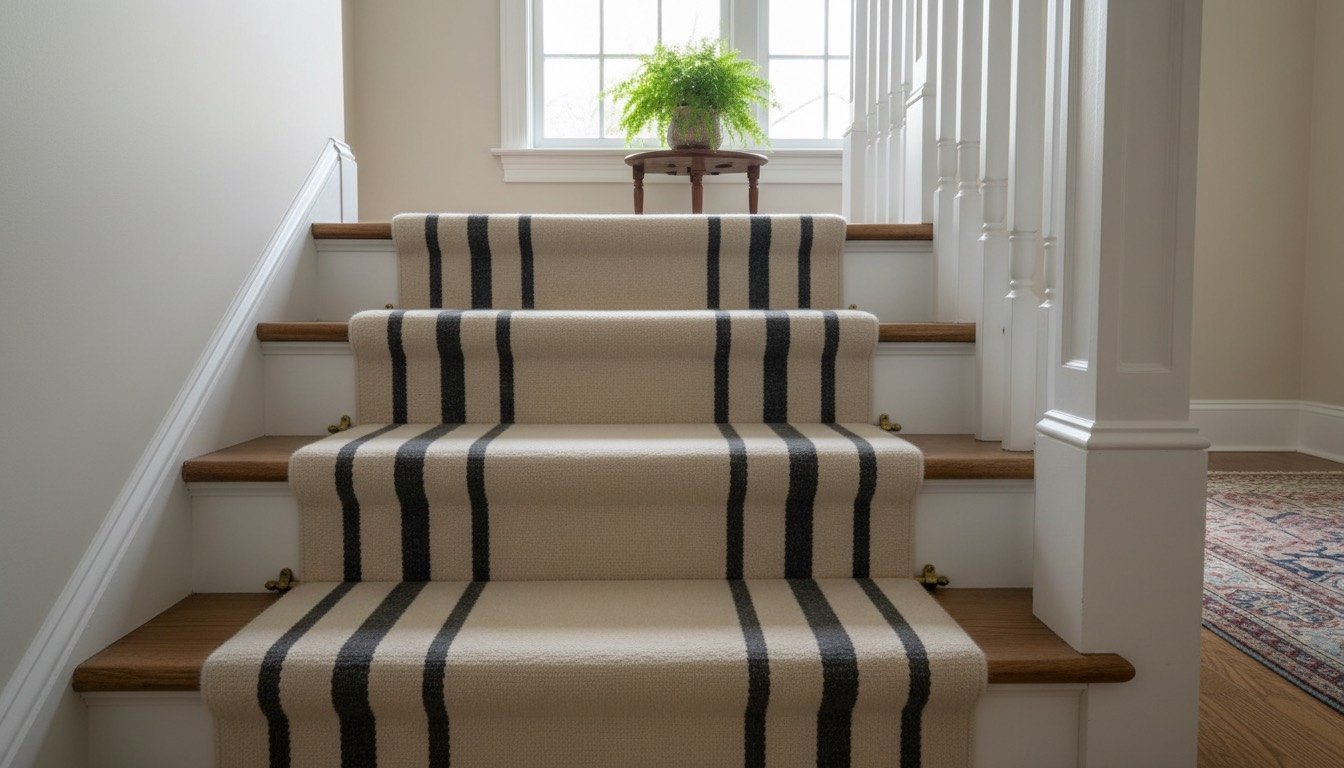
Your stairs take the same footfall as the hallway but concentrate every step onto twelve or so narrow edges, where the carpet bends, compresses and abrades all at once. It's the toughest brief in domestic flooring, which is why the lounge carpet that "has years left" often looks tired on the stairs within three. Fibre, pile, underlay and fitting all matter more here than in any other room.
This guide covers what actually survives stair traffic, runner versus full-width, how professional fitting works, the safety rules that turn loose stair carpet from a cosmetic issue into a real hazard, and the habits that add years to the same carpet. Comparing fibres from scratch first? Our carpet types guide pairs well with this one.
None of it is about chasing the prettiest sample in the shop. It's about specifying a staircase that still looks presentable in year eight, not year two.
Choosing the right fibre and pile for stairs
An 80/20 wool-nylon twist is the standard stair recommendation, and it earns it: wool gives resilience and springs back after compression, nylon adds abrasion resistance wool can't match on a nosing folded hundreds of times a day. Budget roughly £25–£45 per m² for a decent wool-twist. Pure polypropylene is the fibre to avoid on stairs specifically — it flattens permanently under repeated crushing, even though it's good value elsewhere in the house. If budget is tight, 100% nylon (around £15–£28 per m²) is the better synthetic alternative.
Pile matters as much as fibre: go dense, low and tightly twisted rather than deep and loose, which crushes fastest on an edge. Fold the sample sharply in the shop — if the backing shows through, the stairs will expose that within a year. Underlay should be firmer and denser than a bedroom spec too, such as crumb rubber or high-density PU (£8–£15 per m²), because soft underlay feels lovely for a month and accelerates wear once the cushioning collapses. Pattern or mid-tones disguise the traffic lane that will eventually develop up the centre; pale plains show it within a season.
Runner vs full-width stair carpet
Runners with painted or stained borders are firmly back in fashion, and not just decoratively: a runner uses less carpet, so the same budget can buy a better wool-twist per metre, and stair rods add a handsome finish for roughly £15–£40 a set. The trade-off is that the exposed border needs occasional repainting as footfall wears it, and a narrower runner is less forgiving of an unsteady toddler or older relative than carpet covering the full tread.
Full-width carpet costs more in material but needs no border upkeep and gives grip edge to edge — worth prioritising if the household includes young children or anyone less than fully steady on their feet, or where a stair lift is fitted alongside. Whichever you choose, professional fitting matters more on stairs than anywhere else: this is where DIY fitting gets found out fastest, and carpet that isn't correctly tensioned is a safety issue, not a cosmetic one.
How stair carpet fitting actually works
A competent fitter follows broadly the same sequence on every staircase, which helps you judge a quote:
- •Strip and inspect: old carpet and underlay come up, and the fitter checks each tread and nosing for squeaks or loose fixings first.
- •Fit gripper strips: tackless gripper is fixed to the back of each tread and base of each riser, angled so the carpet locks under tension.
- •Lay underlay: cut and fixed to each tread individually — a continuous roll causes premature wear at every nosing.
- •Fit the carpet: worked tread by tread, stretched over the gripper with a knee kicker so there's no slack at the nosing.
- •Trim and finish: edges tucked at skirting and stringer, with stair rods or edge trims fitted last.
What stair carpet and fitting typically cost
For a standard straight staircase of 12–14 steps, budget roughly £15–£25 per step for professional fitting on top of carpet and underlay, putting a full re-carpet — wool-twist, dense underlay, professional fit — at somewhere between £600 and £1,200. A runner with rods can come in lower overall since it uses less carpet. Winder and open-tread staircases cost more to fit, since each step needs individual measuring and extra fixing points, so treat a quote that doesn't distinguish between the two with caution. Our flooring installation cost guide covers pricing more generally.
Stair carpet safety rules you can't skip
UK fitters generally work to BS 5325, the British Standard covering textile floorcovering installation, which sets tighter gripper spacing on stairs than on a flat floor, because stair carpet under tension is doing structural work as well as decorative work. Any carpet that lifts, bulges or comes loose from the gripper at a nosing is a trip hazard to fix immediately, not at the next redecoration.
This matters more still for landlords: under the Housing Health and Safety Rating System, loose or unsecured stair coverings are specifically assessed as a falls hazard. If a household includes anyone with reduced mobility, pair a well-fitted carpet with proper handrails and good lighting on every step.
Caring for stair carpet so it lasts
Vacuum stairs weekly, using the crevice tool along each nosing specifically, where grit collects and grinds into the pile with every step. A useful trick: specify an extra half-metre or so of carpet at fitting so it can be lifted and shifted a few centimetres years later, moving the worn section away from the nosing edge — a small extra cost that can roughly double useful stair carpet life. Our vacuum cleaner guide covers models that handle stairs well.
Annual professional cleaning earns its keep on stairs more than anywhere else: banister use adds body oils to the usual grit, and trapped grit does its fastest damage on a bend. See our carpet cleaning cost guide for typical UK pricing, and deal with spills on the stairs promptly rather than letting them set into the nosing.
Common stair carpet mistakes to avoid
- •Choosing on colour alone: a pale plain that shows the traffic lane within months isn't a bargain, whatever it cost.
- •Using bedroom-spec soft underlay, which accelerates wear once the cushioning collapses under repeated compression.
- •Skipping the fold test — if a sample's backing shows through when creased, it will show on every nosing within a year.
- •Treating a loose edge as cosmetic rather than re-gripping it promptly; see our carpet repair guide for small fixes worth doing yourself.
- •Not budgeting extra for winder or open-tread stairs, which need more measuring and fixing points than a straight run.
- •Choosing polypropylene for cost: fine value elsewhere in the house, but it flattens permanently on stair nosings.
Frequently asked questions
**How long should stair carpet last?** A quality wool-nylon twist, properly fitted with dense underlay and vacuumed weekly, typically lasts 10–15 years, compared with as little as 3–5 years for a soft or polypropylene carpet on bedroom-spec underlay. Our guide to making carpet last longer covers habits that apply to any room.
**Can I fit stair carpet myself?** It's possible but not advisable for most people. Correct gripper spacing, tensioning at every nosing and safe cutting around winders are easy to get wrong, and poorly fitted stair carpet is a genuine trip hazard rather than just an untidy job.
**Do I need underlay on every step, or can I use one continuous roll?** Underlay should be cut and fixed to each individual tread. A continuous roll bunches and thins at the nosings, exactly where the most protection is needed.
**Is a stair runner as durable as full-width carpet?** The carpet itself can be identical quality either way. A runner exposes more of the tread edge, meaning slightly more visible border wear over time, but the central section wears at the same rate as full-width carpet of the same specification.
**What's the clearest sign it's time to replace?** Backing showing through the pile at the nosing of the top or bottom three steps, which carry the most traffic — often visible well before the rest of the run looks worn.
Found this useful?
There's plenty more — hundreds of guides and honestly-tested product reviews for every corner of your home.
Browse All Guides