Product Reviews · 6 min read · 14 July 2026
The Best Under Bed Storage UK (2026): What Actually Fits, and What Lasts
Most under-bed boxes are bought before anyone measures the gap. Work out which of the five under-bed problems you have, then buy the box that solves it.
By the Nims Casa editorial team — written from professional cleaning experience and checked against our editorial standards.
Affiliate disclosure: if you buy through links in this article we may earn a small commission at no extra cost to you. Our recommendations come from professional cleaning experience and are never influenced by retailers or brands.
Almost every under-bed box that ends up in a charity shop was bought in the wrong order. Someone sees a tidy photograph, orders four, then finds the frame gives 175mm of clearance while the lid clips need 230mm. Much of what UK retailers file under storage will not slide beneath an average British bed, and plenty of what does fit will not survive being dragged across carpet twice a year.
So this guide runs backwards. Diagnose the space first, then buy. The right container for a divan on castors in a cold Victorian terrace is not the right one for a slatted pine frame in a warm new-build, and no volume of five-star reviews changes that.
Our top picks at a glance
Really Useful Box 64 Litre XL
~£22-28Made in Yorkshire from thick polypropylene with a clipped lid and a properly ribbed base, this is the one that is still intact when the bed gets replaced. At 710 x 440 x 230mm it needs a genuine 250mm of clearance, so measure first.
Pros
- ✓ Clip lid seals well enough to keep dust and moths out for years
- ✓ Stacks and takes a second full box on top without the lid deforming
- ✓ Range has been in production for decades, so you can match sizes later
Cons
- ✗ 230mm tall rules it out for low frames and most divans
- ✗ Heavy and awkward to drag when fully loaded — no wheels as standard
IKEA SKUBB Storage Case (69 x 55 x 19cm)
~£10-14A zipped fabric case with a mesh window and carry handles that squashes into gaps rigid boxes cannot reach. Folds flat when empty, which matters if you only use it for six months of the year.
Pros
- ✓ Compresses into roughly 150mm of clearance when not overfilled
- ✓ Very cheap per litre and available in a matching range of sizes
- ✓ Handles make it easy to drag out one-handed
Cons
- ✗ No moisture or moth barrier — not for wool or for cold solid floors
- ✗ Sides collapse if you understuff it, so contents shuffle and crease
Wham Crystal Underbed Box 32L with Wheels
~£11-16Clear, low-profile and on castors, this is the practical choice when you are in and out of the box regularly. Widely stocked in UK supermarkets and hardware chains, which makes matching sets easy.
Pros
- ✓ Sub-180mm height clears most standard frames with room to spare
- ✓ You can see the contents without unclipping the lid
- ✓ Wheels glide well on laminate, boards and vinyl
Cons
- ✗ Thinner walls than premium boxes; lid clips can crack in cold rooms
- ✗ Wheels are close to useless on deep-pile carpet
Spacesaver Premium Vacuum Storage Bags (Jumbo, 5-pack)
~£18-25The only genuine answer to spare duvets and winter coats in a 150mm gap, cutting bulk by roughly two-thirds with a household vacuum. Double-zip seal and a valve that takes a standard hose or the supplied hand pump.
Pros
- ✓ Reduces two synthetic duvets to something that slides under a low divan
- ✓ Fully sealed against dust, damp and moths once evacuated
- ✓ Hand pump included, so it works without a vacuum cleaner
Cons
- ✗ Permanently flattens the loft of down and wool if left compressed for over a season
- ✗ Valves and seals fail eventually; a bag that re-inflates over a month is done
Who This Is For, and Which Under-Bed Problem You Actually Have
This is for anyone whose bedroom has run out of cupboard and whose bed sits on roughly 1.5 square metres of unused floor. It is not for anyone still holding bags they have not opened in three years, which is a different problem, better solved with a proper pass to declutter the room first.
Run through these five profiles. Almost everyone matches exactly one, and that answer decides the purchase.
- •Clearance problem: under 150mm from carpet to frame. Common on low fabric beds and MALM-style frames. Rigid boxes are out; zipped soft cases and vacuum bags are the only realistic options.
- •Access problem: you need the contents weekly, not seasonally. Shoes, gym kit, hobby supplies. You want wheels, clear walls so you can see in, and boxes light enough to lift when loaded.
- •Environment problem: solid concrete ground floor, external wall behind the headboard, a room that goes cold overnight. Contents need a clipped seal and air beneath. Loose lids and cardboard grow mould by March.
- •Volume problem: two spare duvets, winter coats and a sleeping bag, all needed once a year. Compression is the only answer, because rigid boxes waste half their volume on air.
- •No-space problem: a divan flat to the floor, or an ottoman bed. Fix the base, add 100mm risers, or use height instead with small-space storage ideas.
Measure First: The Three Numbers That Decide Everything
Four minutes with a tape is the difference between storage and a stack of boxes on the landing. One caution: manufacturers quote external heights and rarely include lid clips, handle lips or wheels, so subtract 20mm from whatever you measure before comparing anything.
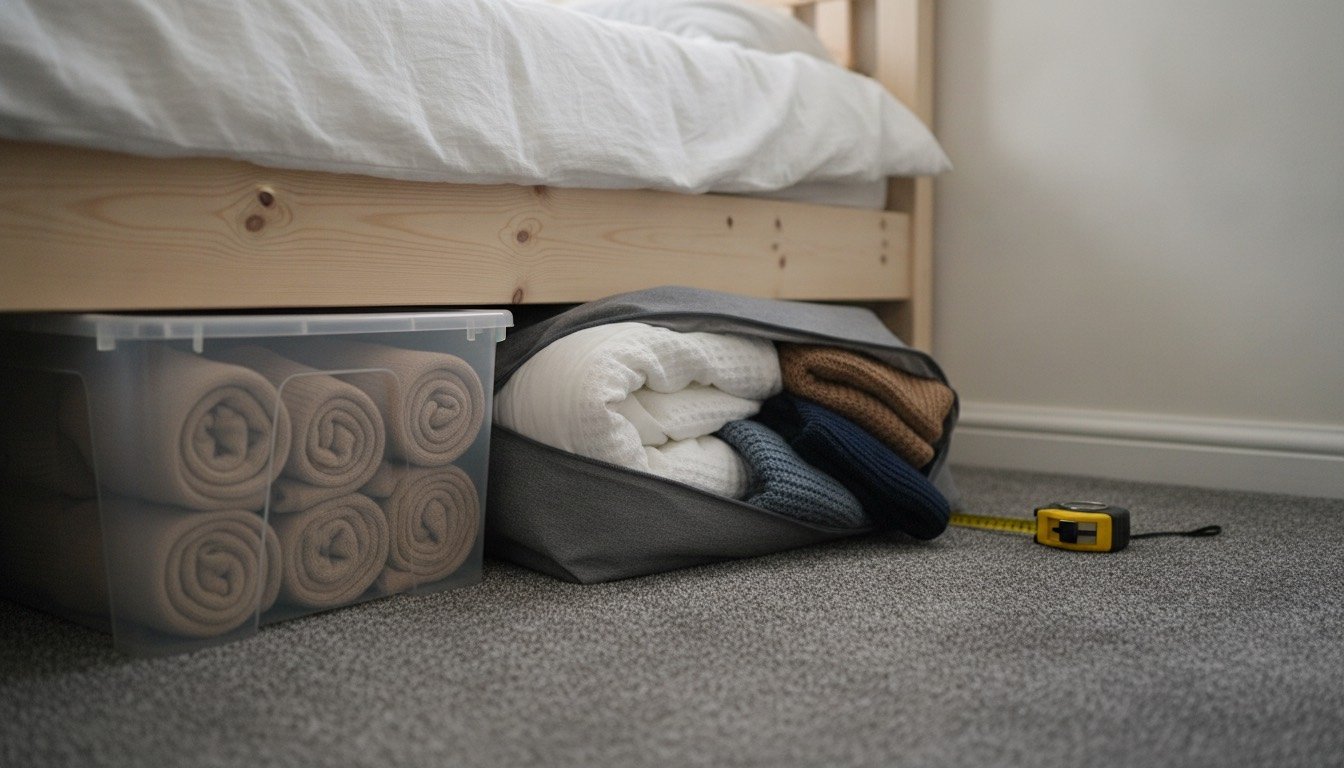
- •Clearance: floor to the underside of the lowest structural member, meaning a side rail or centre beam, not the slats. Measure mid-bed and press into the carpet pile, because a loaded box compresses it anyway. Typical UK figures are 90-140mm for a divan on castors, 140-180mm for a low fabric frame and 200-300mm for a standard wooden or metal frame.
- •Run: side rail to centre beam. Most UK double, king and super-king frames have a central support with a leg, so you have two bays roughly 550-650mm deep rather than one 1350mm bay. That is why 710mm boxes have to go in end-on.
- •Approach: the floor beside the bed. You need the box's full depth plus 100mm to pull it clear and open the lid. A bed 500mm from a wardrobe cannot take a 550mm box on that side, whatever the clearance allows.
How We Judge This Category
Being straight about method: this is not a laboratory review. It comes from end-of-tenancy and home-organising work across several hundred UK bedrooms, where you see which boxes crack, which lids warp and which fabric cases collapse after two or three years, plus long-term personal use of everything listed here. Prices are typical UK retail in mid-2026.
- •Real fit: does it go under a 200mm frame with the lid clipped and wheels on?
- •Seal: clipped versus friction lids, judged on dust ingress and smell after six months closed.
- •Drag test: loaded to about 12kg and pulled across medium-pile carpet fifty times. Ribbed bases and radiused corners survive this; thin flat bases split.
- •Cost per litre and replaceability: a range still stocked in five years beats one that vanishes.
Matching the Picks to Your Problem
Cross-reference your profile with the picks below. Clearance problem: a SKUBB-style zipped case is the only structured option that fits, with vacuum bags covering the bulky remainder. Environment problem: clipped polypropylene and nothing else, lifted on two lengths of 25mm batten so air can move underneath.
Access problem: wheeled and clear, accepting that castors are near-useless on deep pile and genuinely good on laminate. Volume problem: vacuum bags, with one caveat. Compressing goose down or wool for more than a season permanently flattens the loft, so keep them for synthetic duvets and coats.
What to Look For
Once the category is settled, small details separate a box that lasts a decade from one that cracks in eighteen months.
- •Clip-down lids, not push-on. Push-on lids lift when the box is dragged and let in dust, which under a bed is mostly skin cells and fibre, the same material feeding a dusty house.
- •Ribbed or webbed bases: a flat 1.2mm base panel splits at the corners when loaded.
- •Recessed handles rather than protruding grips, which steal 15-20mm of the clearance you just measured.
- •Wall thickness you can judge from the listing photo: light through the corners is a warning sign on clear polypropylene.
- •Litre ratings are measured to the brim. Assume you get about 80 per cent of the quoted volume with the lid on.
Common Buying Mistakes
Five patterns account for most of the wasted money in this category.
- •Buying before measuring. The commonest cause of returns, and the box is usually unreturnable once it has been scuffed under a bed.
- •Buying one huge box instead of two. A 100-litre box is unliftable when full and will not pass a bedside table. Two 32-50 litre boxes cost about the same and actually get used.
- •Storing wool unprotected. Under a bed is warm, undisturbed and low-traffic, which is exactly what carpet moths and clothes moths want. Wash first, then seal.
- •Using cardboard, which draws moisture from a cold floor, delaminates and collapses as you pull it out.
- •Filling the space and never revisiting it. Tie the review to the same seasonal wardrobe rotation you already do in spring and autumn.
Keeping It From Becoming a Damp, Dusty Problem
Under-bed storage fails quietly. Nobody looks for two years, then a box comes out smelling of cellar. In UK housing stock with solid ground floors, single-skin external walls and bedrooms heated four hours a day, the risk is condensation on cold surfaces rather than rising damp, and a sealed box sitting on a cold floor makes an excellent condenser.
- •Leave a 50mm gap to the wall and never fill the entire footprint of the bed. Air has to move under there.
- •Lift boxes off solid floors on 25mm timber battens or two lengths of foam pipe insulation.
- •One silica gel sachet per sealed box, replaced annually; pence each in bulk.
- •Vacuum the whole under-bed area at every duvet change, and clean the mattress while the bed is stripped. If a box smells musty on opening, treat it as a symptom and check the room before refilling.
Found this useful?
There's plenty more — hundreds of guides and honestly-tested product reviews for every corner of your home.
Browse All Guides