Cleaning Guides · 6 min read · 12 July 2026
How to Clean a Mattress: Stains, Smells & the Dust Mite Problem
You wash the sheets weekly — and the thing under them never. The twice-yearly mattress routine that handles stains, smells and the millions of guests.
By the Nims Casa editorial team — written from professional cleaning experience and checked against our editorial standards.
You wash the sheets weekly, but the thing underneath them almost never gets touched. Every night your mattress absorbs roughly half a pint of moisture from sweating, plus shed skin cells that feed a thriving dust-mite population — the biggest allergy trigger in the average British bedroom. Sheets carry away some of it; the rest settles in for years, which is why a mattress that looks clean can still be the smelliest, most allergenic object in the house.
This guide covers the twice-yearly deep clean that shifts that build-up: the tools worth buying, the bicarbonate method, and fixes for the three stains that cause most panic — sweat, blood and urine — without soaking a mattress you can't rinse. There's also the dust-mite angle, the mistakes that damage mattresses rather than clean them, and when it's time to call a professional cleaner or simply replace the thing.
None of it is complicated — it just needs doing on a schedule, not once a decade.
Tools and materials you'll actually need
Nothing here requires specialist kit — most of it is already in a UK kitchen cupboard, and the rest costs less than a takeaway.
- •A vacuum with an upholstery or crevice attachment — budget uprights start around £60–£90 and it's the most-used tool here.
- •Bicarbonate of soda, 500g–1kg — roughly £1–£3, the workhorse for both odour and moisture.
- •White vinegar, about £1–£2 a litre, for sweat and yellowing.
- •Table salt, pennies per stain, for fresh blood.
- •An enzyme-based stain and odour remover, £4–£9 a bottle, essential for urine.
- •A washable, waterproof mattress protector — £15–£40 for a double, £25–£60 for a king — the best single investment in this guide.
- •A few microfibre cloths, for blotting rather than scrubbing.
The twice-yearly deep clean, step by step
Do this in spring and autumn as a minimum — more often if you have pets, young children, or hay fever and dust-mite allergies in the household. Pick a dry day so the mattress has time to air properly. Twice a year conveniently matches the seasonal bedding change — many households do it while switching duvet togs for autumn and again in spring.
- •Strip everything back and wash the bedding at 60°C, the temperature that actually kills dust mites rather than just dislodging them — duvets and pillows need their own occasional wash too.
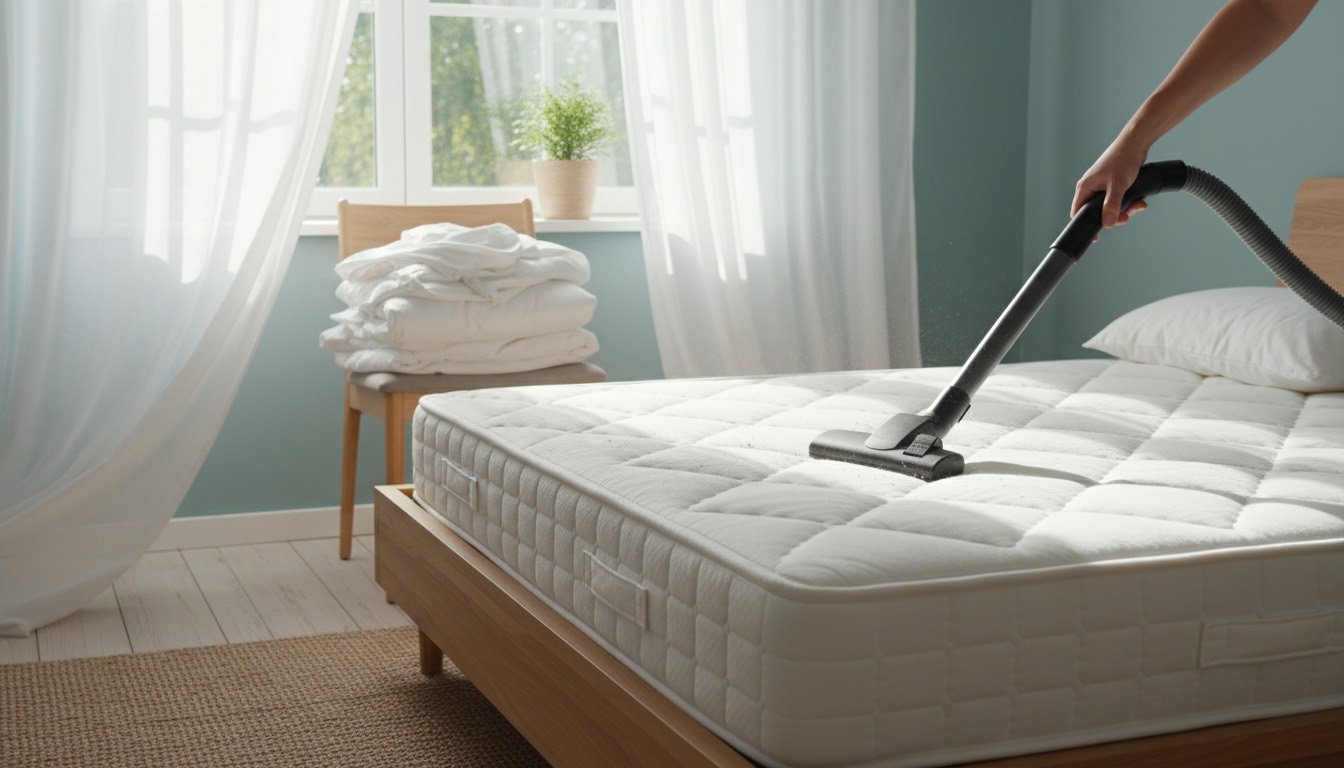
- •Vacuum the entire surface slowly with the upholstery tool, in overlapping strips. Don't skip the sides, piping, seams or buttons — these are where dust and mite debris collect most.
- •Sift bicarbonate of soda evenly across the surface with a sieve so it doesn't clump. Leave for at least two hours, ideally six to eight — the longer it sits, the more moisture and odour it draws out.
- •Vacuum the bicarbonate off completely, going over each section two or three times. Any residue left will feel gritty through a sheet.
- •Prop the bare mattress against a wall or open window for a few hours if weather allows — daylight and airflow both reduce mite populations.
- •Rotate the mattress head-to-toe before remaking the bed, to even out wear. Only flip it top-to-bottom too if it's a genuine double-sided mattress — most modern ones aren't.
- •Fit a clean, washable waterproof protector before the sheets go back on.
Removing sweat, blood and urine stains safely
A mattress can't be rinsed the way a carpet or a sink can, so the rule for every stain is the same: minimal moisture, always. Dab and blot with a barely damp cloth — never pour or spray liberally, because anything that soaks past the surface struggles to dry and can encourage mould inside the mattress core.
For sweat and yellowing, dab equal parts white vinegar and water onto the stain, then sprinkle bicarbonate over the damp patch once it's stopped glistening; leave to dry fully before vacuuming off. For blood, always use cold water — hot water sets the protein permanently, the single most common mistake people make. Dab with cold, salted water or a bicarbonate paste, repeating two or three times rather than scrubbing harder.
Urine needs the most care. Blot immediately with dry towels, pressing rather than rubbing, then apply an enzyme cleaner as a light mist — enzymes break down the compounds behind the lingering smell, which vinegar and bicarb alone don't fully address. Let it dry completely before recovering; stand it on its side if you can. If a stain or smell survives two rounds, a professional clean uses hot-water extraction that rinses and immediately draws the moisture back out — what a bathroom sponge can't replicate. The same enzyme-cleaner logic applies to pet accidents on carpet.
Dust mites, allergies and why airing out matters
Dust mites don't bite or spread disease, but their droppings are a common trigger for asthma, eczema and rhinitis, and a mattress is their favourite habitat — warm, humid overnight, and constantly resupplied with skin cells. Numbers build fastest in centrally heated bedrooms with poor ventilation, which describes most British houses for half the year. If the bedroom windows fog most mornings, our guide to signs of poor home ventilation covers the fixes.
The bicarb clean helps because mites need moisture to survive, and drawing it out genuinely reduces their numbers, not just the smell. Between deep cleans, a weekly hoover through the fitted sheet and washing bedding at 60°C keep populations low. Anyone with diagnosed allergies may find a dedicated air purifier worth running overnight, and a dehumidifier worth considering in a damp or poorly ventilated room, since mites struggle in low-humidity air.
Common mattress-cleaning mistakes
A few habits do more harm than the dirt they're meant to remove.
- •Soaking a stain to lift it in one go — mattresses can't drain, so excess liquid sits in the foam and can cause mould you won't see until it smells.
- •Using bleach or undiluted chemical cleaners — these degrade foam, discolour fabric permanently, and leave a residue that's uncomfortable to sleep on.
- •Remaking the bed before the mattress is fully dry — trapped moisture under a sheet is exactly what dust mites and mould prefer.
- •Scrubbing a stain hard with a brush — this pushes the mark deeper and damages the fabric, when blotting achieves more.
- •Never fitting a protector, then being surprised the mattress needs full-scale rescue every year instead of a routine wipe-down.
When to call a professional, or replace the mattress
A professional clean is worth booking for stains or odours that survive two DIY attempts, a mattress inherited second-hand, or after a significant spill or illness — expect roughly £40–£70 for a single mattress and £70–£110 for a double or king, depending on region.
Cleaning also has limits. A UK mattress typically lasts seven to ten years; sagging, visible lumps, smells that return within days of a deep clean, or worsening allergy symptoms overnight all signal the mattress itself, not just its surface, is done. At that point, choosing a well-reviewed replacement beats repeated professional cleans on a mattress that's already broken down internally.
Frequently asked questions
How often should I clean my mattress? Twice a year is the general minimum — spring and autumn work well as reminders — but allergy sufferers, pet owners and homes with young children often benefit from a light vacuum and bicarbonate treatment every three to four months.
Can I use a steam cleaner on a mattress? Handheld steam can work for surface sanitising on some types, but check the care label first — memory foam can be damaged by heat and moisture. When in doubt, stick to the dry bicarbonate method, which suits every mattress type.
Will bicarbonate of soda damage my mattress? No — it's dry, mild and widely used precisely because it's safe on fabric, foam and springs alike, provided it's vacuumed off thoroughly so no gritty residue remains.
How do I get rid of new-mattress smell? This off-gassing usually fades within a few days to two weeks once the mattress is aired in a well-ventilated room — it isn't a sign of a fault.
Do I need to clean both sides of my mattress? Only if it's a genuine double-sided, flippable design — most modern mattresses have one sleep surface over a non-sleep base, so flipping just puts the wrong side up.
Found this useful?
There's plenty more — hundreds of guides and honestly-tested product reviews for every corner of your home.
Browse All Guides