Tools & Workshop · 6 min read · 22 June 2026
Cordless vs Corded Tools: Real Performance, 10-Year Costs and the Jobs That Still Need a Cable
A 5.0Ah battery holds about 90 watt-hours. A 1,400W corded saw eats that in under four minutes. That one sum explains most of the cordless-versus-corded argument.
By the Nims Casa editorial team — written from professional cleaning experience and checked against our editorial standards.
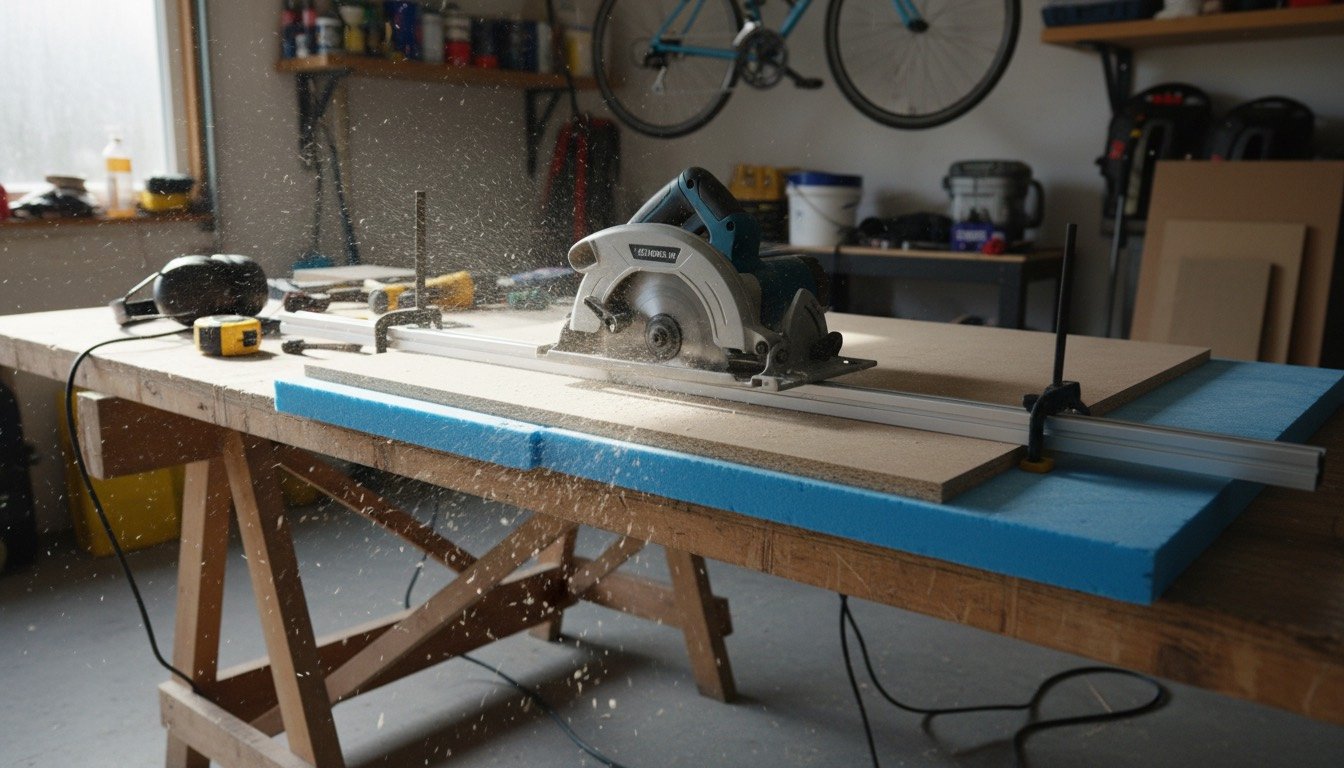
A 5.0Ah 18V battery holds roughly 90 watt-hours. A corded 1,400W circular saw consumes that much in under four minutes of continuous cutting. Batteries have improved enormously, but they have not repealed physics, and that sum explains why a working joiner's van still carries a mains lead alongside six packs.
Most people arrive here after buying the wrong thing once: cordless that kept dying, or corded that means Saturdays untangling leads. In nearly every case the tool was not the problem. Before spending anything, work out which problem you actually have.
First, diagnose the actual problem
Run through these in order. Each points at a different fix, and only two are solved by switching between cordless and corded.
- •It stops mid-job and the pack is flat — a runtime problem, not a cordless problem. A second 5.0Ah pack (£70-110) fixes it for less than a corded rebuy.
- •It stalls under load while the pack shows three bars — a torque problem. You have a DIY-class tool doing trade work. Brushless cures it; corded cures it cheaper.
- •Cuts are slow, burning or wandering — nine times out of ten that is a blunt blade or wrong tooth count, not power. Change the consumable before the tool.
- •You are forever moving leads, or working up a ladder — a genuine mobility problem, and the strongest case for cordless.
- •It runs eight minutes in an unheated garage in January and quits — a temperature problem. Lithium cells lose 20-30% of usable capacity around 0-5°C. Store packs indoors.
- •The job runs for hours at high draw: floor sanding, plaster mixing, wall chasing. That is a sustained-power problem, and no 18V platform answers it at any price.
Cordless vs corded: the side-by-side
Like for like — an 18V brushless tool against a mid-range 230V equivalent from Screwfix, Toolstation or B&Q.
- •Purchase price: corded wins. A 750W hammer drill is £45-70; an 18V brushless combi kit with two packs is £140-220.
- •Sustained power: corded wins. A 13A socket delivers 3kW all day; an 18V pack peaks near 1.5-2kW for seconds before heat management pulls it back.
- •Weight overhead: corded wins. A bare jigsaw is 2.1-2.4kg; with a 5.0Ah pack it is 3.2-3.6kg.
- •Set-up time: cordless wins decisively. No reel to unwind, no RCD adaptor, no cable route to plan.
- •Outdoors and near water: cordless wins. No trailing 230V lead across a wet patio.
Performance: where each genuinely wins
For short, intermittent work — driving screws, pilot holes, cutting skirting, fitting a kitchen — 18V brushless matches or beats corded, because more of the hour is spent working. A brushless impact driver sinks 300-plus 5.0 x 80mm screws into softwood on one 4.0Ah pack. Our impact driver vs drill comparison settles which to buy first.
For sustained high-draw work the cord still wins, and it is not close. Mixing bonding compound, chasing a channel for a socket, grinding through concrete lintels, sanding a floor — all pull 1,200-2,000W for minutes at a time. Cordless tools thermally cut out doing that, and you will empty four packs before lunch. Hire shops stock corded and 110V for this reason; our guide to using a circular saw explains why blade speed under load beats headline wattage.
The 10-year cost, counted properly
Battery packs are consumables: roughly 300-500 charge cycles before capacity drops below 80% — five to eight years for a weekend user, two or three for a tradesperson. Three realistic UK cases over ten years:
- •Occasional DIY, cordless: brushless combi kit with 2 x 2.0Ah £160, bare jigsaw £75, bare multi-tool £70, one replacement 4.0Ah pack around year seven £75. Roughly £380.
- •Occasional DIY, corded: 750W hammer drill £55, jigsaw £45, 1,400W circular saw £75, 25m reel £32, RCD adaptor £15, brushes £9. Roughly £231 — plus perhaps 40 hours of cable handling.
- •Heavy user, single platform: four bare tools £420, four 5.0Ah packs at £85 replaced twice £680, two chargers £110. Roughly £1,210 — worth it if the tools earn.
- •The hidden cost is platform abandonment: anyone who bought 18V NiCd, or the older DeWalt slide-pack system, paid twice. Ten-year pack availability matters more than any tool's spec, which is the real argument in DeWalt vs Milwaukee.
Set-up and upkeep: leads, RCDs, brushes and cells
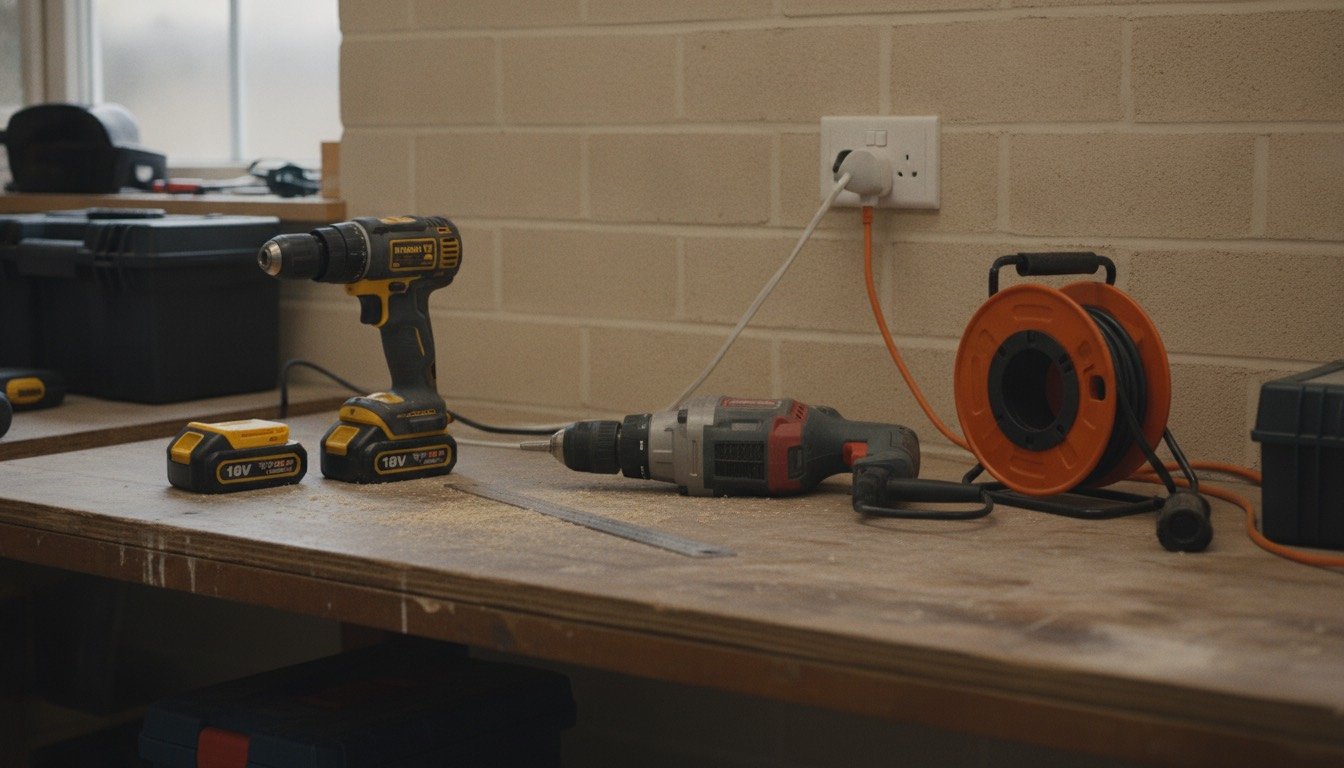
Corded tools carry a set-up cost people forget. A 13A socket gives about 3.1kW — fine for one tool, not a saw and an extractor together. Extension reels are the classic trap: a 50m reel rated near 3kW unwound often manages only 1,000-1,300W while coiled, because the windings cannot shed heat. Unwind the drum fully, every time.
Anything used outdoors or in a garage should run through a 30mA RCD — a proper RCD socket, or a plug-in adaptor at £12-18. Plenty of older UK garages have no RCD protection at all, a real shock risk with a corded tool on damp concrete. Cordless sidesteps that; run through our power tool safety checklist either way. Cordless has one rule of its own: keep the charger indoors, as most refuse to charge below 0°C.
Corded maintenance is cheap and mechanical. Brushed motors want new carbon brushes every few hundred hours — a £6-12 part and a fifteen-minute job. Blow the vents clear, check the cable at the strain relief, and replace any lead with exposed cores rather than taping it.
Cordless maintenance is all cells. Store packs at 40-60% charge for a season in the drawer, never flat, never left on a charger for weeks. Keep them out of unheated sheds over winter: cold storage plus deep discharge is why so many UK garage-kept kits die in year three, not year seven. Wipe brick dust off the terminal rails — it causes intermittent power mistaken for a failing tool.
Who each suits
No universal answer, but the typical cases are clear.
- •Flat or terrace, occasional shelves and flat-pack: one good 18V brushless combi drill and nothing else.
- •Older house with solid walls and a garden list: cordless combi and impact driver, plus a corded SDS drill (£60-110) for masonry. The sweet spot for most UK homeowners.
- •Landlord or maintenance work across sites: full cordless on one platform, a corded grinder held in reserve.
- •Workshop woodworking: corded on the bench — table saw, router, sander, extractor — cordless only for assembly and site visits.
- •Renting, or no permanent workspace: cordless, starting from our homeowner tool list rather than a bargain 100-piece set.
The verdict
For drilling, driving, cutting sheet material and general household work, cordless has won and the argument is over. The set-up time saved justifies the premium on its own, and one quality 18V brushless combi drill covers about 80% of what a UK home asks of you.
For sustained high-draw work — mixing, chasing, grinding, sanding floors — corded remains correct, and buying cordless for those jobs wastes money twice. The honest answer is a cordless core plus two or three cheap corded specialists bought as jobs arise. Choose the platform on ten-year pack availability, not this weekend's kit price. More in our Tools & Workshop guides.
Found this useful?
There's plenty more — hundreds of guides and honestly-tested product reviews for every corner of your home.
Browse All Guides