DIY & Maintenance · 6 min read · 22 April 2026
Gutter Cleaning & Maintenance: The Cheapest Damp Prevention There Is
A blocked gutter pours roof-loads of water down one patch of wall — the origin story of half the penetrating damp we meet. The twice-yearly clear, done safely.
By the Nims Casa editorial team — written from professional cleaning experience and checked against our editorial standards.
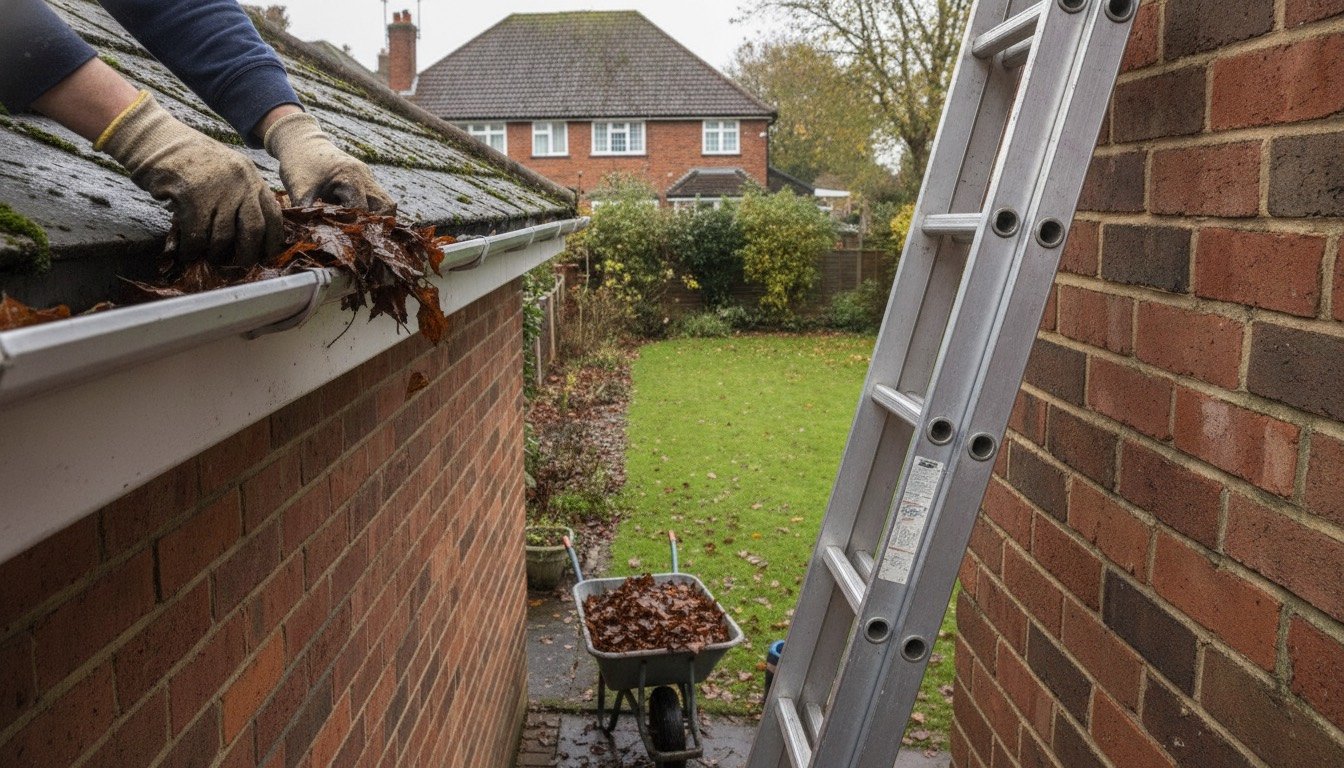
Look upward before you look at the wall. Much of the penetrating damp we get asked to explain traces back to something six metres overhead: a gutter choked with leaves, tipping roof run-off down one stretch of brickwork instead of into the downpipe. Storm after storm, that overflow saturates the wall until a patch turns up on a bedroom ceiling — by which point the fix costs far more than an hour with a bucket.
Gutter clearing sits at the unglamorous end of home maintenance, which is exactly why it gets skipped. This guide covers when to do it, the ladder rules that keep the job safe, a step-by-step for clearing and flushing the run yourself, the warning signs that mean more than a scoop-out is needed, whether gutter guards earn their keep, and the mistakes that turn a routine autumn job into a call-out.
Why a Blocked Gutter Causes Far More Than a Wet Patch
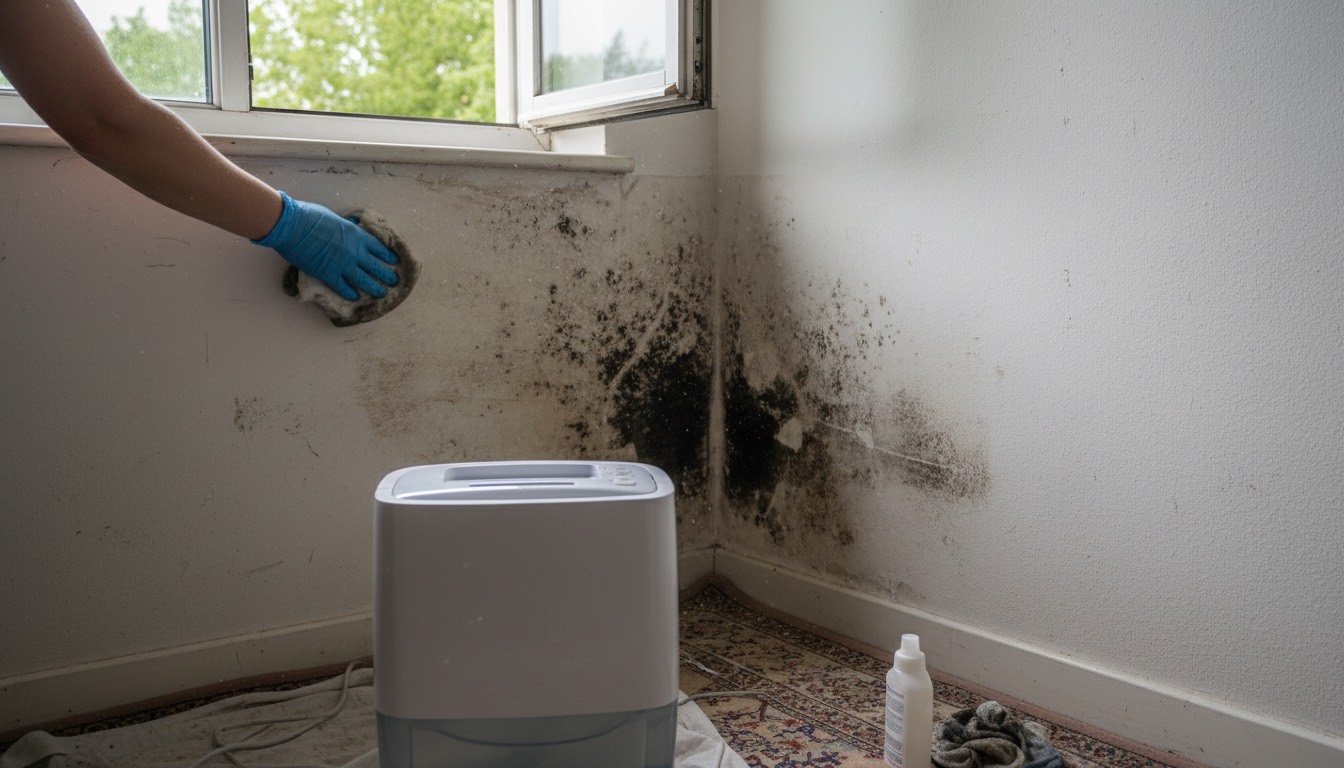
A gutter's job looks trivial — carry rainwater from roof to drain — but a full-size roof can shed several hundred litres in a single downpour, and every millilitre has to go somewhere. Once leaves and grit dam a section, water pours over the front lip instead of reaching the downpipe, hitting the same patch of wall every time it rains. That's the mechanism behind much of the penetrating damp we diagnose in older homes: not a failed roof, but water redirected by a blockage that never needed to happen.
The clues arrive before the damp does. A green-black algae stripe down render or brickwork, moss sprouting from the gutter itself, a curtain of water instead of a controlled trickle at the downpipe, or drip stains behind a joint — each is the gutter announcing it's overdue a clear, weeks before anything shows on a ceiling.
Tools and Materials for a DIY Gutter Clean
A single-storey clear needs little kit, most of it a one-off buy that lasts years. Budget roughly £120–£180 from scratch; a fair share of that is the ladder, which is not the place to cut corners.
- •Extension ladder with a stand-off stability bar: £70–£150 for a decent aluminium ladder — our tested picks cover which models are worth the extra. A stand-off bar alone is £15–£25.
- •Gutter scoop or a cut-down plastic bottle: £3–£6, or a gloved hand.
- •Builder's bucket with an S-hook to hang from a rung: £5–£10.
- •Heavy-duty gardening gloves: £5–£8.
- •A hose with a spray nozzle for flushing the run: £10–£15.
- •Safety glasses for the flush stage, when dirty water comes back at you: £3–£5.
Step-by-Step: How to Clean Your Gutters Safely
Time it for late autumn once the leaves are down, then repeat with a lighter spring check for moss and grit that winter storms loosen from the roof. Both take under an hour per elevation on a straightforward semi. If you are folding it into a wider seasonal round, our September home reset sequences this alongside the other pre-autumn jobs.
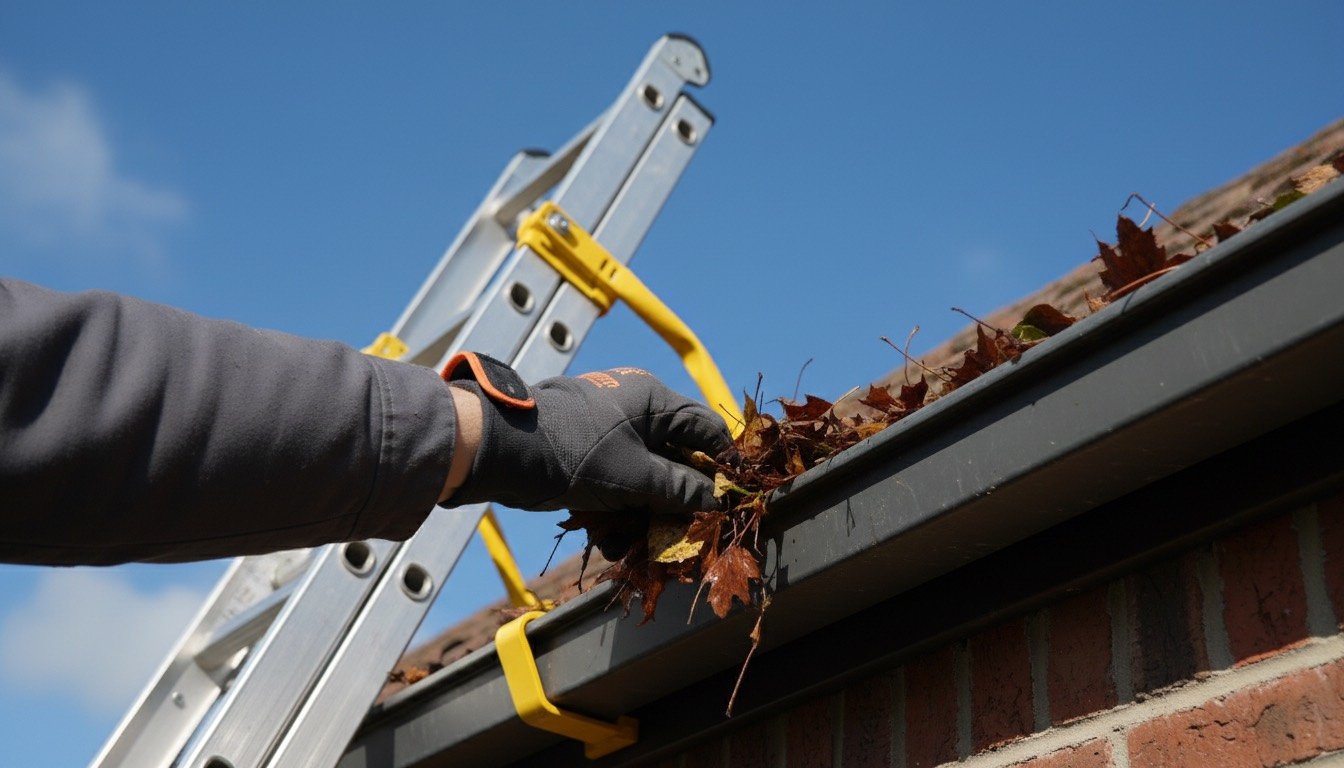
- •Set the ladder with the stand-off bar against the wall, not the gutter — plastic guttering flexes and cracks under a ladder's full weight.
- •Angle the ladder at roughly 1-in-4 (1 unit out from the wall for every 4 units of height), and have someone foot it or tie it off at the top.
- •Never stand above the third rung from the top, and never lean sideways to reach further along the run — climb down and move the ladder instead.
- •Scoop debris into the hung bucket, working away from the downpipe so loose material isn't pushed further into it.
- •Once a section is clear, flush it with the hose toward the downpipe and watch the water exit cleanly at the bottom.
- •A gurgling or backed-up flow means the downpipe itself is blocked — a drain rod or pressure-washer flush from the top usually shifts it. Check how far the downpipe should discharge from the wall while you're down there. A clear downpipe is also the moment to add a water butt for rainwater harvesting — the same water you are managing away can be stored and used.
- •Check the fall as you go: gutters should slope gently toward the outlet, roughly 1cm per 3 metres of run. A section still holding water after flushing has lost its fall and needs a bracket adjusted.
- •Move the ladder in short, overlapping sections rather than stretching sideways — a gutter run is never worth the risk of a fall.
Spotting Problems Beyond a Simple Clean
A clean-out sometimes reveals the gutter needs work, not just debris removal. Sagging sections that hold water despite a good fall usually mean a bracket has pulled from the fascia — cheap to refix while you're up there. Drip stains beneath a joint point to a failed seal, worth tackling before winter rather than after a hard frost cracks the fitting further. Soft, spongy fascia board is rot from years of unnoticed overflow — the point where a DIY clean tips into a proper repair job.
While you're up there, a two-minute look at the roof covering — slipped tiles, cracked ridge mortar, moss colonies — pays off. Our roof inspection checklist covers what to look for from a ladder, without climbing onto the roof itself.
Are Gutter Guards Worth the Money?
Gutter guards promise to end the twice-yearly chore, and mostly they don't deliver. Brush-style guards collect debris on themselves and still need clearing. Mesh guards keep large leaves out but let seed and grit through, silting up invisibly below — harder to spot than an open gutter. Under a heavy tree canopy, a decent mesh guard genuinely stretches the interval from twice a year to once; everywhere else, it's an added expense for a marginal gain. Our gutter guards versus gutter screens comparison breaks down the material differences and prices.
A genuinely useful recent alternative is a window cleaner offering ground-level gutter vacuuming as an add-on — typically £25–£45 per visit, no ladder required.
Common Mistakes (and When to Call a Professional)
A handful of habits turn a routine clear into a bigger job than it needed to be:
- •Leaning the ladder against the gutter instead of the wall — plastic guttering buckles under sideways load.
- •Clearing only the front elevation because it's visible from the drive, while the back and side runs quietly block up.
- •Pushing debris toward the downpipe rather than scooping it away, which packs the blockage in tighter.
- •Skipping the spring check — moss shaken loose by winter storms is a different problem to fallen leaves, and collects lower down the run.
- •Ignoring a downpipe that gurgles rather than tracing the blockage, letting water back up and overflow at the hopper head above.
Frequently asked questions
**How often should gutters actually be cleaned?** Twice a year covers most UK homes — once in late autumn after leaf-fall, again in spring to catch moss and grit loosened by winter storms. Homes under mature trees, especially overhanging conifers, often need a third clear in midsummer.
**Can I clean gutters without a ladder?** Yes, for single-storey homes — a telescopic gutter-cleaning vacuum attachment fits most household vacuums or a dedicated pole system, and works from the ground up to around 4 metres. Above that, a ladder or a professional is the safer route.
**Why does water come over the front even though the gutter isn't full?** Usually a fall problem, not a blockage — a section has sagged and lost its slope toward the outlet, so water pools and spills over the lowest edge instead of reaching the downpipe. It needs a bracket adjustment, not another clean.
**Are plastic or cast iron gutters easier to maintain?** Plastic (UPVC) is lighter and cheaper to replace section by section, and what most post-1960s homes have. Cast iron, common on Victorian and Edwardian houses, lasts far longer but needs repainting every few years to stop rust.
**Is it normal for gutters to sag slightly between brackets?** A very slight dip is normal, but if it's deep enough to hold standing water after a flush, the bracket has pulled loose or the spacing is too wide — brackets should sit roughly every metre — and it's worth refixing.
**What does a professional gutter clean cost?** Roughly £60–£90 for a typical semi-detached house, rising to £120–£180 where scaffolding or a cherry picker is needed for a three-storey property or a conservatory roofline.
Found this useful?
There's plenty more — hundreds of guides and honestly-tested product reviews for every corner of your home.
Browse All Guides