Kitchens & Bathrooms · 6 min read · 25 July 2026
Kitchen Island vs Peninsula: Differences, Pros, Cons and Real UK Costs
Most UK kitchens cannot take an island, and the deciding number is the floor left around it, not the block itself. Here is the honest comparison, with the money split into labour and materials.
By the Nims Casa editorial team — written from professional cleaning experience and checked against our editorial standards.
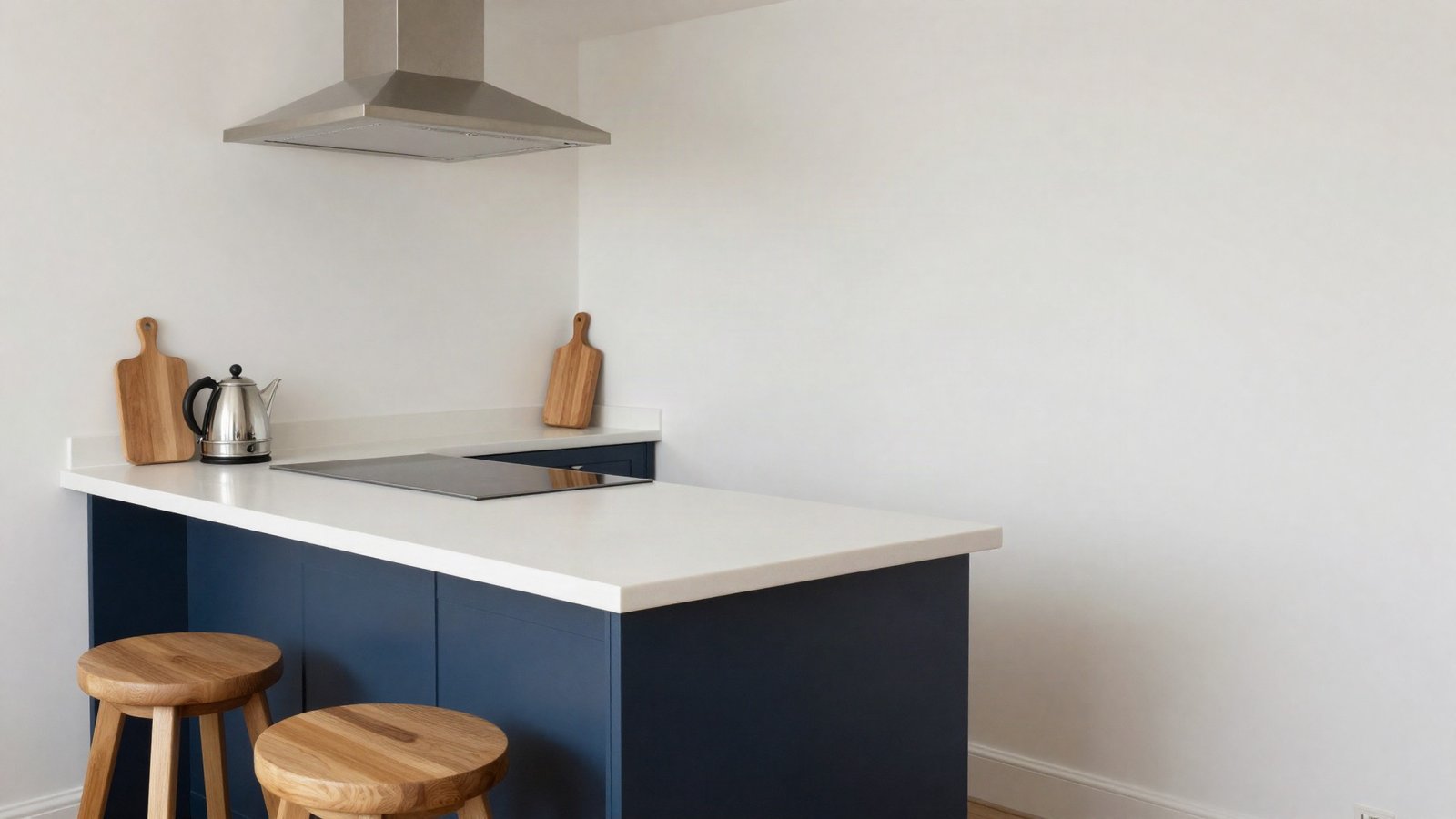
What settles this is not the size of the island but the width of clear floor left around it. Below roughly 3.2 metres wall to wall, an island becomes something you edge around holding a hot roasting tin, and a peninsula does the same job for about half the money.
The two are also less alike than showrooms suggest. A peninsula borrows the services already in the wall it grows out of. An island is free-standing: it needs its own power, plus waste and gas if it is to do more than hold a fruit bowl. Services are where the price gap opens.
Can your kitchen take an island? The measurements that decide it
Measure at skirting level, subtract the depth of your existing runs, then tape the footprint on the floor and live with it for three days, opening the oven and dishwasher every time you pass.
- •Island depth: 900mm minimum (560mm carcass, 600mm worktop, 300mm overhang); 1,000-1,100mm for seating one side and drawers the other.
- •Clearance: 1,000mm every side is the floor, not the target. Allow 1,100-1,200mm on the hob and dishwasher side — an open dishwasher door alone eats 500mm.
- •Minimum room width for an island: about 3.2m wall to wall. At 3.0m it works only if one side is a walk-past, not a work zone.
- •Peninsula: clearance on two sides only, so it fits rooms from roughly 2.4m wide, or 2.7m once stools are involved.
- •Seating: 600mm of worktop per stool and 380mm of knee overhang to be comfortable.
Kitchen island vs peninsula, side by side
The trade-offs come down to circulation and to how far your services must travel — the same pattern behind any honest kitchen remodel cost breakdown.
- •Circulation: an island gives two routes round the kitchen; a peninsula creates a cul-de-sac with one way in and out.
- •Dead space: a peninsula creates a blind corner where it meets the run. Budget £150-£300 for a decent pull-out or accept a black hole.
- •Services: an island needs new power runs, plus waste and gas if the sink or hob moves. A peninsula piggybacks the wall run already there.
- •Worktop gained: an 1,800 x 1,000mm island adds roughly 1.8m²; a 2,000 x 650mm peninsula adds roughly 1.3m².
How each performs once you are actually cooking
An island only earns its keep if it sits inside the working triangle rather than across it. Sink on the wall, hob on the island, and you are carrying pans of boiling water over open floor: the layout that heads every list of kitchen remodelling mistakes we compile.
A peninsula extends the run, so prep, wash and cook stay a couple of steps apart; the compromise is that anyone on a stool sits in the only doorway. Watch the depth void, too: a 1,000mm-deep island built from 560mm carcasses leaves a 400mm cavity down the middle. Good fitters turn it into shallow drawers from the far side; poor ones board it in.
Installation and cost in the UK: materials versus labour
Materials for an 1,800mm island at 2026 trade prices (Howdens, Benchmarx, DIY Kitchens): carcasses and doors £550-£1,400; end panels and plinth £120-£300; worktop £120-£260 in laminate, £250-£450 in solid oak, £900-£1,600 for 30mm quartz templated and fitted, £1,300-£2,200 in porcelain. Add £180-£450 for sockets with a certificate and £400-£2,000 for an island extractor plus ducting. Carcasses price up as in our kitchen cabinet cost guide.
Labour: fitters charge £190-£280 a day outside London and £280-£380 in the South East, and an island build is one to one and a half days. An electrician is £150-£220 for half a day. Moving a sink runs £350-£900 over suspended timber and £900-£2,200 over concrete, because the waste needs a fall of 18-45mm per metre and the slab has to be cut.
The ratio is the tell. A dry island is roughly 70% materials to 30% labour. Add a sink, hob and ducted extraction and it shifts to 50/50, or 45/55 on concrete. If a quote for a serviced island puts labour below 25% of the total, someone has under-priced the disruption and will be back for the difference.
- •Peninsula, existing run extended, laminate top, one twin socket, Midlands: units £380, worktop £150, electrics £190, fitting 0.75 day £180 — about £900.
- •Island 1,800 x 1,000mm, mid-range units, 30mm quartz, two sockets, no plumbing, timber floor, Yorkshire: units £950, quartz £1,350, electrics £320, fitting 1.5 days £360 — about £2,980.
- •Island with undermount sink, induction hob and ducted ceiling extractor, concrete floor, Surrey: units £1,300, quartz £1,900, extraction £1,600, new circuit £650, plumbing and floor chasing £1,750, fitting 3.5 days £1,120 — about £8,320.
How to tell a fair quote from a suspect one
Apply the discipline you would to any trade estimate; our guide to comparing contractor estimates covers the rest.
- •Units, worktop and appliances should be separate lines. A worktop not priced by area, with joins and cut-outs stated, is a guess dressed as a figure.
- •Stone is templated after the units are fitted. A quote with quartz or granite and no 7-14 day gap in the programme either uses a pre-cut slab, and should say so, or has not done this before.
- •A VAT-registered firm must show its VAT number. A £7,000 island quoted with no VAT by a company with a showroom and liveried vans deserves a question.
- •Overhangs beyond 300mm on 30mm quartz (250mm on 20mm) need steel flat bar at 400-500mm centres, £120-£300. Not on the quote means not in the price.
The ten-year cost and what wears out
Islands age faster because they take knocks from four sides, and worktop choice drives almost all the running cost — the trade-offs in our quartz vs granite guide apply here too.
- •Solid oak: re-oil every 6-12 months, 30 minutes and £15 of Danish oil a time — around £150 and 15 hours per decade.
- •Laminate: no maintenance, but replacement at 8-12 years for £150-£400. Steam creeping into the join beside a dishwasher is the usual killer.
- •Quartz: effectively nothing, though a chipped edge repair is £150-£350 and replacing one island slab starts around £900.
- •Recirculating extractor: charcoal filters at £30-£60, twice a year — £600-£1,200 over ten years. A ducted hood costs nothing beyond washing the grease filter.
- •Peninsula blind-corner pull-out: mechanisms fail around year seven, £120-£250 to replace.
Who each suits, and the verdict
Choose an island if the room is over 3.2m wide, the floor is suspended timber so services are cheap to run, more than one person cooks, and you can fund the serviced version rather than a decorative block. Choose a peninsula if the room is 2.4-3.1m wide, the budget is under about £3,000, or you are over solid concrete where every pipe run costs four figures.
For most British kitchens a well-planned peninsula beats a compromised island: squeezed into 2.9m, an island gives worse cooking, worse circulation and a bigger bill. Where the width genuinely exists, an island wins on prep space and flow — but only fully serviced and properly extracted. Half an island is worse than none. Plan with our kitchen remodel planning guide, tape the footprint on the floor, then compare three itemised quotes on labour percentage, not total.
Found this useful?
There's plenty more — hundreds of guides and honestly-tested product reviews for every corner of your home.
Browse All Guides