Roofing & Exterior · 6 min read · 6 July 2026
Roof Inspection Checklist for UK Homes (Printable)
Most UK roofs don't fail dramatically. They fail at the underlay, a lead flashing or a ridge bedded in mortar in 1987 — and nearly all of it is visible months before it gets expensive.
By the Nims Casa editorial team — written from professional cleaning experience and checked against our editorial standards.
By the time a stain appears on a bedroom ceiling, water has usually been tracking along a rafter for months, entering the roof three or four metres from where it lands. That gap between cause and symptom is why roofs get expensive: the £120 job in October becomes the £2,400 job in March.
Almost none of it needs you on the roof. This is the sequence we work through on a survey, grouped by frequency, with honest times and the point where you phone somebody.
Ground rules: where you inspect from, and who the law covers
Ninety per cent of a competent inspection happens from the ground with binoculars and from the loft with a torch. Nobody should walk on a tiled roof: concrete interlockers crack under a heel and Welsh slate snaps, so a five-minute look becomes a £400 repair.
The Work at Height Regulations 2005 cover people at work — contractors and the self-employed — not a homeowner on their own house. Your roofer must justify a ladder over a tower; you have no such duty, which is exactly why homeowners are the ones who fall. Borrow their standards anyway: see the best ladder for homeowners for stand-offs and levellers.
- •Binoculars, 8x42 or 10x42 — £40 to £80. The roofing tool most households lack.
- •Head torch, 300+ lumens — £15 to £25.
- •Pin-type moisture meter — £25 to £40. Settles 'active or historic' in seconds.
- •FFP3 mask and gloves — £10. Old mineral wool and rodent dust are both up there.
- •An EN 131 Professional ladder at 1:4 on level footing, stand-off fitted so nothing bears on the gutter.
- •A phone camera and dated storage — insurers take dated records seriously.
Twice a year: the full inspection (spring and autumn)
Late March or April once the gales finish, then late September before they start. Budget 45 minutes for both halves. Walk the whole perimeter, including the gable ends nobody looks at, and work top-down.
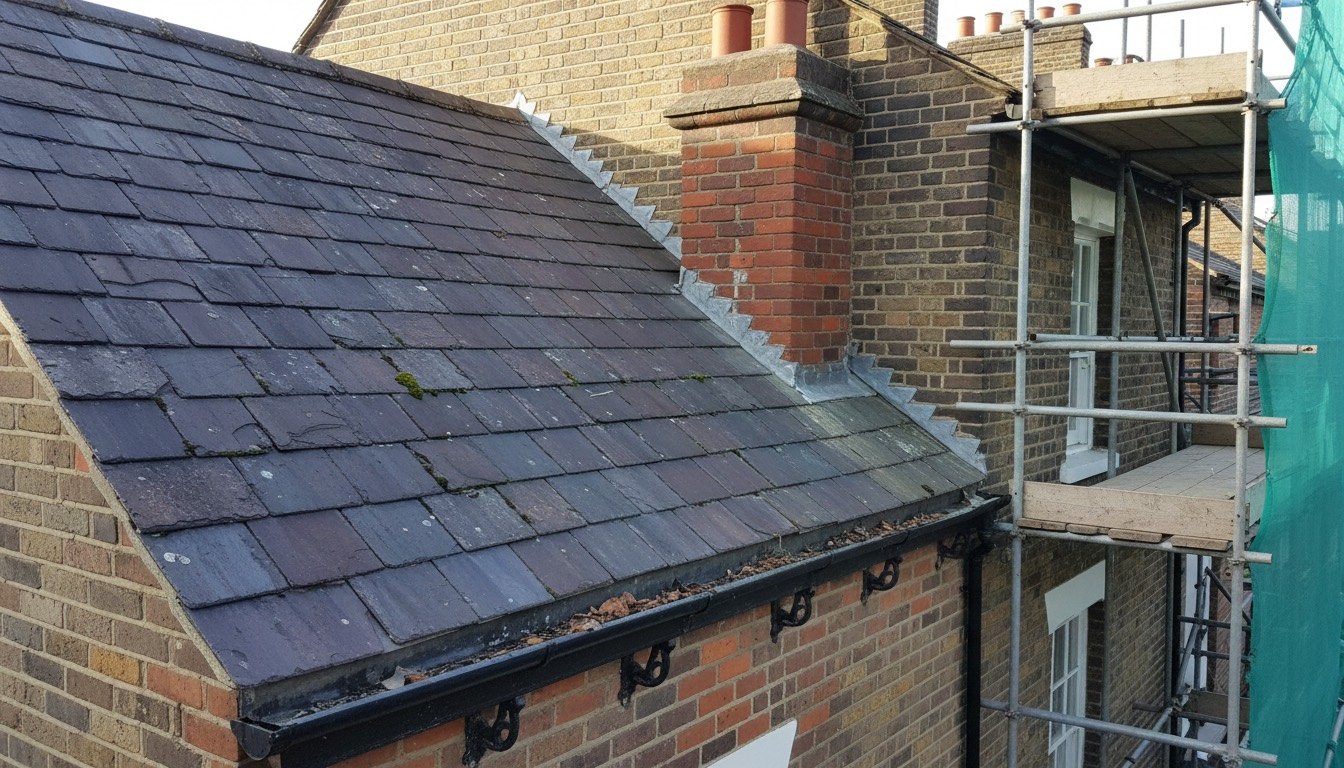
- •Ridge, hips and verges: uneven tiles, gaps in the bedding mortar, crumbs of it in the gutter. These wind-exposed edges fail first.
- •The field: slipped, cracked or missing units. A dark rectangle is a missing tile; one sitting proud is a failed nail.
- •Valleys: moss dams and split lead. A blocked valley backs water under the tiles in one heavy shower.
- •Chimney: cracked flaunching, open bed joints, stepped lead lifting from the mortar. Chimneys leak more often than coverings do.
- •Abutments, dormers, soil pipes, rooflights, fascias and bargeboards: every flashing and collar, plus soft timber.
- •Gutters and downpipes: sagging runs, plant growth, staining below a joint — gutter cleaning and maintenance covers realistic frequency.
- •Loft, lights off, bright day: daylight that isn't a vent, brittle or torn underlay at the eaves, dark staining on rafters. Under 18% moisture content is fine; over 20% is wet now.
- •Loft ventilation: insulation shoved into the eaves blocks the 10mm gap BS 5250 expects, and condensation under the felt is ventilation, not a leak.
- •Flat roofs and porches: ponding beyond 48 hours, blisters, splits at upstands, lifting trims.
After every storm: the 20-minute check
A named storm or gusts above 50mph earns a look next morning — never in the wind itself. Start in the garden: a fragment of slate on the path, or ridge mortar on the lawn, tells you where to point the binoculars. Photograph everything before anyone touches it; insurers reject claims where damage was tidied away. If water is getting in, work out how to find and fix the roof leak from inside — the entry point is rarely above the stain.
Time and cost per task
Realistic 2026 figures for a three-bed semi. Access is the expense, not the repair — bundle jobs into one visit.
- •Ground sweep with binoculars — 25 minutes — £0
- •Loft inspection with torch and meter — 20 minutes — £0
- •Gutters cleared yourself — 2 to 3 hours; contractor £80 to £150, or £150 to £250 vacuumed from the ground
- •A few slipped tiles replaced — £90 to £180 first visit
- •Ridge re-bedded or dry-fixed — £45 to £70 per linear metre plus access
- •Chimney repointed and re-flaunched — £450 to £900 including a tower
- •Soft-scrape moss removal — £250 to £600. Never jet-wash concrete tiles: it strips the surface and forces water under the laps.
- •Drone survey with photo report — £120 to £300; RICS Level 3 report £600 to £1,200
- •Scaffold to a semi, two weeks — £600 to £1,200
Every three to five years: the longer clock
Book a professional inspection every five years, or every three once the covering passes 40. What times out is rarely the tile — concrete interlockers run 40 to 60 years, clay plain tiles 60 to 100 — it is the underlay beneath. Pre-1980 bitumen felt goes brittle and tears at the eaves while the tiles above look immaculate.
The other end-of-life signal is nail fatigue on slate: units slipping one at a time in unrelated places, not one patch. That is a strip-and-re-cover, and patching on is money burnt — signs you need a new roof works through the call. Flat roofs run their own clock: felt 10 to 20 years, GRP 20 to 25, EPDM 25 to 30.
Where UK rules actually bite
Inspection is unregulated; what follows from it often isn't. These catch people out mid-job, when the scaffold is already up.
- •Re-covering more than 25% of a slope counts as renovating a thermal element under Part L: building control, plus an insulation upgrade where reasonable. Either a building notice through the council, or a CompetentRoofer-registered roofer who self-certifies.
- •Planning: new rooflights are permitted development only if they project no more than 150mm beyond the roof plane and sit no higher than the ridge; solar panels get 200mm. Conservation areas, Article 4 directions and listed buildings mean like-for-like slate.
- •Scaffolding on a pavement needs a Highways Act 1980 licence — the scaffolder usually arranges it, £70 to £200. Cutting a flashing into a party wall triggers the Party Wall etc. Act 1996: two months' notice.
- •Only a Gas Safe registered engineer may disturb a room-sealed boiler flue terminating through the roof, or its weathering collar.
- •Landlords: a roof letting water in is a fitness defect under the Homes (Fitness for Human Habitation) Act 2018, and social landlords have worked to statutory damp and mould timescales since October 2025.
If you've only got an hour
Order matters more than completeness. These four catch most of what becomes a four-figure bill; check roof repair costs before accepting a quote, and the Roofing & Exterior guides for the repairs themselves.
- •1. Clear the gutters and check every downpipe runs — blocked gutters cause more UK damp than defective coverings.
- •2. Binoculars on the ridge, hips and verges: the wind-vulnerable edges.
- •3. Chimney flashing and flaunching — the likeliest leak source on any British house.
- •4. Twenty minutes in the loft on a bright day with the lights off.
- •Skip guilt-free: cosmetic moss on a north slope, colour variation in tiles, lichen on sound ridge mortar.
- •Call a roofer for daylight through the covering, a rafter over 20%, moved ridge tiles, split lead, or slates slipping in more than one place.
Found this useful?
There's plenty more — hundreds of guides and honestly-tested product reviews for every corner of your home.
Browse All Guides