Laundry & Fabric Care · 6 min read · 12 April 2026
Why is My Dishwasher Not Draining? The Fix Order That Works
Two inches of grey water sitting in the bottom of the machine looks like a dead pump. It almost never is. Here is the order to check things, and the exact point where you stop and phone someone.
By the Nims Casa editorial team — written from professional cleaning experience and checked against our editorial standards.
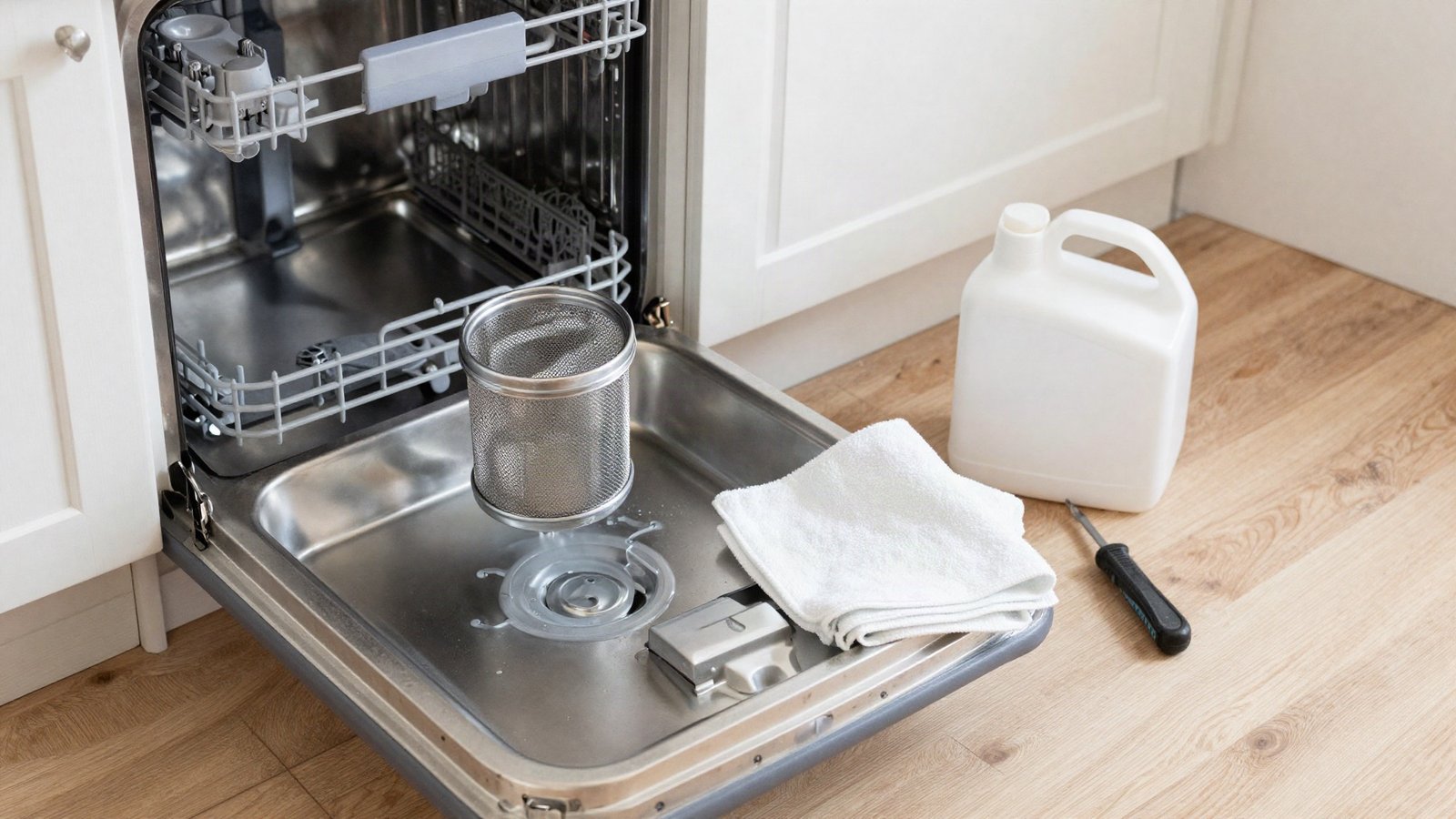
Open the door on a finished cycle, find an inch of cloudy water in the sump, and the assumption is always the same: the pump has gone. In fifteen years of pulling appliances out of British kitchens, the pump was genuinely dead maybe one call in six. The rest were a clogged filter, a fat-filled trap spigot, a crushed hose, or a blanking plug the fitter never knocked out.
The three commonest causes cost nothing and take half an hour with a screwdriver and an old towel. A few of the others put mains electricity within inches of standing water, and those carry a hard stop. Below is the diagnosis in the order an engineer works it.
Start Here: The 60-Second Diagnosis
Isolate the machine first. Most UK dishwashers run off a socket behind the neighbouring base unit or a switched fused spur above the worktop. Switch it off and check the display is dead before your hand goes near the sump. Then run these checks.
- •Is there an error code? Bosch, Siemens and Neff flag E24 for a restricted drain and E25 for a blocked pump or unlocked filter cover. Hotpoint and Indesit show F05.
- •Is the kitchen sink slow too? If both are sluggish, the dishwasher is innocent and you have a shared waste blockage.
- •Has any glass broken recently? Shards routinely jam the chopper blade above the impeller.
- •Is this a new install that has never drained? Then it is almost certainly the blanking plug, still sealed in the trap spigot.
Symptom to Cause: Match What You Are Seeing
Dishwashers fail in narrow patterns, and the symptom usually names the culprit.
- •No pump noise at all on the drain phase: failed pump, or a dead control board output.
- •A loud buzz from the base: the pump is energised but jammed, usually by glass, a fruit stone or a cocktail stick.
- •Drains slowly then stops short: partial blockage in hose, spigot or standpipe.
- •Water reappears between cycles: siphoning back from the sink waste because the hose has no high loop.
- •Greasy water and debris on the upper rack: filter and sump blocked, the same fault behind a machine that has stopped cleaning properly.
The Causes, Ordered by How Often We Find Them
This is the running order from real callouts, not a manufacturer's manual. Work it in sequence and most faults surface in the first two.
- •Blocked filter and sump, roughly 40 per cent. Tags, seeds, rice and fat mat over the coarse filter, and hard water binds it nearer concrete.
- •Blocked or kinked drain hose, about 20 per cent. Shoving the machine into its housing crushes the corrugated hose, usually 100-200mm from the rear panel.
- •Blocked trap spigot, about 15 per cent. That 22mm plastic stub silts up with fat faster than the trap.
- •Blanking plug never removed, about 8 per cent, and near enough every new install that never worked.
- •Jammed impeller or chopper blade, about 8 per cent. Glass, bone, a screw off a saucepan handle.
- •Failed drain pump, about 6 per cent, with stuck non-return valves and board faults the rest. Common only past eight years.
The Fixes, Ordered from Safest to Riskiest
Work down, not across. Each step assumes the last one failed, and the risk climbs as you go.
- •Bail the sump. Scoop the water out with a mug and mop the rest with a towel. Expect one to two litres; nothing else works until it is dry.
- •Strip and wash the filter. Twist it anticlockwise, lift it out with the mesh plate beneath, scrub both under a hot tap, and soak in 50/50 white vinegar for 20 minutes if scaled. Refit until it locks.
- •Clear the sump recess. Wipe it out and feel around the impeller wearing a rubber glove; broken glass is the commonest find there.
- •Check the hose. Ease the machine forward (integrated units are held by two screws into the worktop batten and a plinth clip), straighten any kink, then unclip it over a bowl.
- •Clear the spigot and trap. Undo the jubilee clip, poke a screwdriver in to confirm the blanking plug is gone, and clean the trap while it is apart. A slow sink is its own job, like any blocked kitchen sink.
- •Verify the high loop. The hose must rise at least 400mm above floor level, clipped under the worktop, before dropping to the trap, or the machine siphons dirty water back.
- •Reconnect, refit, and run an empty 65°C cycle with a dishwasher cleaner to flush the pipework.
Where DIY Stops: The Professional Boundary
This is the part most guides fudge. A competent DIYer can do everything above: filters, sumps, hoses, traps, spigots and hose routing are cold-water plumbing on an unplugged machine, none of it notifiable, none of it needing the casing off.
Stop and call someone the moment any of the following is true. And if the machine is under two years old, do nothing beyond rinsing the filter: Bosch, Miele, AEG and Beko warranties are voided by opening the casing.
- •The pump needs replacing: laying the machine on its back or dropping the base tray, working inches from mains terminals in a wet cabinet. Appliance engineer.
- •The fault is electrical. A fused spur, damaged flex or a socket tripping the RCD needs a qualified electrician, and in England and Wales new kitchen circuits are notifiable under Part P. See the electrical jobs never worth DIYing.
- •Waste pipework needs cutting or re-siting. Solvent-welded 40mm waste and shared soil stacks are a plumber's job; a wrong fall causes years of smell.
- •Water backs up into the sink or floor gully too: the shared run, needing rods or jetting.
- •Any smell of burning or scorching around the pump housing. Isolate at the consumer unit and stop.
What It Costs to Put Right in the UK
Filters, hoses and traps cost only your time. Beyond that, an independent appliance engineer charges roughly £70-£110 for the first hour including the callout, and most drain faults are resolved inside it. A drain pump is £25-£55 as a part, £110-£170 fitted; a plumber for waste pipework runs £60-£90 an hour outside London. Our breakdown of appliance repair costs has the regional spread.
The real judgement is age. Most UK dishwashers give eight to eleven years, so a £150 pump in a nine-year-old machine that already washes badly is money you will spend again inside eighteen months. A decent freestanding model starts around £280, a good integrated one £400-£600, and current machines use 9-10 litres a cycle against 14-16 a decade ago. Check typical appliance lifespans first.
Stopping It Happening Again
Drain faults build up rather than strike suddenly. Fifteen minutes a month prevents nearly all of them, the cheapest line on any appliance maintenance routine.
- •Rinse the filter under the tap every fortnight. Thirty seconds, and it heads off most of the above.
- •Run an empty 65°C cycle monthly with a dishwasher cleaner to melt fat out of the sump and hose.
- •In hard water areas keep the salt topped up and set the machine's hardness level rather than the factory default.
- •Never pour caustic drain cleaner into the machine or its hose; it attacks the seals.
Found this useful?
There's plenty more — hundreds of guides and honestly-tested product reviews for every corner of your home.
Browse All Guides