Home Safety & Security · 6 min read · 9 June 2026
Basement & Cellar Flood Cleanup Checklist (UK, Printable)
Cellar flooding is never just water. Here is the order professional restoration crews work in, what each stage costs, and the point where carrying on yourself becomes genuinely dangerous.
By the Nims Casa editorial team — written from professional cleaning experience and checked against our editorial standards.
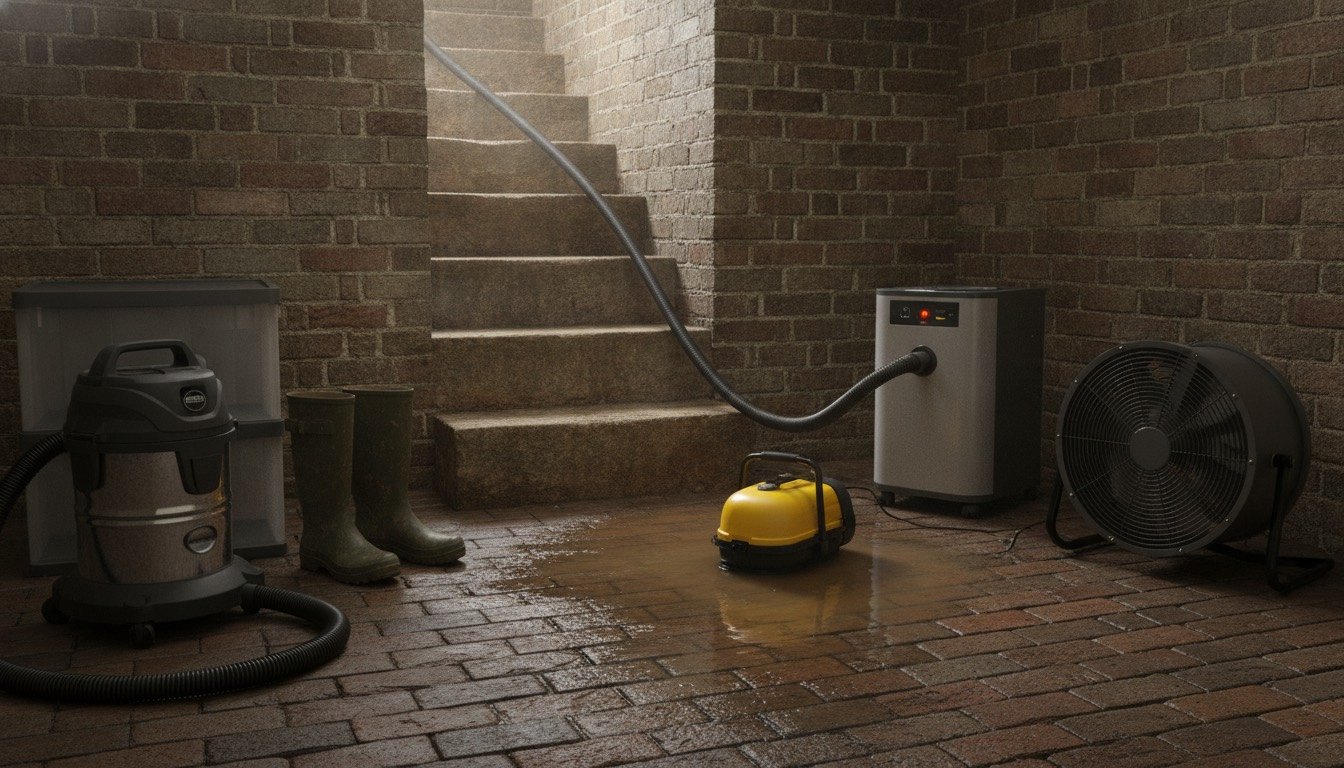
Whatever came into your cellar brought silt, drain contents and whatever was on the bottom shelf with it. The order of work matters more than the effort you put in: pump too fast, disinfect too early, or re-energise a circuit before it is tested, and you either damage the structure or hurt yourself.
Restoration crews follow the same sequence whether the water came from a burst main, a surcharged sewer or surface water off the road. This is that sequence, adapted for UK cellars — Victorian brick, 1930s coal holes, converted basements with tanking and a sump.
The first 30 minutes
Nothing below is worth an electric shock. Cellars concentrate two hazards ordinary rooms do not: submerged wiring you cannot see, and heavier-than-air gases that pool at floor level.
- •Isolate at the consumer unit — but only if it is dry, above the water line and reachable without standing in water. If not, ring 105 for your network operator. Free, 24 hours.
- •Smell gas? Leave the property and ring 0800 111 999.
- •Identify the water. Burst pipe is category one, appliance discharge category two, anything from a foul drain, gully or WC category three — treat that as sewage.
- •For foul water, ring your water company first. Internal sewer flooding is theirs to clean and disinfect, and the Guaranteed Standards payment equals your annual sewerage charge, minimum £150, capped at £1,000.
- •Photograph and video everything before you move an item, then ring your insurer — our guide to filing a home insurance claim covers what loss adjusters want.
- •PPE on: wellingtons, nitrile gloves, an FFP3 mask, disposable coverall. About £18 from any builders' merchant.
The DIY-or-pro boundary, stated plainly
Most cellar flood work is unskilled graft any capable adult can do: pumping and vacuuming water, shovelling silt, stripping saturated carpet, washing down surfaces, running hired dehumidifiers and logging readings. A short list is not, and some of it is unlawful to do yourself.
- •PRO — Any electrical work in the flooded area. Cellar circuits sit in a special location and post-flood remedials are notifiable under Part P; use an NICEIC, NAPIT or ELECSA electrician, £180–£350 to inspect and test. Never re-energise a submerged circuit — see electrical repairs you should never DIY.
- •PRO — Any boiler, meter or gas appliance touched by water. Gas Safe engineer only, before relighting. A submerged boiler is normally condemned.
- •PRO — Category three foul water. Contaminated silt and sewage-soaked plaster need trained operatives; your insurer usually funds it.
- •PRO — Mould over roughly one square metre, or any mould where someone has asthma, COPD or a suppressed immune system.
- •PRO — Anything disturbing suspect asbestos. Pre-2000, damaged Artex, insulating board and bitumen adhesive are all candidates and the Control of Asbestos Regulations 2012 apply. £150–£250 to test a sample.
- •NEVER — Run a petrol pump, generator or disc cutter in a cellar. Carbon monoxide pools there and kills people every year.
Kit list: hire, don't buy
Buying drying gear for a one-off flood is a false economy, and hired machines are far more capable.
- •Submersible puddle pump, hire £25–£40 a day or buy a 400W unit for £60–£120. Clears to about 2mm.
- •Wet-and-dry vacuum, 20–30 litre, £60–£150 — the one thing worth buying.
- •Commercial LGR dehumidifier, hire £15–£25 a day or £60–£90 a week. Domestic compressor units stall below about 15°C — most UK cellars in winter.
- •Two air movers, £8–£12 a day each. Air movement matters as much as the dehumidifier.
- •Pin moisture meter £25–£60 and a £12 hygrometer. Without them you are guessing.
- •Yard broom, shovel, rubble sacks, biocide or 1:10 bleach, around £35. Never mix bleach with ammonia-based cleaners.
- •Running cost: three machines at roughly 1.5kW, about £9 a day.
Day one: water out, contents out
Do not drain a flooded cellar in one go while the ground outside is saturated — groundwater pressure against an empty cellar can crack a slab or push a wall in. Pump down a third, wait an hour, and see whether the level creeps back.
- •Pump in stages, 2–4 hours for a typical 20m² cellar. Discharge to a foul gully, never over a neighbour's boundary.
- •Vacuum the last 10–20mm, then shovel and brush the silt out before it sets. 1–2 hours of grim work.
- •Carry everything out and sort into keep, insurer to inspect, and dispose. Photograph the disposal pile with a newspaper in shot. 2–3 hours.
- •Bin without hesitation: carpet and underlay, chipboard furniture, mattresses, upholstery, insulation, anything porous that met foul water. 4-yard skip, £180–£280.
- •Wash hard surfaces top to bottom with detergent, then disinfect — biocide on dirty surfaces does very little. 2 hours.
- •Lift a few floorboards or pull one skirting to release trapped water — water hidden behind a sound surface is why cellars never dry.
Days 2 to 21: the drying schedule
Patience runs out here, and most long-term damage is done here. Masonry dries at roughly one month per 25mm of thickness, so a 225mm solid brick wall is a long job. Log readings daily; adjusters like to see the table.
- •Daily, 10 minutes: record humidity and temperature. Target 45–55% RH and above 15°C.
- •Daily, 5 minutes: empty condensate and reposition air movers so they sweep along walls, not at them.
- •Ventilate on dry, breezy days only. Opening up on a muggy afternoon at 90% outdoor humidity feeds moisture back in.
- •Every three days: moisture readings at the same marked points. Timber must be below 18% moisture content before anything is boxed back in.
- •Week 2: check for mould at wall-to-floor junctions, behind stored boxes and on joist ends — identifying mould in a cellar shows the early bloom.
- •Week 3: white salt crystals on brick are normal. Brush efflorescence off dry rather than washing it back in; the method is in how to remove efflorescence.
Weeks 4 to 12: making good, and stopping the next one
Do not replaster, paint or refit until readings have been stable for two weeks. Sealing damp masonry behind fresh plaster turns a one-off flood into a permanent damp problem.
- •Renovating plaster on cellar walls, £45–£70 per m² supplied and fitted, once readings hold.
- •Book the electrician back to test and reinstate circuits before any refit. Non-negotiable.
- •Fit or service a sump and pump if water came up through the floor: £600–£1,500 installed, then run through how to test a sump pump quarterly.
- •Clear gutters, gullies and any light-well drain. Free, and it prevents a surprising share of repeat flooding.
- •If this is the second event, price up tanking or a cavity drain membrane — options compared in our guide to waterproofing a basement.
- •Store on shelving 150mm off the floor in lidded crates, not cardboard. About £80, saves a fortune next time.
If you only have two hours
Sometimes you get one evening. Prioritise in this order; everything else waits a day.
- •Make it electrically safe, or get the network operator out.
- •Photograph and video everything, including the tide mark on the walls.
- •Get the bulk water out and the silt shovelled before it sets.
- •Carry porous but salvageable items — books, textiles, timber furniture — up to dry air.
Found this useful?
There's plenty more — hundreds of guides and honestly-tested product reviews for every corner of your home.
Browse All Guides