Kitchens & Bathrooms · 6 min read · 7 July 2026
Bathroom Remodel Checklist (Printable): The UK Stage-by-Stage Plan
Bathrooms rarely fail at the tiling. They fail on sequence, and on the jobs nobody was allowed to touch. Here is the stage-by-stage list we work from, with real times, real prices and a hard DIY line.
By the Nims Casa editorial team — written from professional cleaning experience and checked against our editorial standards.
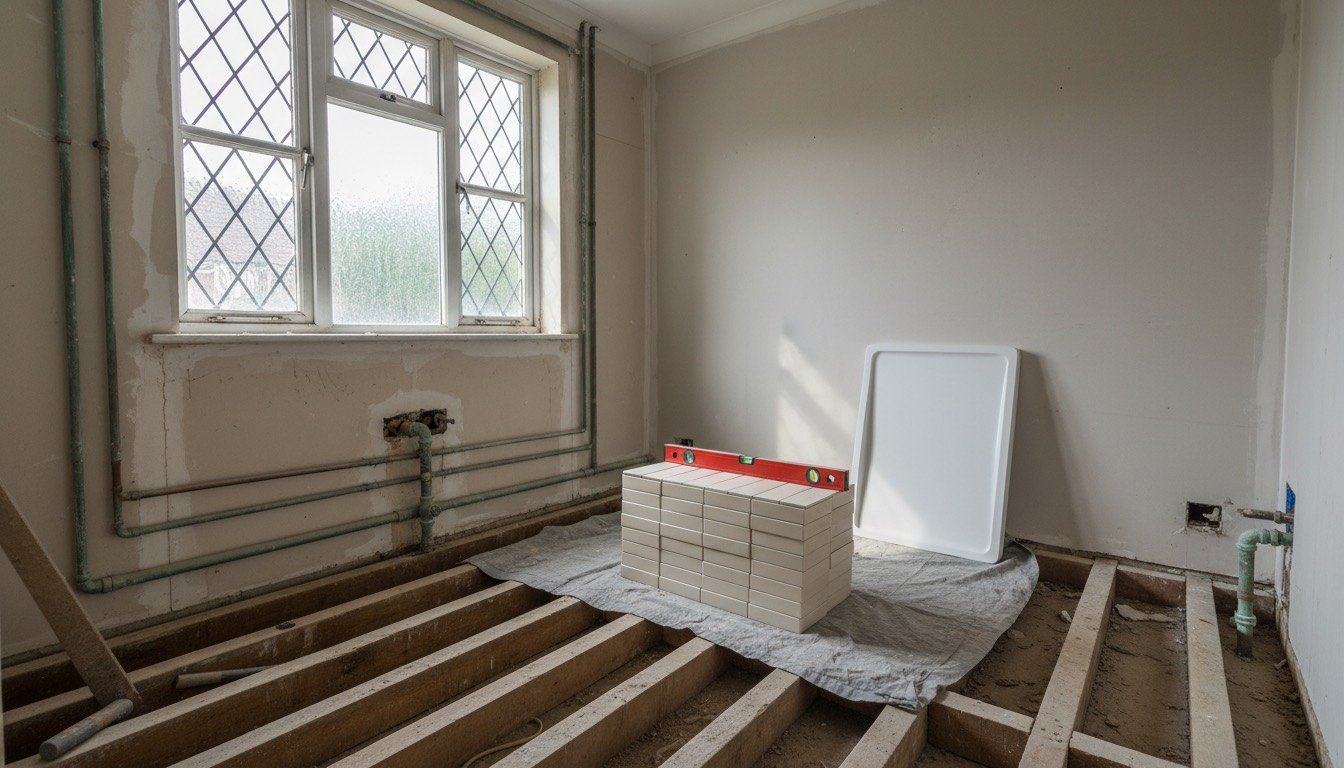
Bathrooms rarely go wrong at the tiling stage. They go wrong on sequence: the shower tray that lands after the floor has gone down, the electrician booked for a Friday when the walls were boarded on Thursday, the 40mm waste run that cannot cross the joists without a structural fix nobody priced.
What follows is the list we work from on a typical UK refit — a 2.4m by 1.8m room in a 1930s semi taken back to brick. Times assume one fitter with trades in and out; prices are 2026 rates including VAT, outside London. If layout and budget are still open, settle those with our guide to planning a bathroom remodel and the current bathroom remodel cost ranges first.
Eight to two weeks out: orders and lead times
Nothing starts on site until the long-lead items are physically in your hallway. Bespoke screens and stone tops run four to eight weeks, and tile ranges get discontinued mid-project far more often than suppliers admit.
- •Week 8 — Confirm whether the WC moves. Beyond about 1.5m from the 110mm stack you are into a macerator or a new stack: £450-£900 fitted, and Building Regulations Part H applies.
- •Week 8 — Book trades. Good fitters are 6-10 weeks out; electricians and Gas Safe engineers 2-4 weeks.
- •Week 6 — Order tiles with 12-15% over for cuts and breakages: ceramic £18-£35/m², porcelain £30-£60/m², large-format £45-£90/m².
- •Week 6 — Order sanitaryware, brassware, tray and screen. Check the tray's trap depth (usually 75-90mm) against the space under your floor before you buy, not after.
- •Week 4 — Book waste removal. A 6-yard skip is £220-£320 including a road permit; two collected builder's bags run £120-£180.
- •Week 4 — Pre-2000 house? Have textured coatings or old vinyl tile adhesive tested for asbestos before a scraper touches it. A lab test is £30-£60.
- •Week 2 — Clear the room and prove you can isolate the bathroom water without shutting off the house.
What a competent DIYer can legitimately do
Most of a bathroom is unregulated work. There is no licence to be a plumber in the UK, and stripping out, boarding, tiling and decorating carry financial risk rather than legal risk. That is where the savings sit, since labour is 55-60% of a refit bill. Be honest about pace, though: a first-time tiler takes twice as long and wastes 8-10% more tile.
- •Strip-out of bath, basin, WC, tiles and flooring — 1-2 days, cost is the skip. Drain down first.
- •Tile backer board over a sound substrate: 6mm walls, 12mm floors, £14-£22/m². Moisture-resistant plasterboard is not waterproof and never was.
- •Tanking the shower area — primer, corner tape, two coats of liquid membrane: £70-£120 of materials and a full day including cure time.
- •Wall and floor tiling — saves £35-£55/m² in labour; allow 1.5-2 days for a small room on a first attempt.
- •Silicone and second-fit trim. Our walkthrough on how to replace silicone sealant around a bath covers the joint that fails first.
What must go to a registered trade
This is the part people talk themselves out of, and it is what voids insurance and stalls a house sale. In England, a new circuit, a consumer unit change or any alteration inside the zones around a bath or shower is notifiable under Part P; Wales kept the wider rule, where effectively all fixed electrical work in a room containing a bath or shower is notifiable. A registered electrician self-certifies within the price — see current electrician day rates ; notifying building control yourself costs £250-£450 and adds weeks.
- •Electric shower — 8.5-10.8kW needs its own 40-50A radial in 10mm² cable with RCD protection. £350-£650 with certificate, more if the consumer unit is full.
- •Any gas work: re-siting a combi, altering a flue, moving a pipe. Gas Safe registered only, £400-£1,200.
- •Unvented cylinder work — Building Regulations G3, ticketed installers only. An untrained alteration here is an explosion risk, not paperwork.
- •Structural work: notching or trimming joists for a 110mm soil pipe, or altering a load-bearing partition. An engineer's calculation is £250-£500 and is cheap insurance.
- •Where a bath is newly installed, Part G limits the hot supply to 48°C. A thermostatic mixing valve is £45-£90 plus fitting.
The on-site checklist, day by day
A full refit runs 7-12 working days. The killer is dead time between trades, so book the electrician and plumber for named half-days rather than sometime that week.
- •Day 1 — Strip out, cap off, sheet the landing. Photograph every pipe run before it disappears.
- •Day 2 — First fix plumbing. Bath and shower waste in 40mm at 18-45mm per metre of fall; basin 32mm, kept under 1.7m to the stack.
- •Day 2-3 — First fix electrics and extractor. Part F wants 15 l/s intermittent extract; a 100mm fan on 4m of flexible duct rarely delivers it, so use rigid duct or step up to 125mm.
- •Day 3-4 — Board and level; deflection worse than 1:400 cracks tile joints, so stiffen a bouncy floor now.
- •Day 4 — Tank the wet area and tape the corners. Do not tile the same day.
- •Day 5-7 — Tile and grout; leave grout 24 hours before siliconing.
- •Day 8-9 — Second fix: sanitaryware, brassware, screen and towel rail, then test under pressure for an hour with the floor still up.
- •Day 10-11 — Silicone, decorate, snag. Budget £150-£300 for what you forgot: an isolating valve, a longer flexi, more trim.
- •Day 12 — Collect certificates. Part P, Gas Safe and any G3 paperwork go in the house file.
Short on time or money? Prioritise in this order
Spend on what gets buried. Anything on the surface can be changed in an afternoon later; nothing behind the tiles can.
- •Waterproofing, waste falls and ventilation first. £250 of tanking and a decent fan prevents a £3,000 rebuild.
- •The shower valve second. A £45 mixer fails inside three years; £180-£300 buys a brass-bodied thermostatic valve with cartridges still available in a decade.
- •Tiling labour third, if cutting is your weak point — neat cuts around a valve are what make a cheap bathroom look expensive.
- •If the budget breaks, keep and re-enamel the existing bath (£350-£450) rather than move a waste.
- •If the timeline breaks, live with an unpainted ceiling for a month. Never live with unfinished tanking.
The maintenance schedule that protects the spend
A well-built bathroom lasts 20 years; the same bathroom unmaintained looks tired in six. This routine keeps sealant, grout and the fan working, and keeps mould off the ceiling and walls in the first place.
- •Weekly, 2 minutes — Squeegee the screen and wipe the tray. The single habit that holds back limescale and black mould.
- •Monthly, 10 minutes — Wash the extractor grille; a furred fan drops well below the 15 l/s it was specified at.
- •Quarterly, 20 minutes, £3 — Soak the shower head in citric acid solution. Non-negotiable in the hard-water belt from Kent to East Yorkshire.
- •Every 6 months — Turn the isolating valves under the basin and WC through a full cycle so they do not seize.
- •Annually, 1 hour — Clean the bath and shower traps, inspect every silicone joint, and check the bath tap still cuts out at 48°C.
- •Every 5-7 years, £60-£120 — Strip and renew all silicone. Regrout only where grout is cracked or crumbling, not on principle.
Found this useful?
There's plenty more — hundreds of guides and honestly-tested product reviews for every corner of your home.
Browse All Guides