Product Reviews · 6 min read · 16 April 2026
Best Air Compressor for Home Garage Use: UK Picks for 2026
Tank size sells compressors; free air delivery and duty cycle decide whether yours can actually do the job. Four machines worth buying in the UK, and the wiring and noise rules nobody mentions.
By the Nims Casa editorial team — written from professional cleaning experience and checked against our editorial standards.
Affiliate disclosure: if you buy through links in this article we may earn a small commission at no extra cost to you. Our recommendations come from professional cleaning experience and are never influenced by retailers or brands.
A 24-litre compressor bought on a Black Friday deal will inflate car tyres, blow swarf off a bench and just about drive a brad nailer. It will not sand a wing, spray a door or keep a half-inch impact wrench turning for more than a few seconds. That gap — between what the box implies and what the machine sustains — is where most British garage owners lose two or three hundred pounds.
The numbers that decide it are free air delivery, duty cycle and noise, in that order. Tank capacity matters far less than the marketing suggests: a bigger receiver buys seconds of stored air, not capability. Below are the four compressors we would put in a UK garage in 2026, with an honest note on where each stops, plus the wiring and pressure-vessel rules that apply the moment the machine stops being a hobby toy.
Our top picks at a glance
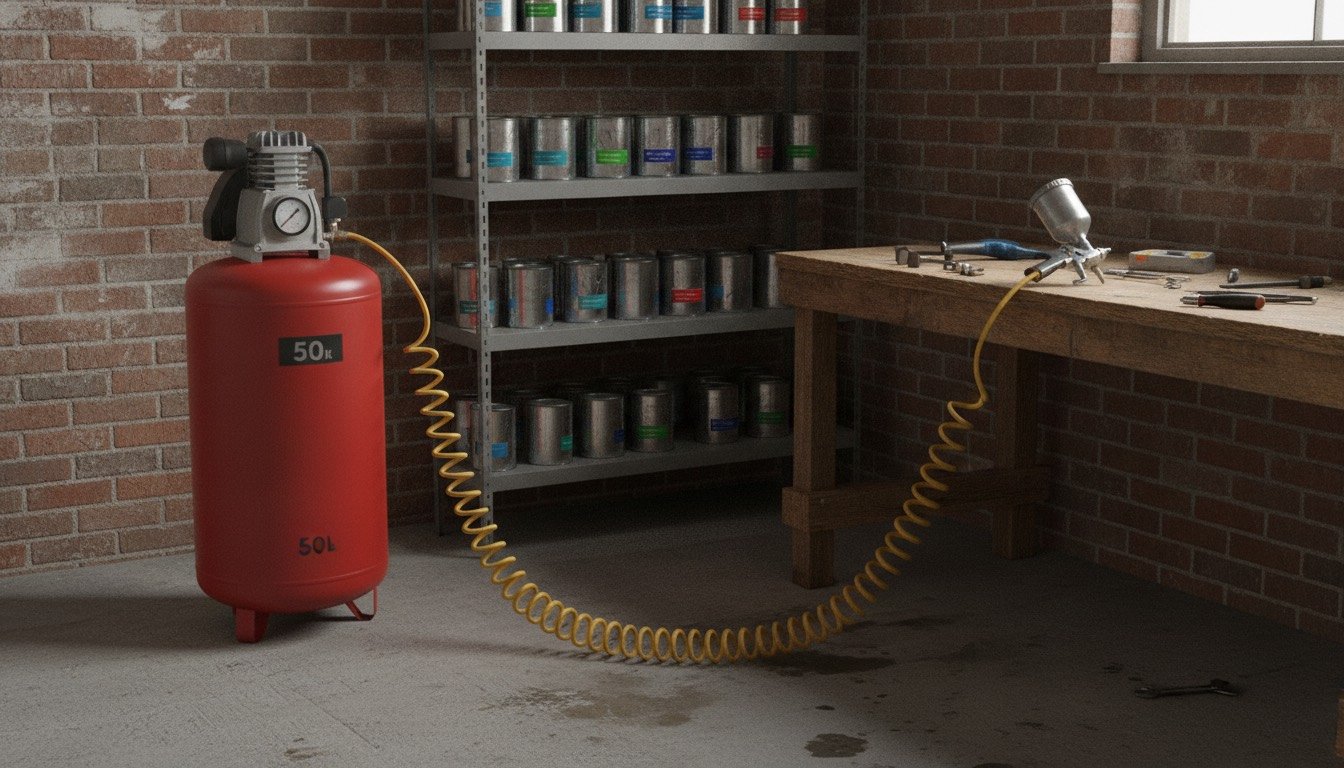
Sealey SAC5020E 50L Direct Drive Air Compressor
~£280–£330A 50-litre, 2 hp cast-iron-pump machine that delivers around 6 CFM at 6 bar, which is enough for an HVLP gun, an impact wrench and light air sanding in short bursts. Parts are stocked across UK factors, and the pressure switch and non-return valve are both replaceable in ten minutes.
Pros
- ✓ Genuine free air delivery figures published, not just displacement
- ✓ Cast-iron pump and proper oil lubrication — long service life
- ✓ Excellent UK spares availability and a two-year warranty
Cons
- ✗ 96 dB is far too loud for an integral garage
- ✗ Heavy at over 50 kg, so plan its position before delivery
Clarke Shhh Air 50/24 Low Noise Compressor
~£320–£380Around 60 dB at one metre, this oil-free low-noise unit is quiet enough to hold a conversation next to and to use in a garage that shares a wall with a bedroom. You give up flow for the peace: roughly 4 CFM free air, which suits nailing, tyres, blowing out and small detail spraying.
Pros
- ✓ Genuinely quiet — the only pick usable in a house-attached garage
- ✓ Oil-free, so no levelling or oil changes
- ✓ Compact 24-litre footprint on castors
Cons
- ✗ Not enough air for sanders, grinders or full panel spraying
- ✗ Oil-free pumps have a shorter working life than cast-iron equivalents
SGS SC24V 24 Litre Direct Drive Air Compressor
~£110–£150The sensible entry point for tyres, dusting, bike work and occasional nailing, with about 3 CFM free air and a workable 50% duty cycle. It comes with a usable hose and inflation kit, which saves another £30 or so on accessories.
Pros
- ✓ Cheapest machine here that is more than a toy
- ✓ Includes hose, tyre gun and blow gun in the box
- ✓ Light enough for one person to move up a step
Cons
- ✗ Noisy at around 92 dB and no quieter than machines twice the price
- ✗ Thin tank walls mean draining after every session is essential
DeWalt DCC1054 54V FlexVolt Cordless Compressor
~£420–£500A cordless 3.8-litre compressor for people who already own the 54V platform and need air on a roof, in a garden or halfway down a driveway. Around 1.2 CFM means it is a nailer and inflation tool, not a workshop machine, but it will drive a second-fix nailer all afternoon on one battery.
Pros
- ✓ No lead, no extension reel, no socket needed
- ✓ Very quiet at roughly 79 dB and starts under load reliably
- ✓ Shares batteries with an existing 18V/54V tool kit
Cons
- ✗ Expensive per CFM and useless for spraying or sanding
- ✗ Price quoted is bare unit; a 9 Ah FlexVolt battery adds substantially
Who this is for — and who shouldn't buy a compressor at all
Be realistic about the jobs on your list first. Two-thirds of the people who ask us about compressors would be better served by a £60 cordless inflator. A compressor earns its floor space if you regularly do any of the following:
- •Spraying — even a small HVLP gun wants 4 to 6 CFM continuously, so a 50-litre machine minimum.
- •Air sanding or grinding — the thirstiest tools in the garage at 6 to 12 CFM. Most home compressors cannot feed them.
- •Second-fix nailing on a real project, where cordless battery cost stacks up over a week.
- •Project car work: blowing out brake dust, seating tyre beads, running an air ratchet, drying panels.
- •If it is only tyres, bikes and footballs, buy a cordless inflator and spend the difference on garage storage.
How we judged these — and what we did not test
Disclosure, because it matters: these picks come from workshop experience with the machines and from cross-checking manufacturer figures against UK retailer data, not from a laboratory test with calibrated flow meters. Where a manufacturer quotes displacement rather than free air delivery, we say so.
The ranking weights four things: free air delivery at 6 bar, the pressure tools actually run at; duty cycle honesty, meaning how long the motor runs in an hour before the thermal cut-out trips; measured noise at one metre; and UK parts availability, since a compressor with no pressure switch on the shelf is scrap in five years.
The picks compared, and where each one stops
The short version: the Sealey does the most work for the money, the Clarke is the only one you can run at 8pm in a house-attached garage without an argument, the SGS is a serviceable budget buy, and the DeWalt is a second-fix tool, not a workshop compressor.
- •Best overall: 50 L, ~6 CFM free air, 96 dB, £280–£330.
- •Best for integral garages: 24 L low-noise, ~4 CFM free air, 60 dB, £320–£380.
- •Best budget: 24 L direct drive, ~3 CFM free air, 92 dB, £110–£150.
- •Best portable: 3.8 L cordless, ~1.2 CFM, no lead, £420–£500 with battery.
- •Rule of thumb: buy for 150% of your thirstiest tool's stated CFM, or you wait on the pump all afternoon.
The specs that actually decide it: FAD, duty cycle and dB
Ignore horsepower. A UK 13A socket gives about 3 kW maximum, so any compressor claiming 3 hp on a plug-in lead is quoting peak, not continuous, output. The honest figure is free air delivery (FAD) — what leaves the coupler at working pressure. Displacement, the number printed largest, is typically 30 to 40% higher.
Duty cycle is the spec nobody reads. Most sub-£400 direct-drive compressors are rated at 50%: thirty minutes of pumping per hour. Belt-drive machines run cooler and often manage 70%, and if you are spraying a bonnet that difference is the whole job. Oil-lubricated pumps last longer but must be kept level and topped up; oil-free pumps are cleaner but wear out far sooner.
Noise is the one people regret. A direct-drive compressor runs at 92 to 97 dB at one metre — roughly a petrol mower at arm's length — and a bare brick garage worsens the reverberation, which is one more argument for insulating the garage first. Ear defenders belong on the same shelf as your power tool safety kit.
The UK rules that apply once it stops being a hobby
Any compressor up to about 2.2 kW runs on a standard 13A socket, and that is where most people should keep it. A dedicated 16A or 32A supply, or a new consumer unit in a detached garage, is a new circuit — notifiable work under Approved Document P in England and Wales. It must be done by an electrician registered with a competent person scheme such as NICEIC or NAPIT, or notified to building control beforehand. Adding a socket to an existing garage circuit stopped being notifiable in England in 2013 but is still notifiable in Wales; Scotland works to its own Building Standards. Our electrician cost guide and the notes on when electrical work needs signing off cover both.
There is a pressure-vessel rule too. The Pressure Systems Safety Regulations 2000 bite at 250 bar-litres — pressure multiplied by receiver volume — and a 50-litre tank at 10 bar is 500. For domestic use PSSR does not apply, but the moment you service other people's cars there it is a workplace, needing a written scheme of examination and periodic inspection of the receiver. Landlords letting a garage with a fixed compressor inherit the same duty.
Finally, noise. There is no fixed decibel limit for domestic equipment, but persistent evening or weekend use can be judged a statutory nuisance under section 79 of the Environmental Protection Act 1990, and councils do serve abatement notices. Keep noisy work to 8am–6pm on weekdays and site the machine away from the party wall.
Common buying mistakes
- •Buying on tank size. A 100-litre tank fed by a weak pump means a longer wait, not more air.
- •Believing displacement figures. Ask for CFM at 6 bar; if the seller cannot supply it, assume the worst.
- •Undersizing the hose. A 6 mm hose strangles a 6 CFM tool. Use 10 mm bore beyond a nailer, runs under 15 m.
- •Forgetting the water. British garages are damp; without a filter-regulator you will spit water through a spray gun.
- •Skipping the drain. Condensate rusts the receiver from inside. Crack the drain valve after every session.
- •Assuming air beats battery. For occasional nailing it usually doesn't; the cordless versus corded comparison sets out where each wins.
Running costs and keeping it alive
A 2.2 kW compressor pumping for a third of an hour costs about 20p at 27p per kWh — trivial. The real cost is neglect. Change the oil in a lubricated pump at 50 hours and then annually, clean the intake filter every six months, drain the tank after each use, and check the safety relief valve pulls free once a year. Do that and a mid-range machine lasts fifteen years.
One last honest point: if your only need is tyres and dusting, buy an inflator and walk away. If you spray or sand, buy once at the 50-litre end and accept the noise. The machines in the middle end up on Marketplace within eighteen months.
Found this useful?
There's plenty more — hundreds of guides and honestly-tested product reviews for every corner of your home.
Browse All Guides