Product Reviews · 6 min read · 10 April 2026
The Best Air Purifier for Smoke UK (2026): Wood Burners, Cooking Fumes and Bonfire Season
Wood smoke is the hardest job you can give a domestic air cleaner, and most machines sold for it cannot do it. Here is what works in UK homes, what it costs, and when a purifier is the wrong answer entirely.
By the Nims Casa editorial team — written from professional cleaning experience and checked against our editorial standards.
Affiliate disclosure: if you buy through links in this article we may earn a small commission at no extra cost to you. Our recommendations come from professional cleaning experience and are never influenced by retailers or brands.
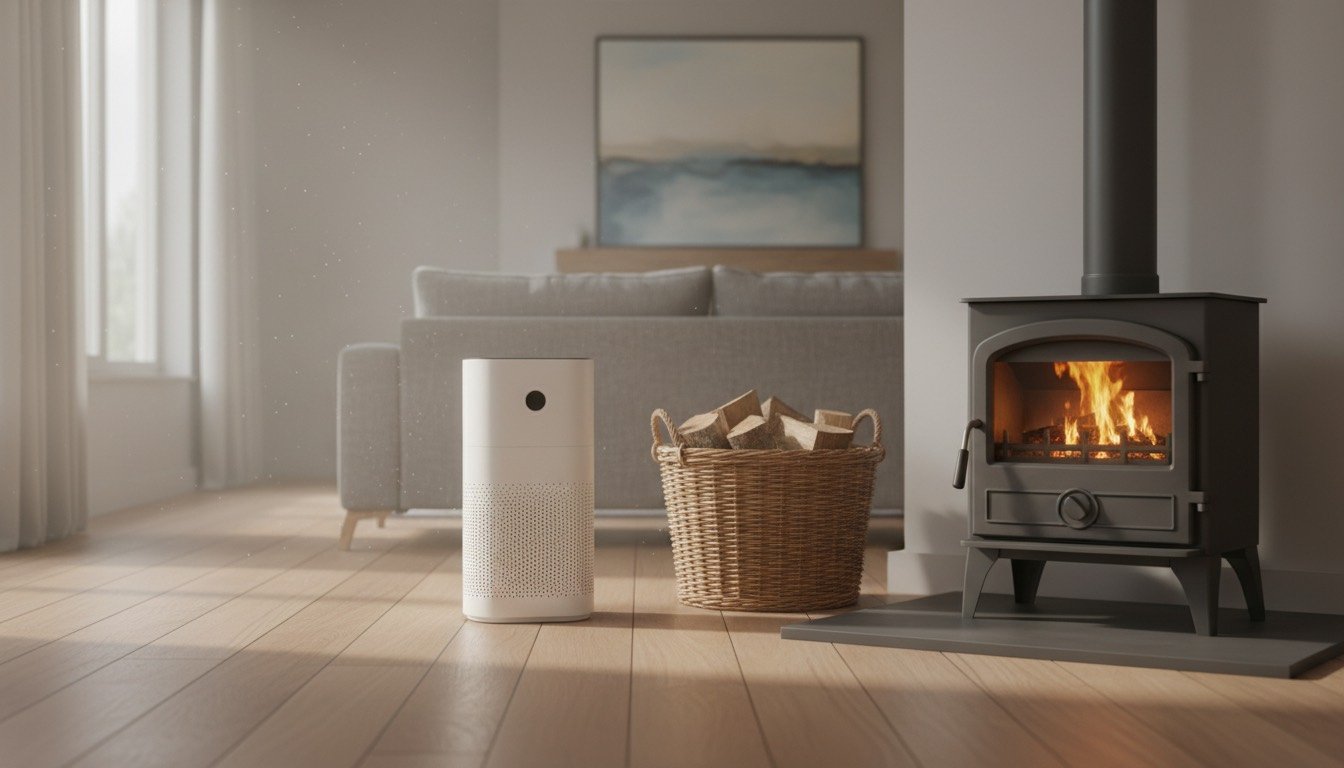
Wood smoke is the hardest test you can set a domestic air cleaner. The particles are tiny, most of what leaves a stove or a bonfire sitting under one micron, and the part that leaves a room smelling of ash three days later is not a particle at all: it is gases and volatile organics, and they walk straight through a HEPA filter unless there is real weight of activated carbon behind it.
We have cleaned up after enough of it to have firm opinions: smokers’ flats at end of tenancy, kitchens after a chip pan, terraces where the stove backpuffs whenever the wind swings south-west. Here is what shifts smoke in a British house, and where a DIYer should stop and ring a registered trade.
Our top picks at a glance
Levoit Core 400S
~£180–220A quoted 400 m³/h CADR on a machine this size is unusually good value, and Levoit sells a dedicated smoke and toxin replacement cartridge with far more carbon than the standard one. This is what we suggest when someone describes an ordinary UK living room and an occasional smoke problem.
Pros
- ✓ Enough smoke-grade airflow for a 45 to 55m³ room at five air changes an hour
- ✓ Optional Smoke Remover filter adds meaningful carbon capacity for odour
- ✓ PM2.5 readout and an auto mode that genuinely reacts to frying
Cons
- ✗ Combined HEPA and carbon cartridge means binning good HEPA when the carbon saturates
- ✗ Around 52dB flat out: fine in a lounge, borderline in a bedroom
Austin Air HealthMate Plus
~£700–900Roughly 6.5kg of activated carbon and zeolite packed into a steel drum, which is a different category of odour control to anything using a fabric filter. Bought once, it deals with wood smoke and cigarette smoke for about five years.
Pros
- ✓ Kilograms of loose carbon rather than a coated mesh, the only reliable answer for smoke odour
- ✓ Five-year filter life keeps the annual running cost sensible
- ✓ Steel casing, no plastic off-gassing, and repairable rather than disposable
Cons
- ✗ Heavy, industrial-looking and a serious outlay up front
- ✗ No sensors or app, and noticeably loud on the top setting
Philips Series 3000i (AC3033)
~£300–380Rated around 520 m³/h, which is where you need to be for a knocked-through ground floor or a room with 2.9m Victorian ceilings. The three-layer filter includes a proper carbon layer rather than a token dusting.
Pros
- ✓ Airflow to cover 90 to 100m³ at five air changes an hour
- ✓ Clear numeric PM2.5 display instead of a vague colour ring
- ✓ Sleep mode drops to roughly 33dB
Cons
- ✗ Replacement filters run to about £70 to £80 a year with real smoke exposure
- ✗ Physically large and impossible to hide in a corner
Levoit Core 300S
~£90–120About 240 m³/h from a unit the size of a kitchen bin, which is enough for a typical UK double bedroom at five air changes an hour. It is the sensible way to protect the room you sleep in through a handful of bonfire nights a year.
Pros
- ✓ Genuinely affordable, with replacement filters at around £25
- ✓ Small footprint and quiet enough to sleep beside on the low setting
- ✓ Takes the same smoke-specific filter option as its bigger sibling
Cons
- ✗ Not enough airflow for a living room, whatever the packaging claims
- ✗ Modest carbon volume: good for short episodes, not for constant smoke
Who this guide is for
Smoke problems fall into a few patterns, and the right machine depends on which you have.
If the smell is musty rather than burnt, you are in the wrong aisle: read air purifier versus dehumidifier first, because a purifier does almost nothing for damp. For pollen and pet dander, our air purifiers for allergies list is the better start.
- •Wood burner and open fire homes: heavy, intermittent, odour-dominated smoke. Carbon capacity matters more than headline airflow.
- •Flats with a smoking neighbour: constant low-level infiltration through gaps and shared voids. You want quiet continuous running, not bursts.
- •Cooking and frying: short particulate spikes. Airflow near the kitchen door beats any amount of carbon.
- •Bonfire and heath fire episodes: a few days a year, windows shut, one hard-working unit where you sleep.
- •Fire damage: not a purifier job. Soot bonds to plaster and textiles and needs specialist restoration through your insurer.
How we judge, and what we have not done
We do not run a sealed test chamber. These picks come from published smoke CADR figures cross-checked against AHAM or EN 1822 filter data, from the weight and type of carbon in each filter, and from using these units in occupied UK homes: two stove-heated terraces and a flat above a heavy smoker.
- •Smoke CADR in cubic metres per hour, never coverage quoted in square metres
- •Carbon by weight and form: grams of coated mesh versus kilograms of loose pellets
- •Noise measured at the speed you will actually need, not at setting one
- •Filter cost per year at realistic UK intervals; past £90 a year it has to earn it
- •No ozone: ionisers, plasma and UV are out unless the function switches off
Sizing it properly: the sum that decides everything
Manufacturers quote coverage at two air changes an hour. For smoke you want five. The sum takes thirty seconds and stops you buying half the machine.
Then shut the door while it runs, and close the trickle vents during an outdoor smoke episode. Most complaints about weak performance are really ventilation problems: the machine is cleaning air replaced faster than it can filter it.
- •Measure in metres and multiply length by width by height. A 4.2m x 4.8m x 2.4m living room is about 48m³.
- •Multiply by five for the smoke CADR you need: 48 x 5 = 240 m³/h.
- •Victorian rooms with 2.7m to 3.0m ceilings need 300 m³/h or more for the same floor area.
- •Use the smoke CADR, not the pollen or dust figure — always the flattering one.
The four we would actually buy
Detail sits in the picks below. In short: the Levoit Core 400S is the default for a normal living room; the Austin Air is for constant smoke where the smell is the complaint; the Philips covers open-plan and high-ceilinged rooms; the Core 300S is the budget answer for one bedroom.
One caveat applies to all four. A purifier treats a symptom. If smoke enters from an appliance rather than from outdoors, no filter is the answer.
Where DIY stops and a professional starts
This matters more than the product choice, because smoke indoors sometimes means something is wrong rather than merely dirty. That line is drawn by regulation as much as by risk.
- •DIY: siting, running and cleaning the purifier and changing its filters. No tools, ten minutes.
- •DIY: sealing leak paths — draught strips on doors, a brush seal on the letterbox, filler around skirting where smoke tracks in from next door.
- •DIY: fitting battery smoke alarms and an audible CO alarm to BS EN 50291, legally required in rented homes with a solid fuel appliance.
- •DIY: cleaning the stove glass, emptying the ash pan, checking the door rope seal still grips paper.
- •Professional only: chimney sweeping — annually for wood, twice yearly under heavy use, by a sweep registered with HETAS, NACS or the Guild of Master Chimney Sweeps. The certificate matters to your insurer.
- •Professional only: installing or relining a stove or flue. Approved Document J work, notifiable to Building Control, in practice a HETAS registered installer.
- •Professional only: anything gas. Only a Gas Safe registered engineer may touch a gas fire, boiler or flue; it is a criminal offence otherwise.
- •Professional only: an electrical burning smell. Kill the circuit at the consumer unit and call an NICEIC or NAPIT registered electrician.
- •Professional only: soot damage after a fire. Specialist restoration through your insurer, never a job for a £200 appliance.
The hard stop, and the common buying mistakes
If a stove or open fire spills smoke back into the room, switch it off, open a window, leave, and have the flue checked before lighting it again. Visible smoke means combustion gases you cannot see, and carbon monoxide has killed people sitting beside a running purifier. A purifier is not a safety device.
- •Buying on square metres. That claim assumes two air changes an hour and a 2.4m ceiling. Marketing, not sizing.
- •Trusting carbon-coated fabric. A few grams of carbon on a mesh handles cooking smells for a fortnight, no longer.
- •Choosing on quietness at setting one. You will run it flat out in an episode, so check the decibels at maximum.
- •Ignoring consumables. A £60 a year gap in filter costs makes the cheaper machine the expensive one by year three.
- •Expecting it to solve dust in general — a permanently gritty house usually has another cause, which we unpick in why your house is so dusty.
- •Running it with a window open during a bonfire — you are filtering the outdoors.
Running costs and the verdict
Expect 25W to 60W on medium. At roughly 25p per kWh a 40W unit running around the clock costs about 24p a day, or £85 a year, so run it hard during episodes and low the rest of the time. Filters add £40 to £90 a year on most mid-range units, while the Austin Air’s five-year cartridge works out cheaper despite the sticker shock.
For most households the Core 400S is the right buy: enough smoke CADR for a real living room, and consumables that will not sting. If wood heat or a smoking neighbour makes the smell the complaint, spend once on the Austin Air. Either way it is one layer, and the rest of the work is improving indoor air quality at source: sweeping the flue, sealing the leaks, ventilating when the outside air is worth having.
Found this useful?
There's plenty more — hundreds of guides and honestly-tested product reviews for every corner of your home.
Browse All Guides