Heating & Cooling · 6 min read · 9 April 2026
Air Purifier vs Dehumidifier: Which One Does Your UK Home Need?
They sit in the same aisle at similar prices and solve completely different problems. Diagnose with a £12 hygrometer first — then decide, using real UK running costs and a 10-year comparison.
By the Nims Casa editorial team — written from professional cleaning experience and checked against our editorial standards.
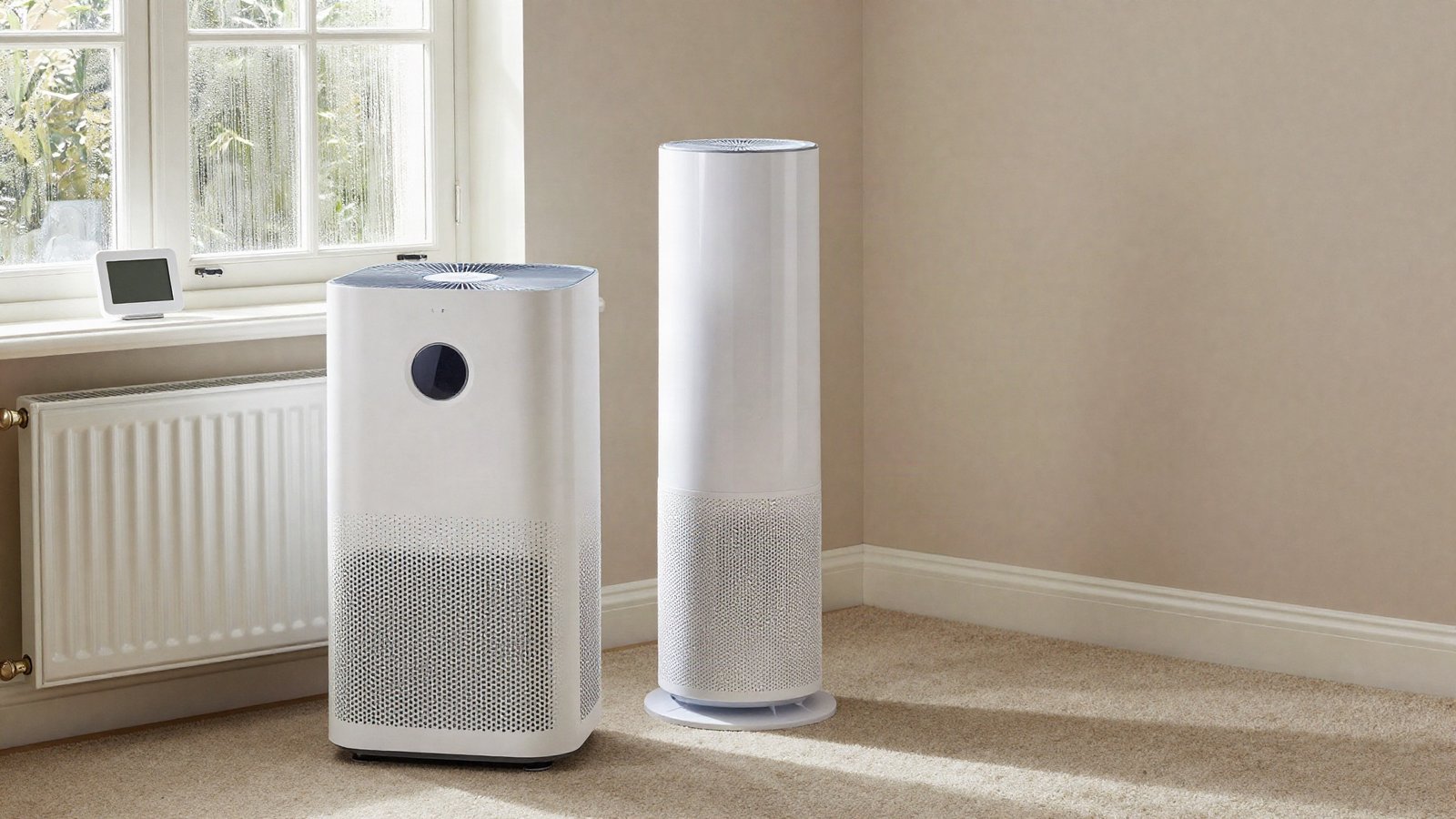
Two machines, similar price, sold in the same aisle, solving completely different problems. An air purifier takes particles out of air that is already in the room. A dehumidifier takes water vapour out. Neither does the other's job, and buying the wrong one is the commonest £200 mistake in British homes.
In UK housing stock — solid walls, cold north-facing bedrooms, washing dried over radiators — the problem is far more often moisture than particles. So work out which one you have before you spend anything.
Diagnose First: Which Problem Do You Actually Have?
Buy a hygrometer first. They cost £10–£15, and a week of readings settles the argument. Take them in the worst room at about 7am, when the house is coldest and humidity peaks.
Condensation is the only damp a dehumidifier treats, so rule the other kinds out first — our guide to damp and mould in UK homes covers telling them apart, and ideal indoor humidity explains the numbers worth aiming for.
- •Relative humidity above 65%, streaming windows, black spotting on window reveals or behind wardrobes — a moisture problem. Dehumidifier, plus ventilation.
- •RH between 40% and 60% but you sneeze, wheeze or wake congested — a particle problem. Air purifier.
- •RH above 65% and allergy symptoms — treat moisture first. Dust mites and mould spores both thrive above 60% RH, so drying the air cuts the allergen at source instead of filtering it afterwards.
- •RH below 40% in winter, with dry throats and static — you need neither. That is over-heating and under-humidifying.
- •Damp on one wall only, rising from skirting level with a tide mark — penetrating or rising damp, not condensation. No appliance fixes it; find the defect.
- •Musty cellar with no visible mould — look for a leak before assuming condensation.
Side by Side: What Each Machine Actually Does
- •Target — purifier removes particles (pollen, dust, pet dander, smoke, spores); dehumidifier removes water vapour.
- •Core technology — HEPA H13 filter and a fan, versus a refrigerant compressor or a desiccant wheel.
- •Power draw — 15–50W for a purifier on low; 250–600W for a dehumidifier while the compressor runs.
- •Effect on mould — a purifier captures spores already airborne but does nothing to stop the wall growing more; a dehumidifier removes the condition mould needs.
- •Effect on allergies — a purifier gives relief from pollen and dander within hours; a dehumidifier reduces dust mites over several weeks by drying out their habitat.
- •Side effects — a dehumidifier warms a room slightly and dries laundry noticeably faster; a purifier does neither.
- •Noise — roughly 25–50dB for a purifier, 40–55dB for a dehumidifier whose compressor cycles on and off audibly.
Performance: What to Expect in a Real UK Home
Both categories are rated in laboratory conditions your house does not reproduce. Dehumidifier extraction figures — the '20 litres a day' on the box — are measured at 30°C and 80% RH. In an 18°C British bedroom at 70% RH, expect roughly a third to a half of the badged figure. A 20L machine realistically pulls 6–9 litres a day in winter, which is still a lot of water.
Compressor dehumidifiers lose efficiency below about 15°C, so for an unheated garage, cellar or conservatory a desiccant model is the better buy despite drawing more power. Air purifiers are rated by CADR: match it to the room volume and be sceptical of anything claiming to cover a whole house from the hallway. A purifier only cleans the room it is standing in, with the door shut.
Running Costs and the 10-Year Picture
At around 28p/kWh, the gap in running cost is far wider than the gap in purchase price. And if every room streams with condensation, note that a plug-in dehumidifier shuffled between bedrooms is a running cost forever, whereas a PIV unit in the loft treats the cause across the whole house.
- •Air purifier — £90–£280 to buy. Twelve hours a day at 25W is about £30 a year in electricity, plus £35–£60 a year in replacement HEPA and carbon filters.
- •Dehumidifier — £150–£300 for a 12–20L compressor unit, £220–£400 for desiccant, and £70–£120 a year in electricity across a UK damp season.
- •Ten years, air purifier — roughly £180 unit + £300 electricity + £450 filters, so about £930.
- •Ten years, dehumidifier — roughly £230 unit + £950 electricity + one replacement around year seven, so about £1,400.
- •Positive input ventilation, for comparison — £400–£650 fitted, then about £8 a year to run.
Installation, Placement and Maintenance
- •Neither needs installing — both plug into a 13A socket. PIV is the only option here that needs an electrician and loft access.
- •Stand a dehumidifier centrally with 20–30cm clearance all round and the door shut, not jammed against a wall.
- •Put a purifier in the room you actually occupy: a bedroom overnight beats a living room by day for hay fever.
- •Empty the dehumidifier tank daily in winter, or run a continuous drain hose to a sink if the machine allows it.
- •Wash the dehumidifier's dust filter monthly. A clogged filter is the commonest cause of 'it has stopped extracting'.
- •Replace HEPA filters every 9–12 months and pre-filters every 3. A saturated carbon filter starts releasing what it absorbed.
- •Check for a defrost function if the room drops below 15°C — cheap compressor units ice up and quietly stop working.
Who Each One Suits
Buy a dehumidifier if windows stream in winter, you dry washing indoors, there is black mould in a bathroom or bedroom corner, or you are drying a room out after a leak. In UK housing that covers the majority of cases. Drying one load of washing indoors alone releases two to three litres of water into the air, which is why drying clothes indoors without causing damp is worth getting right before you buy anything.
Buy an air purifier if humidity is already sensible and the complaint is hay fever, pet dander, cooking smells, wood-burner smoke or a road-facing flat. It will not stop mould returning. Shortlists for both sit in our best dehumidifiers and best air purifiers for allergies guides.
The Verdict, and the Radon Exception
For most UK homes the dehumidifier wins, because the dominant indoor air problem in British housing is moisture rather than particles. Hold humidity at 45–55% and a fair share of the complaints filed under 'air quality' — mustiness, mite allergy, airborne mould spores — ease off on their own. Add a purifier afterwards if symptoms persist.
One exception is worth knowing. Neither machine deals with radon: it is a gas, so a HEPA filter ignores it and a dehumidifier ignores it. If you live in a radon-affected area — parts of Devon, Cornwall, Derbyshire, Northamptonshire and mid-Wales — a test kit costs around £50, and a reading above the UK action level of 200 Bq/m³ needs a sump or positive ventilation, not an appliance.
The next step costs almost nothing: leave a hygrometer in the worst room for a week before spending anything. If it sits above 65%, start with ventilation and a dehumidifier rather than a filter. More on the trade-offs sits in our heating and cooling guides.
Found this useful?
There's plenty more — hundreds of guides and honestly-tested product reviews for every corner of your home.
Browse All Guides