Product Reviews · 6 min read · 16 May 2026
The Best Circular Saw UK (2026): Four Picks and the Cuts That Need a Pro
Most people buy one circular saw and keep it for twenty years. Here are four worth owning in the UK, plus the cuts you should hand to a professional no matter how good the saw is.
By the Nims Casa editorial team — written from professional cleaning experience and checked against our editorial standards.
Affiliate disclosure: if you buy through links in this article we may earn a small commission at no extra cost to you. Our recommendations come from professional cleaning experience and are never influenced by retailers or brands.
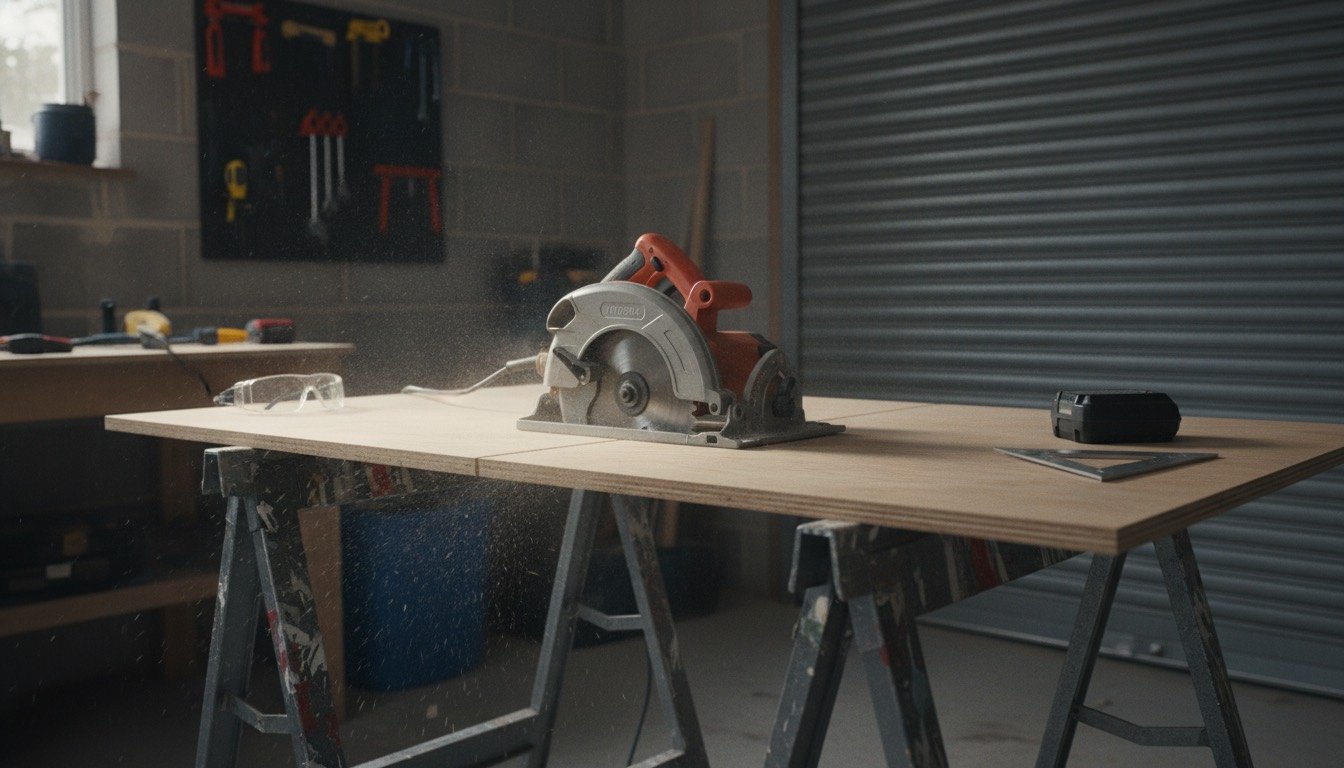
Most people buy a circular saw for a single job — boarding a loft, ripping decking to width, trimming a worktop — then keep it for the next twenty years. The gap between a £75 saw and a £220 one shows up in places the packaging never mentions: whether the shoe is still square after it has been knocked off a trestle, how cleanly the lower guard retracts on a 45-degree bevel, and how much timber you clear in one pass.
There is a second thing this guide does that most do not. A circular saw will cut straight through things it has no business touching — a trussed rafter, a notched floor joist, an asbestos cement garage roof — and it gives you no warning at all. So alongside the picks, we set out plainly which cuts a competent DIYer can make and which belong to a joiner, a structural engineer or a licensed contractor.
Our top picks at a glance
Makita DHS660Z 18V LXT Brushless 165mm Circular Saw
~£175–£210 (bare tool)At 3.2kg with a 5.0Ah pack it is genuinely one-handable on a ladder or a roof, and the electric brake stops the blade in about a second. The cast shoe holds square better than anything else near the price, and 57mm of cut at 90 degrees handles sheet goods, loft boards and 47mm joists comfortably.
Pros
- ✓ Superb balance and a clear sightline down the left of the blade
- ✓ Fast electric brake and a reliable lower guard on bevels
- ✓ LXT batteries fit around 300 other tools
Cons
- ✗ 57mm depth will not clear 63mm CLS in one pass
- ✗ Bare tool at this price — batteries and charger extra
Bosch Professional GKS 190 1400W 190mm Circular Saw
~£120–£145The cheapest sensible route to a full 70mm depth of cut, which means decking, CLS and C16 joists in a single pass without flipping the timber. It is a plain, heavy, honest tool with no battery politics and a rip fence in the box.
Pros
- ✓ 70mm at 90 degrees clears every common UK timber size
- ✓ Sustained ripping with no battery sag
- ✓ Cheap to replace and easy to get parts for
Cons
- ✗ Pressed steel shoe needs checking for square on arrival
- ✗ 4.2kg plus a lead is awkward at height or in a loft
DeWalt DCS572N 18V XR FlexVolt Advantage 165mm Circular Saw
~£200–£245 (bare tool)The one to buy if you cut all day rather than all weekend, because it draws extra current from a FlexVolt pack and refuses to bog down in wet decking or damp CLS. Depth of cut is 61mm at 90 degrees, and the guard and brake are as good as anything on site.
Pros
- ✓ Noticeably more grunt under load than standard 18V saws
- ✓ 61mm depth, better than most 165mm rivals
- ✓ Excellent dust port and easy blade-change access
Cons
- ✗ Only shows its advantage on a FlexVolt battery
- ✗ The most expensive pick here for a domestic user
Evolution R185CCS 185mm Multi-Material Circular Saw
~£70–£95A Sheffield-designed corded saw whose multi-material TCT blade cuts timber, mild steel and aluminium without a blade change, which is genuinely useful for shed and workshop work. Fit and finish are basic, but 60mm of cut for under £90 is hard to argue with for occasional jobs.
Pros
- ✓ Cuts steel and aluminium as well as timber
- ✓ 185mm blade for the money is unusually generous
- ✓ Widely stocked in the UK with cheap replacement blades
Cons
- ✗ Flexy shoe and a coarse bevel scale
- ✗ Noisier and rougher than the pricier picks, with a slow brake
Who this guide is for
This is written for UK homeowners and semi-pro DIYers cutting construction timber, sheet material and decking — not for site chippies who already know which battery platform they are locked into.
- •You cut sheet goods a few times a year: plywood, MDF, OSB, loft boards.
- •You have a shed, deck or garden project using 4x2 CLS or C16 timber.
- •You want one saw, not a workshop full of them.
- •You are not fitting kitchens weekly — that is a plunge-and-track saw job.
- •You would rather spend £30 on the right blade than £100 more on the tool.
How we judged these saws — and what we did not do
Honesty first: this is expert-research-led, not a controlled laboratory test. The picks come from years of using these tools on UK jobs and in domestic workshops, cross-checked against current manufacturer specifications, UK retail availability and the failure patterns we see repeatedly. We have not put four saws on a dynamometer for this update, and we are not going to pretend otherwise.
- •Real depth of cut at 90 and 45 degrees against actual UK timber sizes, not the marketing figure.
- •Shoe rigidity: pressed steel flexes, magnesium or cast does not.
- •Guard behaviour on bevels and part-cut plunge starts, where cheap guards snag.
- •Sightline and dust port — can you see the line without leaning over the blade?
- •UK spares and blade availability five years from now, not just today.
165mm or 190mm: the spec that quietly decides everything
Blade diameter matters more than brand. A 165mm cordless saw gives 55–61mm of cut at 90 degrees and 40–45mm at 45. Standard 4x2 CLS is 63mm thick, so a 165mm saw cannot clear it in one pass — you cut, flip and finish, which is slower and never quite in line. A 184–190mm saw gets you 63–70mm and clears CLS, decking and most C16 joist stock in one go.
On power, an 18V brushless saw with a 5.0Ah pack will manage 50–70 crosscuts in 18mm ply before a battery swap, which covers almost every domestic job. Corded still wins on sustained ripping and price per watt — the full trade-off is in our guide to cordless versus corded tools.
- •165mm cordless: light, one-handable, ideal for sheet goods. Struggles past 57mm stock.
- •184–190mm cordless: 3.5–4kg, but clears CLS and joists in a single pass.
- •190mm corded: cheapest route to full depth; use a 30mA RCD outdoors.
- •Track-guided plunge saws: the right answer for worktops and veneered panels, at a different budget.
What to look for beyond the headline specs
Two saws with identical depth figures can feel a generation apart in the hand. These are the details that separate them.
- •A brake that stops the blade in under two seconds — the best safety feature on a modern saw.
- •A machined or cast shoe. Check it against a known square on arrival and return it if it is out.
- •Positive bevel detents at 22.5 and 45 degrees, not a friction scale you eyeball.
- •A dust port that mates with a 32mm or 35mm extractor hose without gaffer tape.
- •A rip fence in the box, plus a guide rail option if you cut full sheets.
- •A decent blade: 24 teeth rips softwood fast, while 40–60 teeth with negative rake is what laminate, plywood and MDF need to avoid tear-out.
Where DIY stops: the cuts that need a professional
This is the part the manual leaves out. A circular saw is simple to use, but several common household jobs cross into structural, health or regulatory territory where the right answer is to stop. Run through our power tool safety checklist before the first cut, and our guide to using a circular saw for the technique.
- •Fine for a competent DIYer: cutting sheet material to size, ripping decking and battens, trimming skirting and architrave, shed framing, loft boards and non-structural noggins.
- •Fine with care: notching a floor joist for a cable or pipe, but only within the permitted zone — top edge only, between 0.07 and 0.25 of the span, no deeper than one-eighth of the joist depth. Outside that, you have weakened the floor.
- •Call a structural engineer: any cut into a trussed rafter, purlin, binder, steel or lintel. Trusses are engineered assemblies and cutting one web member can compromise the whole roof; no notch in a truss is ever acceptable.
- •Call a professional: altering load-bearing timber, forming an opening for a stair or loft hatch, or anything Building Control would need to sign off.
- •Stop entirely: asbestos cement roof sheets, old garage panels, soffits or asbestos insulating board in pre-2000 properties. Power-cutting these breaches the Control of Asbestos Regulations 2012 — get a survey, and licensed removal for AIB.
- •Wear the kit for the jobs you can do: FFP3 mask, ear defenders, eye protection. Hardwood dust is a Category 1 carcinogen with an HSE exposure limit of 3 mg/m³, and fibre-cement board releases respirable silica that needs on-tool extraction.
Common buying mistakes
- •Buying a 165mm saw for joist and CLS work, then finding it will not clear 63mm in one pass.
- •Taking the kit with two 2.0Ah batteries because it looked like value. A saw drains small packs in minutes — buy bare and add 4.0Ah or 5.0Ah.
- •Keeping the blade that came in the box. A £22 quality TCT blade improves a budget saw more than £100 of extra tool ever will.
- •Cutting freehand across a 2440mm sheet. Clamp a straight edge — otherwise the offcut wanders and the blade binds.
- •Buying a circular saw when the job is repeat accurate ripping; our table saw guide for beginners covers that properly.
The verdict
For most UK households the Makita DHS660 is the saw to buy: light, accurate out of the box, and part of a battery platform you can grow into. If your work is decking, joists and shed framing, take the corded Bosch GKS 190 and spend the difference on blades and a guide rail. If you are still learning the tool, read the woodworking mistakes beginners make first.
Found this useful?
There's plenty more — hundreds of guides and honestly-tested product reviews for every corner of your home.
Browse All Guides