Product Reviews · 6 min read · 13 July 2026
The Best Flooring for a Basement or Cellar (2026 UK Guide)
Most cellar floors fail because the wrong material met the wrong moisture problem. Diagnose the slab first with three cheap tests, then choose from the four floors that actually last below ground.
By the Nims Casa editorial team — written from professional cleaning experience and checked against our editorial standards.
Affiliate disclosure: if you buy through links in this article we may earn a small commission at no extra cost to you. Our recommendations come from professional cleaning experience and are never influenced by retailers or brands.
Most UK homes with a "basement" have a Victorian cellar: brick walls sitting in soil, a slab poured decades before damp-proof membranes were standard, and a room running three or four degrees colder than the rest of the house. That combination destroys flooring. Planks cup, laminate joints swell into ridges you can feel through socks, gripper rusts, and foam underlay quietly turns into a mushroom farm.
So the starting point is not "which floor" but "which water". Get the diagnosis wrong and a £55/m² floor fails inside two winters; get it right and a £30/m² floor outlasts the sofa.
Our top picks at a glance
Karndean Korlok Select rigid-core LVT
~£45-55/m²A rigid SPC core with a 0.55mm wear layer and integrated acoustic backing, clicking together with no adhesive and lifting again if the room ever floods. It is the most convincing wood-look floor that genuinely belongs below ground.
Pros
- ✓ 0.55mm wear layer handles utility and workshop use
- ✓ Lifts and relays without adhesive damage
- ✓ Tolerates roughly 3mm subfloor deviation over 2m
Cons
- ✗ Among the priciest options per square metre
- ✗ Still needs a separate DPM over a damp slab
- ✗ Limited stockists outside specialist flooring retailers
Quick-Step Alpha Vinyl Medium Planks
~£28-35/m²A widely stocked rigid vinyl plank with a pre-attached backing that copes with a slightly imperfect slab and installs quickly on a standard click system. It delivers most of the premium performance for around two-thirds of the price.
Pros
- ✓ Easy to source from UK trade and DIY retailers
- ✓ Pre-attached backing removes a separate underlay layer
- ✓ Straightforward for a competent DIY fitter
Cons
- ✗ Thinner wear layer than premium ranges
- ✗ Check warranty terms for below-ground use
- ✗ Pattern repeat is noticeable in larger rooms
Ecotile E500 interlocking PVC floor tiles
~£33-42/m²UK-made 5mm interlocking PVC tiles that loose-lay straight onto concrete with no adhesive and no membrane, letting the slab keep breathing underneath. If water gets in, you lift the affected tiles, dry the floor and click them back.
Pros
- ✓ Lays directly onto damp or uneven concrete
- ✓ Individual tiles lift for drying or replacement
- ✓ Extremely tough for storage and workshop use
Cons
- ✗ Industrial look rather than a finished living room
- ✗ Visible joint lines across the whole floor
- ✗ Cold underfoot without insulation beneath
Burmatex Tivoli heavy-contract carpet tiles
~£18-26/m²Bitumen-backed contract carpet tiles laid loose or tackified over a 1200-gauge membrane, giving a warm, quiet floor in a genuinely dry Band A cellar. Damaged tiles are swapped individually rather than replacing the whole floor.
Pros
- ✓ Warmest and quietest option of the four
- ✓ Cheap per square metre and simple to patch
- ✓ Synthetic fibre and bitumen backing resist mildew better than broadloom
Cons
- ✗ Only suitable over a proven dry slab
- ✗ Holds odour if the room ever gets wet
- ✗ Limited colour choice in stocked ranges
Start Here: Which Cellar Problem Do You Actually Have?
Three different faults produce the same complaint — "the floor's gone funny down there" — and each rules out different materials. Run these tests before you spend anything.
- •Polythene tape test: gaffer-tape a 500mm square of clear polythene to the bare slab, sealing all four edges. Lift it after 72 hours. Beads underneath, or a dark patch on the concrete, means moisture is rising through the slab.
- •Hygrometer log: a £10-£15 digital hygrometer read morning and night for two weeks. Sustained readings above 65% RH mean an air problem as well as a floor problem.
- •Wall base check: white salt bloom or crumbling mortar in the bottom three courses of brick means liquid water tracking through the masonry — usually a failed gutter, a blocked gully, or external ground levels above the slab.
- •Rain test: water at the wall-floor junction within 24-48 hours of a 25mm downpour is groundwater under pressure. That is a structural job, not a flooring one.
- •Season test: musty smell and clammy walls arriving in June and gone by November are summer condensation — warm humid air hitting a slab still sitting at 12-14°C.
- •Timber probe: on a suspended cellar floor, push a screwdriver into the joist ends where they enter the wall. More than 5mm of give means rot, and no finish hides it.
Score Yourself, Then Match the Band to the Floor
Band A is a dry slab: tape test clear, RH under 60%, no history of water. Band B is damp but dry underfoot — the tape test shows moisture, the room smells earthy, nothing pools. Band C has taken standing water in the last five years.
In Band C, flooring is the last job rather than the first. Read why your basement is damp, then sort the structure using our guide to waterproofing a basement. Laying over unresolved groundwater means paying for the floor twice.
Match the band to the material before you look at a single sample.
- •Band A: almost anything hard-wearing works — rigid-core LVT, glue-down vinyl, porcelain tile, or modular carpet tiles over a 1200-gauge membrane. Engineered wood is defensible if the room is heated all year.
- •Band B: click or loose-lay LVT with a rigid SPC core over a DPM, interlocking PVC tiles, or welded sheet vinyl. Nothing with a fibreboard core, nothing with organic underlay.
- •Band C: interlocking PVC tiles or sealed bare concrete only, until the waterproofing has survived one full British winter.
- •Any band, for warmth: 25mm XPS insulation board under the finish at roughly £9-£12/m² lifts surface temperature several degrees and cuts condensation on the floor itself.
How We Judge Basement Flooring
These picks come from fitting and inspecting cellar floors across UK housing stock — Victorian terraces, 1930s semis with old coal cellars, modern tanked conversions — plus published manufacturer data on wear layers, core stability and moisture tolerance. There is no laboratory programme behind this, and any guide claiming to have flooded a test basement for you is selling something.
Laminate is excluded outright. Its fibreboard core swells irreversibly at roughly 12-15% moisture content and never recovers, whatever the "water resistant" claim on the box. Our LVT vs laminate vs engineered wood comparison shows where laminate does earn its place — upstairs, not here.
- •Moisture tolerance: does the core survive 48 hours of standing water and dry out without permanent distortion?
- •Wear layer: 0.3mm is the domestic minimum; 0.55mm for a utility, gym or workshop cellar.
- •Subfloor forgiveness: rigid cores tolerate about 3mm deviation under a 2m straightedge; glue-down vinyl needs nearer 1mm and a latex screed at £8-£14/m².
- •Reversibility: can one person lift it in an afternoon, dry the room and put it back?
- •Warranty: several manufacturers void guarantees on below-ground installations. Check before, not after.
The Picks and What They Cost to Fit
Prices below are supply-only per square metre at typical UK retail. Fitting adds roughly £12-£25/m² depending on how much levelling the slab needs, and a liquid DPM another £10-£16/m².
Laying click vinyl yourself, the sequence in our step-by-step LVP installation guide holds below ground with two changes: the membrane goes down first, lapped 150mm, taped at every joint and turned up 50mm behind the skirting; and the planks acclimatise in the cellar for 48 hours, not in a warm hallway.
What to Look For on the Spec Sheet
Cellar floors are won and lost on details that never appear in the showroom.
- •A rigid SPC core, not WPC foam and never HDF. SPC moves around 0.02% across normal temperature swings, and that stability is the point.
- •1200-gauge (300 micron) polythene DPM, or a two-coat liquid epoxy DPM rated to 95% RH if the tape test came back wet.
- •A 10mm expansion gap at every wall and a break at every doorway — cellars swing further in temperature and humidity than any other room.
- •Skirting fixed to the wall, never through the floor, so the floor can move and lift without wrecking joinery.
- •Ten per cent waste on a straight lay, fifteen on a diagonal, plus a spare pack stored flat for repairs.
Common Buying Mistakes
- •Buying on wear layer alone. The core decides whether the floor survives; the wear layer only decides how long the pattern lasts.
- •Fitting carpet or foam underlay over an untested slab. Fine for eight months, then the smell arrives and never leaves.
- •Skipping the membrane because the slab "looks dry". Bare concrete passes several litres of vapour per 100m² a day and still feels dry to the hand.
- •Gluing down without a moisture reading. Adhesive failure over a damp slab is the costliest fault to put right.
- •Treating a dehumidifier as an optional extra rather than part of the floor's life support.
The Verdict
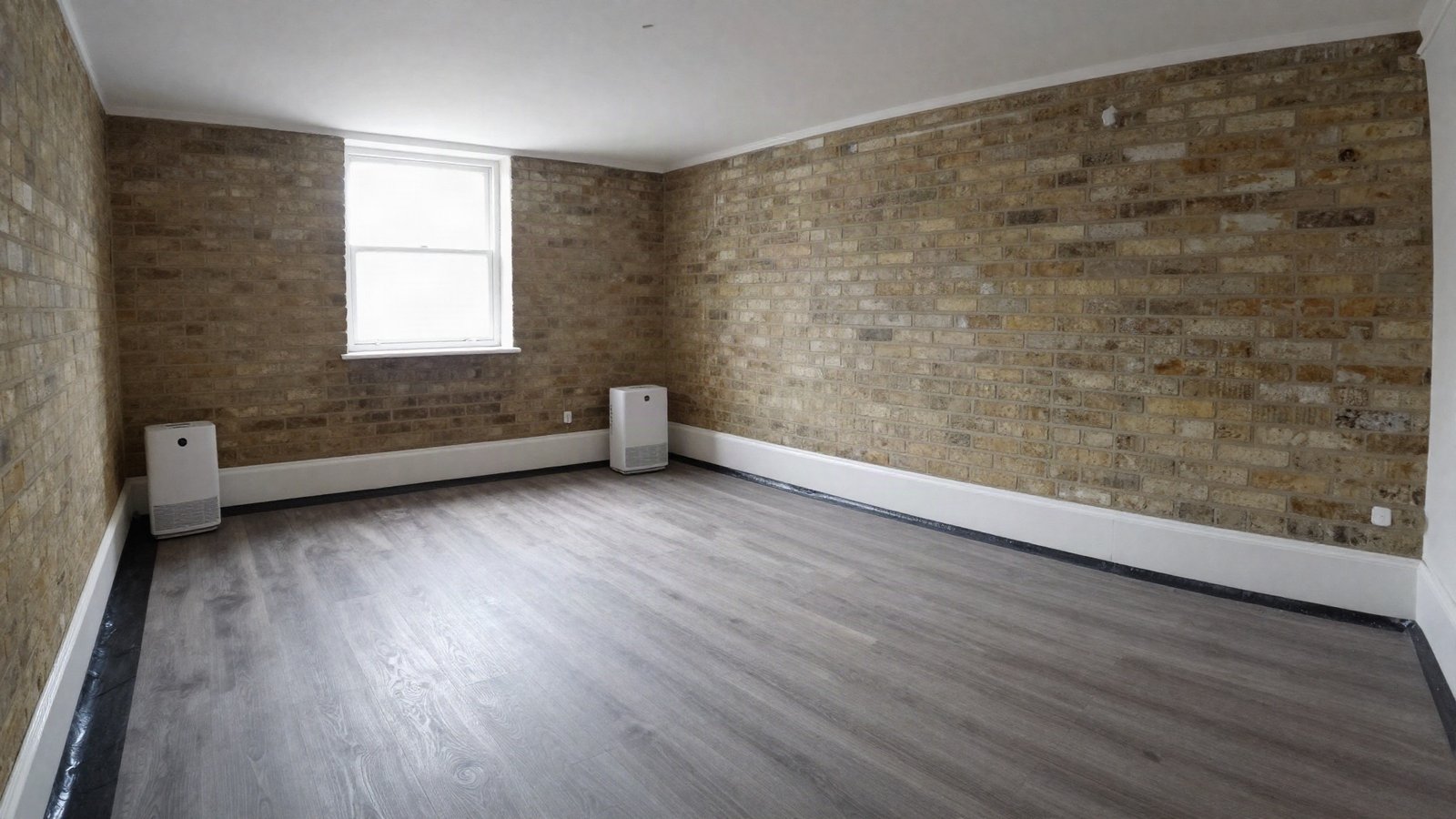
That last point does more work than the flooring choice. A cellar held at 50-55% RH keeps almost any floor happy; one drifting to 75% finds the weakness in whatever you fit. A 12-litre unit costs £150-£250 and £0.09-£0.14 an hour to run — see our dehumidifier round-up. If there is black spotting at the wall base, deal with mould in the cellar first, because sealing it under a new floor only feeds it.
Band A: buy the rigid-core LVT and enjoy a floor that matches the rest of the house. Band B: buy something you can lift, and run the dehumidifier. Band C: put this year's flooring budget into the walls and drainage, and lay the floor next year. Not the answer anyone wants, but the only one that stops you paying twice.
Found this useful?
There's plenty more — hundreds of guides and honestly-tested product reviews for every corner of your home.
Browse All Guides