Product Reviews · 6 min read · 11 June 2026
The Best Lawn Fertiliser for UK Lawns (2026): Picks, Real Costs and Fair Quotes
Four lawn feeds worth buying in the UK, what a year of feeding a typical 100 square metre lawn actually costs, and the numbers that tell you whether a lawn treatment quote is fair.
By the Nims Casa editorial team — written from professional cleaning experience and checked against our editorial standards.
Affiliate disclosure: if you buy through links in this article we may earn a small commission at no extra cost to you. Our recommendations come from professional cleaning experience and are never influenced by retailers or brands.
Most British lawns are overfed in April and forgotten by September, which is exactly the wrong way round. Spring nitrogen buys three weeks of colour and a lot of extra mowing; the autumn potassium and iron feed that hardens the sward against winter disease is the one that quietly makes next year's lawn better.
Below are four feeds we would genuinely buy in the UK, what they cost per square metre once you do the sums, and — because nobody else seems willing to put numbers on it — how a professional lawn care quote splits between materials and labour, so you can tell a fair price from a padded one.
Our top picks at a glance
Aftercut All In One Lawn Feed, Weed & Moss Killer
~£20–30 (350 m² box)The most reliable all-rounder on UK shelves for a lawn carrying both weeds and moss, and the granule spreads more evenly through a cheap domestic spreader than most rivals. Coverage claims are honest at the stated rate, which is not something we can say about every combined product.
Pros
- ✓ Even granule size — very little bridging or dribbling in a drop spreader
- ✓ Visible greening in five to seven days, moss blackened within a week
- ✓ Coverage figure holds up at the recommended application rate
Cons
- ✗ Spring and early summer only — the nitrogen level is wrong for autumn use
- ✗ You still have to rake out the dead moss, which is the job most people skip
Vitax Green Up Lawn Feed
~£25–40 (10 kg)A plain high-nitrogen feed with no herbicide, which is exactly what you want on a lawn that has no weed problem or has just been overseeded. Bought in the 10 kg tub it is one of the cheapest routes to a properly fed lawn per square metre.
Pros
- ✓ No herbicide, so it is safe over recently overseeded or newly laid turf
- ✓ Strong value per square metre in the larger tub
- ✓ Sealed tub keeps unused product usable into a second season
Cons
- ✗ Fast-acting nitrogen means noticeably more mowing for a month
- ✗ Does nothing about weeds or moss — you buy those separately
Westland SafeLawn Natural Lawn Feed
~£15–30 (up to 400 m²)A natural, bacteria-boosted feed with no exclusion period, so children and dogs can be back on the grass immediately after application. It also improves thatch breakdown over a season, which is a genuine benefit rather than marketing.
Pros
- ✓ No keep-off period at all after spreading
- ✓ Improves soil biology and thatch breakdown over repeated use
- ✓ Very difficult to scorch a lawn with it, even applied heavily
Cons
- ✗ Six to eight weeks before the colour change is obvious
- ✗ Weaker on established broadleaf weeds than a chemical weed-and-feed
Miracle-Gro EverGreen Autumn Lawn Care
~£12–25 (up to 360 m²)Low nitrogen, high potassium and iron — the correct chemistry for late September and October, and the single application that does most for how the lawn looks the following March. Cheap enough that there is no excuse for skipping it.
Pros
- ✓ Hardens the sward against frost and winter fungal disease
- ✓ Iron deepens colour without forcing soft, disease-prone growth
- ✓ Widely stocked and often discounted in late autumn
Cons
- ✗ Iron content stains paving and block paving on contact — sweep immediately
- ✗ Useless as a spring feed; the nitrogen level is deliberately low
Who this is for (and who should hold off)
Feeding works on a lawn that is basically healthy but hungry: thin colour, slow recovery after mowing, a bit of moss creeping in from the shaded end. It does nothing for a lawn whose real problem is something else, and that is where most money gets wasted.
- •Buy feed if: the grass greens up unevenly, growth stalls by midsummer, or you last fed it over a year ago.
- •Fix compaction first if: the lawn puddles after rain, or a screwdriver will not push 75 mm into the soil by hand — see when to aerate a lawn.
- •Overseed first if: you can see soil through the sward. Feed thickens what is already there; it cannot create new plants. Our overseeding guide covers the sequence.
- •Diagnose first if: patches are browning in defined shapes. Feed makes fungal disease and chafer grub damage worse — start with why grass turns brown.
How we judged these
Full disclosure on method: these are not lab-tested results. They come from repeated use on domestic lawns across the North East, Yorkshire and the Midlands over several seasons of maintenance work, plus checking each bag's stated coverage against its actual application rate — which is where a surprising number of products quietly fall apart.
The criteria: does the granule spread evenly through a domestic spreader or does it bridge and dribble; is the coverage claim honest at the recommended rate rather than the minimum; does it scorch after a warm dry week; and is the price per square metre reasonable. We weight autumn performance heavily, because a UK lawn is judged in March by what you did the previous October.
What a year of feeding actually costs
Take a typical UK back lawn of around 100 square metres — roughly the useable grass behind a three-bed semi. Granular feeds apply at 25–35 g per square metre, so one application uses about 3 kg. Across four applications a year that is 12 kg of product, which in 2026 works out at roughly £35 to £60 in materials, or about 9p to 15p per square metre per year. A one-off spreader adds £25 to £45 in year one.
A professional treatment programme for the same lawn runs £22 to £40 per visit, with most firms selling four to six visits a year — so £100 to £220 annually. The split matters: materials are typically only 20–30% of that visit price. You are mostly paying for labour, travel, public liability insurance and, for anything containing a herbicide, a qualified spray operator holding PA1 and PA6 certification. That is a legitimate cost, not a markup, and it is the reason a professional visit costs three times the bag of granules inside it.
So what makes a quote reasonable or suspect? Under about £18 a visit on a 150 square metre lawn, something is being skipped — usually the weed control. Above £60 a visit on a small lawn, you should see scarification, aeration or overseeding itemised separately rather than folded into 'treatment'. Ask any firm to name the product and its NPK ratio on the invoice; a straight answer takes two seconds and a refusal tells you everything. Our breakdown of professional lawn care costs covers per-visit pricing by lawn size.
What to look for on the bag
Ignore the photography on the front and read the analysis panel on the back — and note that online listings often spell it 'fertilizer' where UK packaging says 'fertiliser'. Same product; the NPK figures are the only part worth comparing.
- •NPK for spring and summer: high nitrogen, something like 12-4-8 or 20-4-6. Nitrogen drives leaf growth and colour, and you will mow more as a result.
- •NPK for autumn: low nitrogen, higher potassium — 4-4-8 or similar, usually with iron. Potassium hardens cell walls against frost and fusarium; iron greens the leaf without pushing soft growth.
- •Coverage in square metres at the recommended rate, not the minimum. A box claiming 400 m² often means 400 m² at 20 g/m², which is a light feed.
- •Slow-release versus soluble: coated granules release over six to ten weeks and forgive a dry spell. Soluble feeds green up in days and are gone in three weeks.
- •Combined weed and moss killers need a dry day, no rain for 24 hours, actively growing grass and no mowing three days either side. Ferrous sulphate blackens moss within a week — you must then rake it out or you have only changed its colour.
Common buying mistakes
- •Buying a 4-in-1 spring product in September. The nitrogen forces soft growth straight into damp, cool weather and hands fusarium patch an open door.
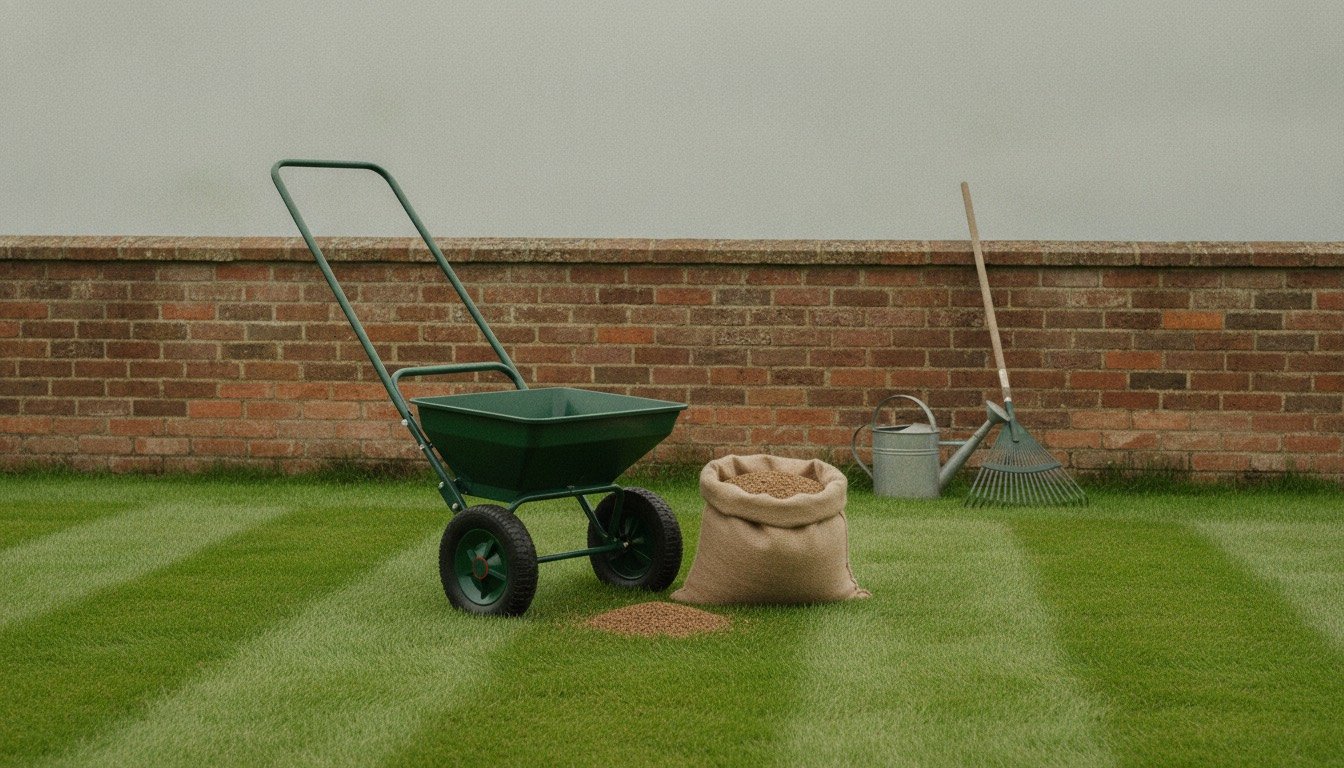
- •Spreading by hand. Hand-scattering doubles the rate in some strips and misses others, producing dark-and-pale banding you will stare at until August. A £30 spreader pays for itself in a season.
- •Overlapping spreader passes at the ends. Shut the hopper before you turn, then reopen it on the straight — headland overlap is the most common cause of scorch.
- •Buying a 20 kg sack for a 60 square metre lawn. Opened granular feed absorbs moisture and clumps within a season; a sealed tub you finish beats a sack you bin.
- •Feeding drought-stressed or frozen grass. Nothing is taken up, and on dry ground the salts sit on the leaf and burn it. Wait for rain or water it in within 48 hours.
- •Applying weed and feed over newly sown or overseeded grass. Wait until the new sward has been mown three times, or you kill what you just paid for.
Building it into a year
Four applications is the sweet spot for a domestic UK lawn: a spring feed once soil temperature holds above 8°C (usually mid-April in the south, early May in the north), a summer feed in late June, an optional light feed in August only if the lawn is irrigated, and the autumn feed in late September or early October. That last one is non-negotiable.
Water granules in within two days if no rain arrives, keep the spreader shut over paths and borders, and sweep any stray granules off block paving straight away — iron-containing feeds stain concrete and sandstone within hours. If you want the month-by-month version with rates and weather triggers, our lawn fertiliser schedule sets out the whole calendar, and the weed control guide covers what to do when feeding alone is not winning.
Found this useful?
There's plenty more — hundreds of guides and honestly-tested product reviews for every corner of your home.
Browse All Guides