Product Reviews · 6 min read · 13 April 2026
The Best Paint for Historic Homes (2026): Breathable Picks for Lime Plaster, Solid Walls and Sashes
Modern vinyl emulsion on a 130-year-old wall is not decorating, it is cling film. Here is what actually belongs on lime plaster, solid brick and original sashes, and why.
By the Nims Casa editorial team — written from professional cleaning experience and checked against our editorial standards.
Affiliate disclosure: if you buy through links in this article we may earn a small commission at no extra cost to you. Our recommendations come from professional cleaning experience and are never influenced by retailers or brands.
Paint a 130-year-old wall with ordinary vinyl matt and you have not decorated it, you have wrapped it in cling film. Solid brick walls, lime plaster on riven timber lath and single-glazed sash boxes were all built to get wet and then dry out again. The coating you put on either allows that or it doesn't, and when it doesn't, the bill arrives about two winters later as blown plaster, flaking paintwork and black mould in the corner of the front room.
We decorate period property for a living, and the honest position is that only a handful of the paints on UK shelves belong on a pre-1919 building. This guide covers the four we specify most often, what each one is genuinely for, and the numbers on a technical data sheet worth reading before you hand over £60 for a five-litre tin.
Our top picks at a glance
Earthborn Claypaint
~£50-58 per 5LA clay and china-clay based emulsion made in Cheshire with an sd value well under 0.05m, so moisture moves through it rather than behind it. It is the paint we reach for on any lime-plastered interior, and it hides the texture of a hand-floated wall better than anything else at the price.
Pros
- ✓ Genuinely vapour-open and safe over fresh lime once carbonated
- ✓ Superb dead-flat finish that flatters uneven period walls
- ✓ Very low odour and low VOC, so a room is usable the same evening
Cons
- ✗ Not wipeable; scuffs in a busy hallway need touching in rather than washing
- ✗ Around £10 a litre, roughly triple the price of trade contract matt
Keim Soldalit Mineral Paint
~£110-140 per 5LA sol-silicate masonry paint that bonds chemically into lime render, brick and stone instead of forming a film on top. Expensive per tin, but it is the specification conservation officers rarely argue with and repaint cycles stretch to 15 years or more.
Pros
- ✓ Extremely high vapour permeability with W2 water absorption
- ✓ Colourfast mineral pigments that do not chalk or fade like acrylics
- ✓ Long service life, so cost per year is competitive despite the price
Cons
- ✗ Needs a mineral substrate; will not go over existing acrylic masonry paint
- ✗ Alkaline and unforgiving on glass and joinery, so masking has to be thorough
Brouns & Co Traditional Linseed Paint
~£60-75 per 2.5LBoiled linseed oil and mineral pigment, with no acrylic film to crack at the joints. It penetrates the timber rather than sitting on it, which is why it can be cleaned down and recoated at year ten instead of stripped back to bare wood.
Pros
- ✓ Excellent coverage; a litre goes a very long way in thin coats
- ✓ Flexes with the timber, so no cracking at rail and stile joints
- ✓ Recoatable without stripping, which suits leaded substrates
Cons
- ✗ Slow to cure, needing 24 to 48 hours between coats in British weather
- ✗ Applied too thickly it stays tacky and can grow surface mildew
Farrow & Ball Limewash
~£70-80 per 5LSlaked lime and pigment, the finish most pre-1900 renders and brick elevations originally carried. It weathers by eroding gently rather than peeling, and touch-ins disappear in a season.
Pros
- ✓ Cheapest genuinely breathable exterior option per square metre
- ✓ Ages beautifully on cob, lime render and soft brick
- ✓ Easy to patch and refresh without a full strip
Cons
- ✗ Wants three to four thin coats onto a dampened wall, so it is slow work
- ✗ Caustic while wet; goggles and gloves are not optional
Who this guide is for
This is aimed at anyone looking after a house built before roughly 1919: Victorian and Edwardian terraces, Georgian townhouses, stone cottages, chapel and barn conversions. The tell-tale signs are structural, not stylistic.
- •Solid walls, one brick (215mm) or one-and-a-half brick thick, with no cavity and often a lime or roughcast render outside.
- •Lime plaster over timber lath, usually with animal hair in the base coats: soft, slightly flexible, and easily wrecked by hard modern filler.
- •Original softwood joinery with putty glazing, painted continuously since the 1880s.
- •Paint layers laid down before 1970, which should be assumed to contain lead until a test says otherwise.
How we judged these paints, and what we did not do
Honesty first: this is not a laboratory review. We have not run wet-cup permeability tests or weathering rigs, and anyone claiming they have on a decorating blog is stretching it. What sits behind these picks is roughly fifteen years of period site work plus the manufacturers' own published data, read sceptically.
- •Vapour permeability from the data sheet, specifically the sd value in metres. Under 0.1m is genuinely breathable; ordinary vinyl matt emulsions sit between 0.3m and 1.0m.
- •Behaviour on real lime: will it grip fresh plaster at pH 12 without burning off, and will it move when the wall moves?
- •What we have seen after five to fifteen winters on exposed west-facing elevations in Wales, the Pennines and the South West.
- •UK availability in sensible tin sizes, with a downloadable data sheet rather than a marketing leaflet.
- •What conservation officers accept on listed buildings without an argument.
Our picks, and where each one belongs
Interiors first. On sound lime plaster, or on freshly repaired patches, which is exactly where old plaster repairs tend to come unstuck, clay paint is our default. It goes on thick, buries the gentle undulation of a hand-floated wall, and lets moisture pass straight through instead of pooling behind a plastic film.
Outside, solid walls want a mineral coating rather than masonry paint. Potassium silicate paint bonds chemically into lime render and bare stone instead of sitting on top as a skin, so it does not blister when the wall starts drying out in April. It only works over lime or mineral substrates, which is one more argument for lime mortar rather than cement when you repoint.
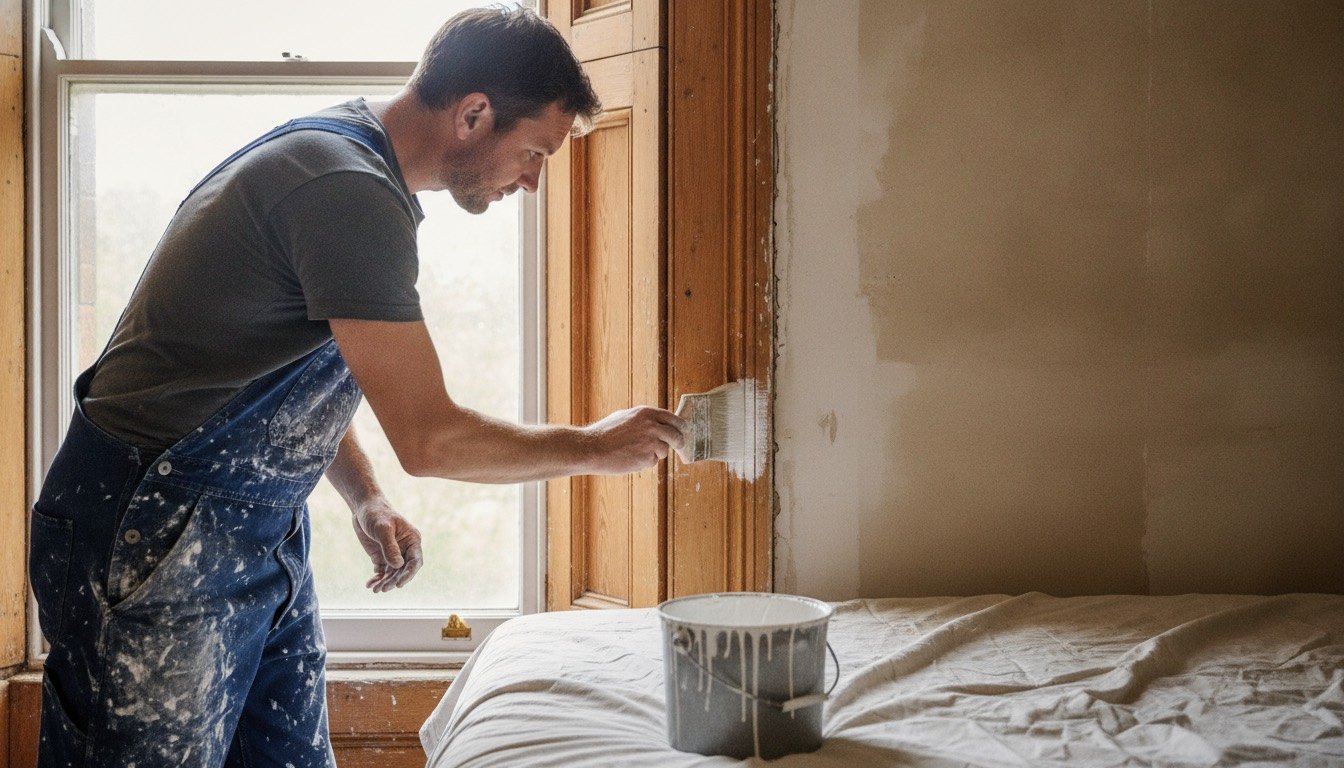
Joinery is the pick people get most wrong. Modern acrylic gloss forms a hard film that splits at the joints; water gets behind it and the bottom rail is soft within a decade. Linseed oil paint soaks into the timber, chalks slowly from the surface down, and is recoated rather than stripped, which is the entire argument for keeping original timber sash windows instead of replacing them.
And on brick, lime render or cob, limewash is still hard to beat: cheap per square metre, utterly vapour-open, and it weathers gracefully rather than failing in sheets.
What to look for on the tin
Ignore the word 'breathable' on the front of the tin. It is unregulated marketing language and it is on products that are nothing of the sort. Turn the tin over, or better, download the data sheet.
- •sd value (equivalent air layer thickness). Below 0.1m is breathable. Between 0.1m and 1.4m is not, whatever the label says.
- •Binder type. Clay, casein, lime, potassium silicate and linseed oil are all vapour-open. Acrylic, vinyl and alkyd resins are not.
- •Water absorption class W2 or W3 on exterior products: rain shed, vapour still passed.
- •No added film biocides on interior walls. If you need fungicide in the paint, the real job is fixing the damp and mould causing it.
- •Matt or dead flat sheen. Lustre on a wavy lime wall picks out every ripple in low winter sun.
- •Coverage per litre, not price per tin. Clay paint at 10 to 12m² per litre looks dear beside £32 contract matt at 14m², until the cheap tin needs three coats on lime and still fails.
Lead paint: the step you cannot skip
Assume every paint layer applied before about 1970 in a British house contains lead. White lead was restricted for domestic use in the 1960s, but old tins ran on for years and the full consumer ban only landed in 1992. Preparation, not painting, is what puts lead into your lungs and your carpet.
If the paintwork is sound, the safest and cheapest option is usually to leave it, clean down with sugar soap and overcoat. Stripping is a decision, not a default; our lead paint safety guide covers containment properly.
- •Swab test kits cost roughly £12 to £18 for a pack of eight and give a result in about 30 seconds.
- •Never dry-sand, disc-sand or blowtorch old paint. Heat above 450°C vaporises lead compounds.
- •Infrared strippers run at 200 to 250°C and soften the film without fuming: around £300 to buy, £40 to £50 a day to hire.
- •Chemical poultice strippers are slow but kind to mouldings; allow up to 24 hours of dwell on Victorian architrave.
- •Bag the waste, damp-wipe every surface, and keep children and pregnant women out until you have.
Common buying mistakes in period homes
Nearly every failure we are called out to fix traces back to one of these six, and five of them are decisions made in the merchants' yard rather than on the wall.
- •Trusting the word 'breathable'. Ask the seller for the sd value. If they cannot produce one, it isn't.
- •Emulsioning over soft distemper. Cornices and ceiling roses are often finished in it, and modern paint over the top lifts in sheets within a year. Wash it off with warm water and a sponge first.
- •Painting new lime plaster too soon. Lime carbonates at roughly 1mm per day, so a 15mm three-coat system wants about six weeks, and a thinned mist coat even then.
- •Cement-based masonry paint on solid walls because it was on offer. It is the commonest cause of blown, salt-stained render on Victorian frontages, and removing it costs more than the paint saved.
- •Budgeting like a 1990s estate. Scaffolding, lime repairs and lead-safe preparation add 30 to 50%, so check realistic exterior painting costs first.
- •Buying paint before fixing water ingress. Peeling above a chimney breast is a flashing problem, and no coating will out-argue a leaking roof.
Found this useful?
There's plenty more — hundreds of guides and honestly-tested product reviews for every corner of your home.
Browse All Guides